Experimental Soft Condensed Matter Group
Research Public lectures On Dec 16, 2020, Dave gave a talk at EML Webinar on Snap, Speckle and Spot: Sight and Sound of Hydraulic Fracture. EML Webinar on Snap, Speckle and Spot: Sight and Sound of Hydraulic Fracture By Professor Weits on December 16, 2020 Advanced Colloids Experiment-Microscopy-2 (ACE-M-2) By Dr. Peter J. Lu & ACE-M2R...
Research Microfluidics for biology We develop and use microfluidic devices to explore questions in biology. Often this involves making picoliter to nanoliter aqueous droplets in an inert, immiscible, carrier fluid. Surfactant keeps each droplet separate from every other droplet, so we can treat each as a reaction vessel containing an independent experiment. This gives us...
Research Microfluidics for material production We develop methods to create new functional materials using microfluidic devices. These devices provide capabilities for very precisely mixing fluids to form new materials. All the structures are based on drops which can both encapsulate active materials and serve as templates on which to build new structures. These have interesting...
Research Microfluidics We have two areas of focus in our microfluidics effort. The first is an effort to use microfluidic devices to create new materials. The second is an effort to use drops in microfluidic devices as reaction vessels for biology. Microfluidics for material production We develop methods to create new functional materials using microfluidic...
Research Flow in Porous Media A part of our research is dedicated to porous media related physics. On the one hand, we design experiments to study single and multiphase flow in permeable porous media. On the other hand, our experimental work focuses on fracture dynamics in ultra-low permeability porous media such as hydrogels and PMMA....
Research Biophysics We use our expertise and our experimental tools to investigate the properties of biological materials and to study the behavior of cells. Much of our focus is on developing an understanding of the mechanical properties of biopolymer networks, formed by reconstituting proteins into gelled networks. These include networks of actin, microtubules, intermediate filaments,...
Congratulations to Dr. Debojyoti Panda and Dr. Max Jiang on successfully defending their PhD dissertations! April 13, 2026 We are excited to announce that Debojyoti Panda has successfully defended his doctoral dissertation. His defense talk was titled “Understanding Bacterial Persistence using Single-Cell Transcriptomics“. His defense committee members were Profs. David Weitz and Davi…
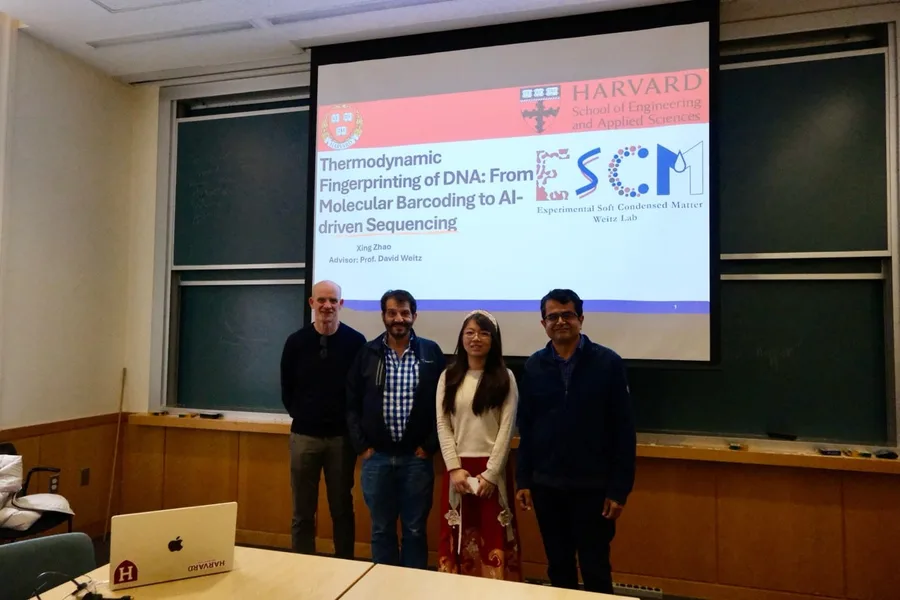
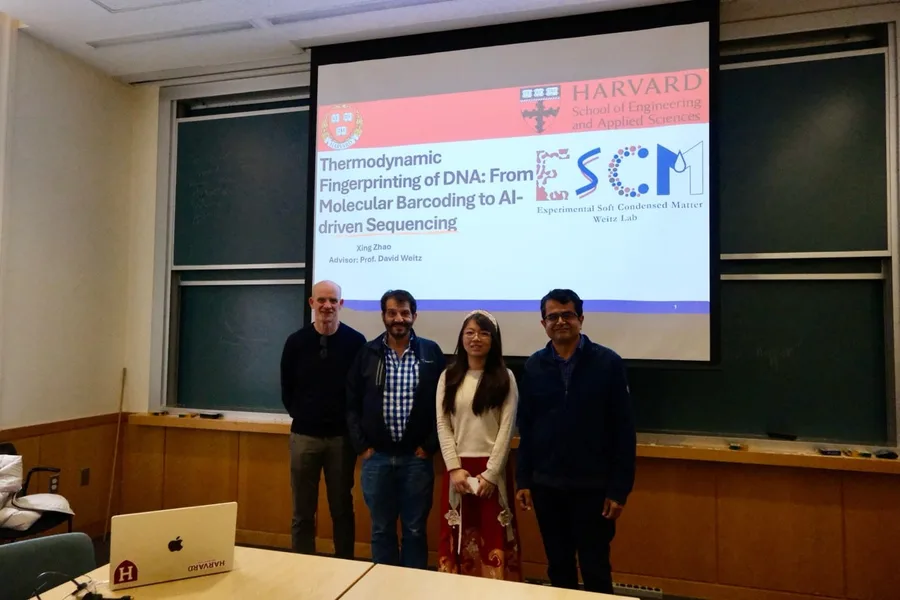
Congratulations to Dr. Xing Zhao on successfully defending her PhD dissertation! Feb 19, 2025 We are excited to announce that Xing Zhao has successfully defended her doctoral dissertation entitled “Thermodynamic Fingerprinting of DNA: From Molecular Barcoding to AI-driven Sequencing” at Harvard University’s School of Engineering and Applied Sciences. Dr. Xing Zhao successfully defended her PhD...
Research Soft Materials This research focuses on the properties of common soft materials. We study colloids, emulsions, drops, polymers and gels. Our focus is on understanding the structure of these materials and how this controls their dynamics and properties. We make extensive use of the experimental tools of a soft matter physics lab, including optical...
Summer Internship Highlight: Hunter Reidhead – Microfluidic encapsulation of Navajo tea Sept 8, 2025 This summer, the Weitz Lab welcomed again many talented young students who came to explore their research interests through hands-on research projects. We are grateful to the mentors who generously dedicated their time to guiding and supporting these students throughout their...
Resources Microrheology What is Microrheology? Complex fluids like mayonaise, complex materials like plastics, and biomaterials like cells are all somewhat squishy. To some degree, these materials can act both like fluids and like solids, depending on how you put forces on them. Conventional rheology is a way to measure the squishiness of materials: how viscous...
Resources Network Storage General Information Our lab has a shared group directory on the SEAS networked file servers. This is useful for storing shared files that you collaborate with others on, or transferring data from one computer to another, and is automatically backed up every night by SEAS IT. We only have 300 GB of free...
Resources Techniques and Tutorials Rheology Particle tracking Paper writing Others Group Theses:...
Resources Weitzlab Rheology Center AR-G2 “Bard”📅 AR-G2 “Druid”📅 Bolin📅 New Ares📅 Anton-Paar📅 Use policy: This is somewhat informal, but in general, if you are more than three hours late for your scheduled time, other people should feel free to use the Rheometer. Please let people know if you have reserved time but are not going to...
Resources Facilities We have a number of facility instruments available in our group. We encourage other groups and researchers who have an interest in using these facilities to contact us to schedule experiments. In the past we have had many groups from within and outside the university, including industrial scientists, use these instruments. We enjoy...
research.ioSign up to keep scrolling
Create your feed subscriptions, save articles, keep scrolling.