AURA Astronomy
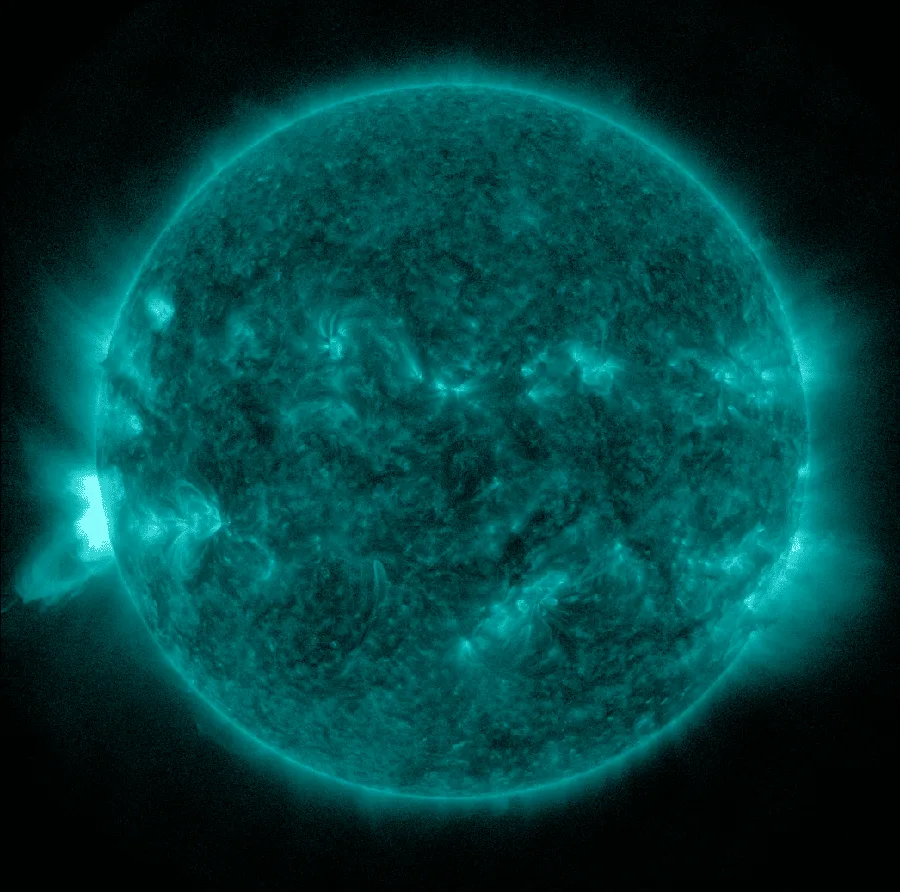
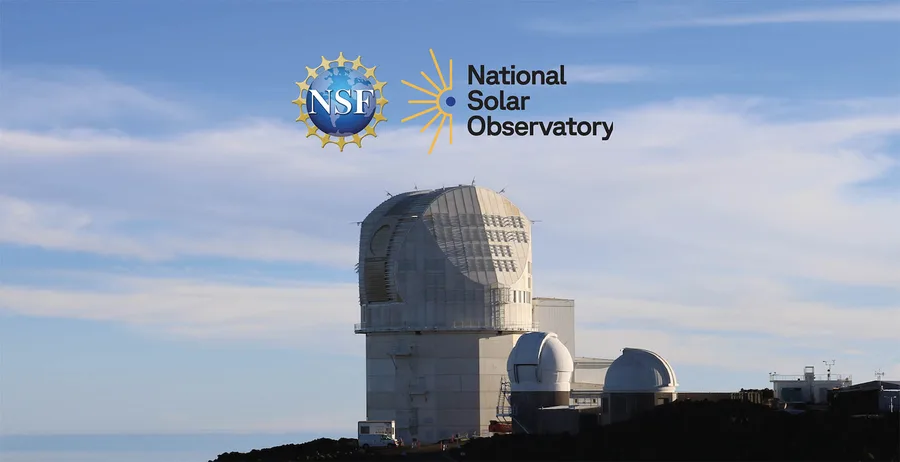
Sometimes the most remarkable scientific achievements aren’t just the ones that dazzle in a moment, but the ones that endure. When the Global Oscillation Network Group (GONG) began operations in 1995, it was designed to run for just three years. Funded by the U.S. National Science Foundation and operated by the NSF National Solar Observatory (NSF NSO), the goal was focused and finite: build a glo…
Four methods for studying dark energy come together in a single experiment for the first time The Dark Energy Survey Collaboration collected information on hundreds of millions of galaxies across the Universe using the U.S. Department of Energy-fabricated Dark Energy Camera, mounted on the U.S. National Science Foundation Víctor M. Blanco 4-meter Telescope at CTIO, a Program of NSF NOIRLab. Their…
Astronomers using the Gemini South telescope achieve unprecedented detection of vaporized metals within a dusty, gaseous cloud during rare stellar occultation Sweeping winds of vaporized metals have been found in a massive cloud that dimmed the light of a star for nearly nine months. This discovery, made with the Gemini South telescope in Chile, one half of the International Gemini Observatory, p…
Interim Deputy Director, Space Telescope Science Institute Dr. Osten has been a member of the STScI science staff since 2008 and is currently a Full Astronomer with Tenure. She has served in numerous roles in that time, most recently as Head of the Instruments Division. She is internationally recognized as an expert in the study of the dynamics of nearby stellar outer atmospheres. Dr. Osten serve…
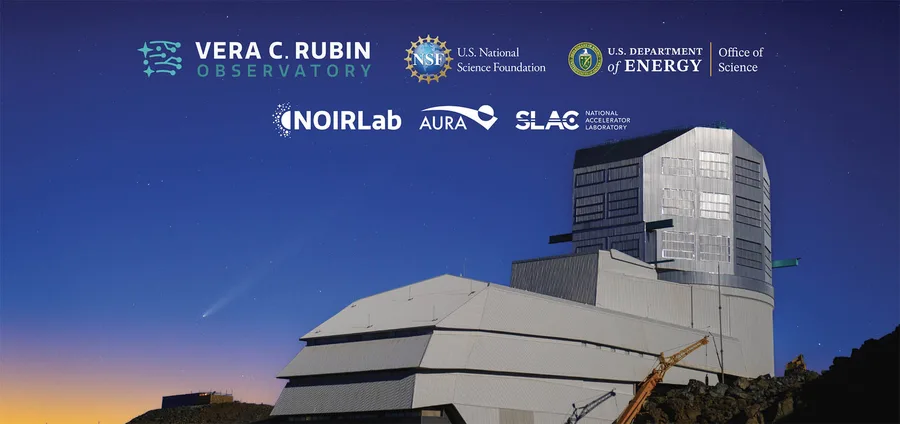
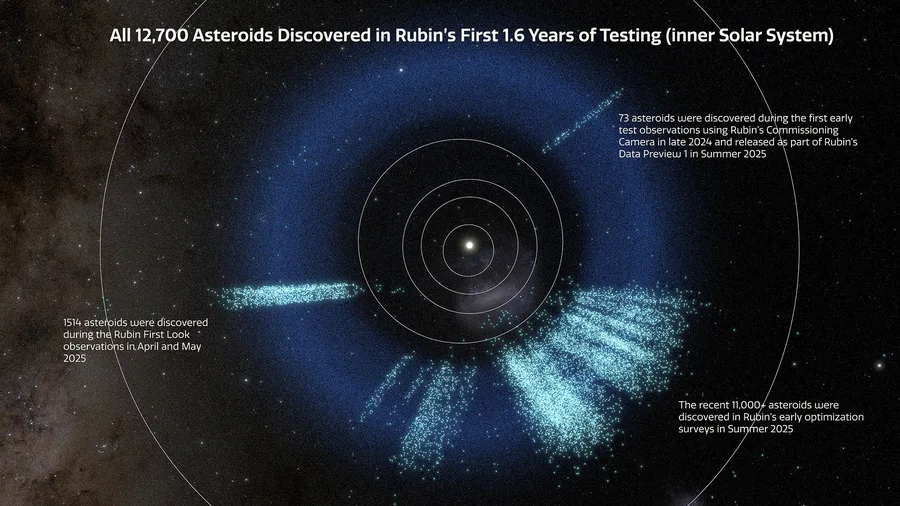
First peer-reviewed paper using LSST Camera data identifies an asteroid, nearly the size of eight football fields, rotating every two minutes. Astronomers analyzing data from NSF–DOE Vera C. Rubin Observatory, jointly funded by the U.S. National Science Foundation and the U.S. Department of Energy’s Office of Science, have discovered the fastest-ever spinning asteroid with a diameter over half a …
A team using NASA’s Hubble Space Telescope has uncovered a new type of astronomical object — a starless, gas-rich, dark-matter cloud considered a “relic” or remnant of early galaxy formation. Nicknamed “Cloud-9,” this is the first confirmed detection of such an object in the universe — a finding that furthers the understanding of galaxy formation, the early universe, and the nature of dark matter…
Like a game of cosmic bumper cars, scientists think the early days of our solar system were a time of violent turmoil, with planetesimals, asteroids, and comets smashing together and pelting the Earth, Moon, and the other inner planets with debris. Now, in a historical milestone, NASA’s Hubble Space Telescope has directly imaged similar catastrophic collisions in a nearby planetary system around …
In 2024, astronomers discovered the brightest Luminous Fast Blue Optical Transient (LFBOT) ever observed. LFBOTs are extremely bright flashes of blue light that shine for brief periods before fading away. New analysis of this record-breaking burst, which includes observations from the International Gemini Observatory, funded in part by the U.S. National Science Foundation, challenges all prior un…
Scientists using NASA’s James Webb Space Telescope have observed a rare type of exoplanet, or planet outside our solar system, whose atmospheric composition challenges our understanding of how it formed. Officially named PSR J2322-2650b, this Jupiter-mass object appears to have an exotic helium-and-carbon-dominated atmosphere unlike any ever seen before. Soot clouds likely float through the air, …
Our universe is filled with galaxies, in all directions as far as our instruments can see. Some researchers estimate that there are as many as two trillion galaxies in the observable universe. At first glance, these galaxies might appear to be randomly scattered across space, but they’re not. The post NASA’s Roman Telescope Will Observe Thousands of Newfound Cosmic Voids appeared first on AURA As…
Gemini North captured new images of Comet 3I/ATLAS after it reemerged from behind the Sun on its path out of the Solar System. The data were collected during a Shadow the Scientists session — a unique outreach initiative that invites students around the world to join researchers as they observe the Universe on the world’s most advanced telescopes. The post Gemini North Color Images Reveal Greenis…
In October 2022, the U.S. National Science Foundation (NSF) Daniel K. Inouye Solar Telescope and the European Space Agency (ESA) Solar Orbiter carried out their first coordinated campaign, capturing a decaying solar active region from two perspectives. Together, their instruments produced open-access, high-resolution datasets that reveal intricate details of coronal structures, small-scale flares…
To celebrate 25 years since the completion of the International Gemini Observatory, students in Chile voted for the Gemini South telescope to image NGC 6302 — a billowing planetary nebula that resembles a cosmic butterfly. The International Gemini Observatory is partly funded by the U.S. National Science Foundation (NSF) and operated by NSF NOIRLab. The post Gemini South Celebrates 25th Anniversa…
A team of researchers has confirmed stars ring loud and clear in a “key” that will harmonize well with the science goals and capabilities of NASA’s upcoming Nancy Grace Roman Space Telescope. The post NASA’s Roman Could Bring New Waves of Information on Galaxy’s Stars appeared first on AURA Astronomy .
NASA’s James Webb Space Telescope has delivered a first of its kind: a crisp mid-infrared image of a system of four serpentine spirals of dust, one expanding beyond the next in precisely the same pattern. (The fourth is almost transparent, at the edges of Webb’s image.) The post Webb First to Show 4 Dust Shells ‘Spiraling’ Apep, Limits Long Orbit appeared first on AURA Astronomy .
To celebrate 25 years since the completion of the International Gemini Observatory, students in Hawai‘i voted for the Gemini North telescope to image NGC 6820 — a striking emission nebula and open star cluster. The image was named Ua ʻŌhiʻa Lani, which means the Heavenly ʻŌhiʻa Rains. The International Gemini Observatory is partly funded by the U.S. National Science Foundation (NSF) and operated …
For more than half a century, scientists have been puzzled by one of the Sun’s unsolved mysteries: why is its outer atmosphere, the corona, millions of degrees hotter than the solar surface below? This superheated crown not only glows brilliantly during total solar eclipses but also spews out the solar wind—a fluctuating stream of charged particles that bathes Earth and the rest of the solar syst…
The SOAR Telescope, located on Cerro Pachón in Chile, has received a major upgrade with the installation of the SOAR Telescope Echelle Spectrograph (STELES). The long-awaited instrument achieved first light in August with observations of the binary star system Eta Carinae, along with 13 other targets. SOAR is part of U.S. National Science Foundation Cerro Tololo Inter-American Observatory (CTIO),…
NASA’s James Webb Space Telescope has revealed a colorful array of massive stars and glowing cosmic dust in the Sagittarius B2 molecular cloud, the most massive and active star-forming region in our Milky Way galaxy. The post NASA’s Webb Explores Largest Star-Forming Cloud in Milky Way appeared first on AURA Astronomy .
research.ioSign up to keep scrolling
Create your feed subscriptions, save articles, keep scrolling.