TeachThought

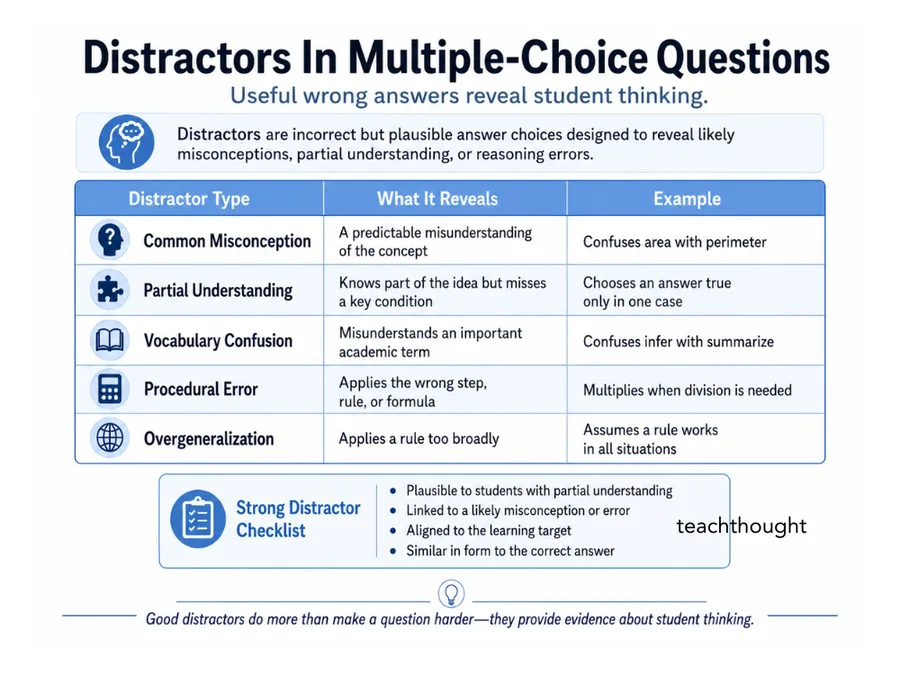
Distractors are the incorrect but plausible answer choices in a multiple-choice question. Strong distractors are written around likely student misconceptions or errors, allowing the teacher to see not only whether a student chose the correct answer, but what kind of misunderstanding may have led them to choose an incorrect one.

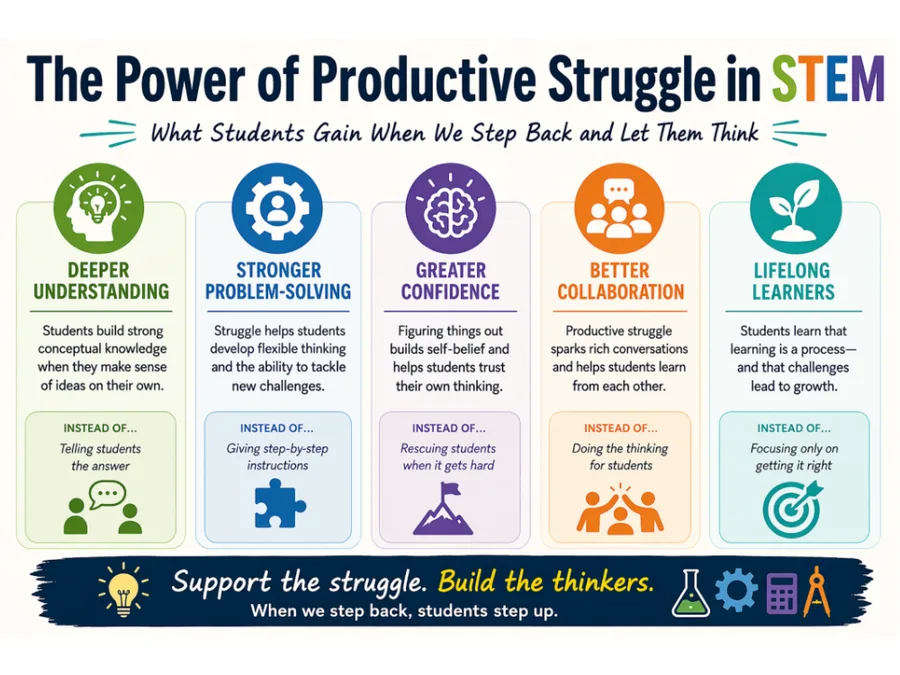
The lesson looked great on the surface. Students were on task. Materials were moving. Directions were being followed step by step. But something felt off. No one was stuck.No one was asking questions.No one was thinking. That’s the moment you realize: the problem isn’t engagement. The task is too easy. That’s the moment you realize:...

educationlearning-sciencestem-education

When Accommodations Exist but Access Doesn’t: A Middle School Reality Check contributed by Pramod Polimari, middle school special education strategist In middle school classrooms across the country, accommodations are in place. IEPs are written. Support plans are documented. Students are technically “included.” And yet, many students still struggle to access learning in meaningful ways. This disc…

educationlearning-sciencespecial-education
TeachThought Staff
4/1/2026

Bloom’s Revised Taxonomy changed the original 1956 framework by updating the level names to verbs, reordering the top levels, and adding a second dimension for types of knowledge. The revision clarifies what students do cognitively and how those actions interact with factual, conceptual, procedural, and metacognitive knowledge. Original vs Revised Level Names What Changed Beyond the Words The rev…

educationlearning-science

How To Incorporate Social Emotional Learning Into Your Classroom contributed by Meg Price, the ei experience Social-emotional learning (SEL) by definition is a process for learning life skills, including how to deal with oneself, others, and relationships, and work in an effective manner. Although there are many great SEL programs, SEL can also be incorporated into each lesson as a way of teachin…

educationpedagogy

What Is Are The Underlying Assumptions of a Curriculum? by Terry Heick There are ideas and then there are ideas between ideas. The spaces between ideas can be pregnant with ideas of their own in the same way that there are stars and then there are spaces between the stars. And these spaces matter because they’re dark and dark (and its absence) characterizes light. Okay, how about this: Every real…

Classroom Management Strategies Classroom management strategies are the deliberate actions teachers use to organize learning conditions so students can participate productively. Effective management depends on how teachers build relationships, establish routines, design tasks, and respond to behavior in real time.

educationpedagogy

You can find a classroom-ready copy of our Anticipation Guide prompts here. The Great Gatsby Major Characters Looking for more classroom discussion resources? If you are planning anticipation guides and critical thinking activities for other units, consider adding these resources to your lesson plans: Great Gatsby Anticipation Guide Agree/Disagree Statements (plain text) 1. Desire can obscure jud…

educationpedagogy

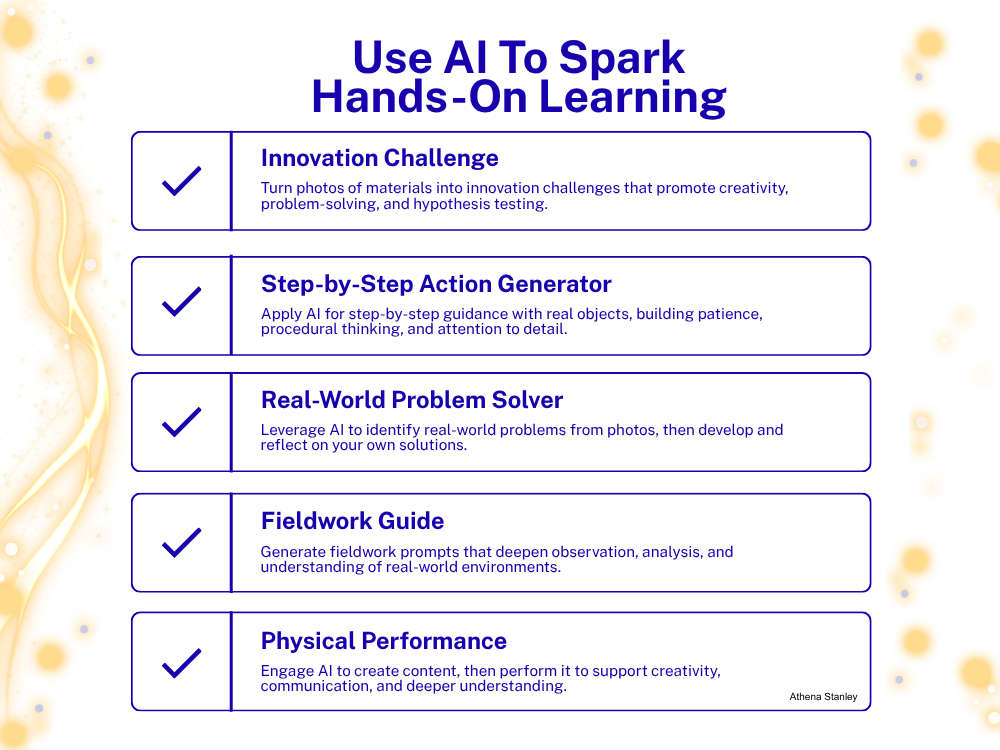
Where AI Fits in Curriculum and Assessment contributed by Dr. Athena Stanley Artificial intelligence is increasingly present in education conversations. Some teachers are experimenting with it. Others are cautious. Many are simply unsure where it belongs or whether it belongs at all. A recent Gallup poll found that three in ten teachers use AI weekly, with findings indicating improvements in the …

aiedtecheducationmachine-learning
TeachThought Staff
3/25/2026

Definition Cognitive dissonance is a theory in psychology describing the tension that arises when a person holds inconsistent beliefs, or when behavior conflicts with stated values. That discomfort often motivates the person to reduce the inconsistency by changing behavior, revising beliefs, or adding a justification. Key Characteristics of Cognitive Dissonance - It involves felt psychological di…

cognitive-psychologypsychology

1. Brighterly An online math and reading-focused learning platform that provides 1:1 learning, personalized lessons, and parent reporting. Before creating a study plan, this K-12 resource runs a diagnostic check to identify gaps, then appoints a specialized tutor to move the student toward advanced topics while following US educational requirements. 2. Zearn Math A top-rated digital curriculum bu…

edtecheducation

contributed by Mike Brown, education researcher at preppool. Every educator has seen it. A thoughtful, engaged student studies diligently, participates in class discussions, completes assignments on time—and then underperforms on the first major assessment. The disappointment is visible. Sometimes the teacher feels it just as strongly as the student. The instinctive explanations are familiar: anx…

educationlearning-science

Some students walk into class ready to talk. Others enter quietly, holding their backpack close, scanning the room before taking a seat. For many multilingual learners and cautious children, spoken language comes last. Before words, they communicate through posture, gaze, proximity, hands, and small actions. These signals often go unnoticed, and silence gets interpreted as “shy,” “behind,” or “no…

cognitive-psychologyeducationlearning-sciencepsychology
research.ioresearch.io

Sign up to keep scrolling

Create your feed subscriptions, save articles, keep scrolling.

Already have an account?