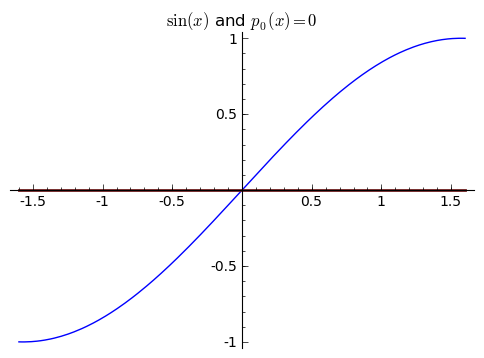
This is a note written for my fall 2013 Math 100 class, but it was not written “for the exam,” nor does anything on here subtly hint at anything on any exam. But I hope that this will be helpful for anyone who wants to get a basic understanding of Taylor series. What I want […]
You have a midterm next week, and it’s not going to be a cakewalk. As requested, I’m uploading the last five weeks’ worth of worksheets, with (my) solutions. A comment on the solutions: not everything is presented in full detail, but most things are presented with most detail (except for the occasional one that is […]
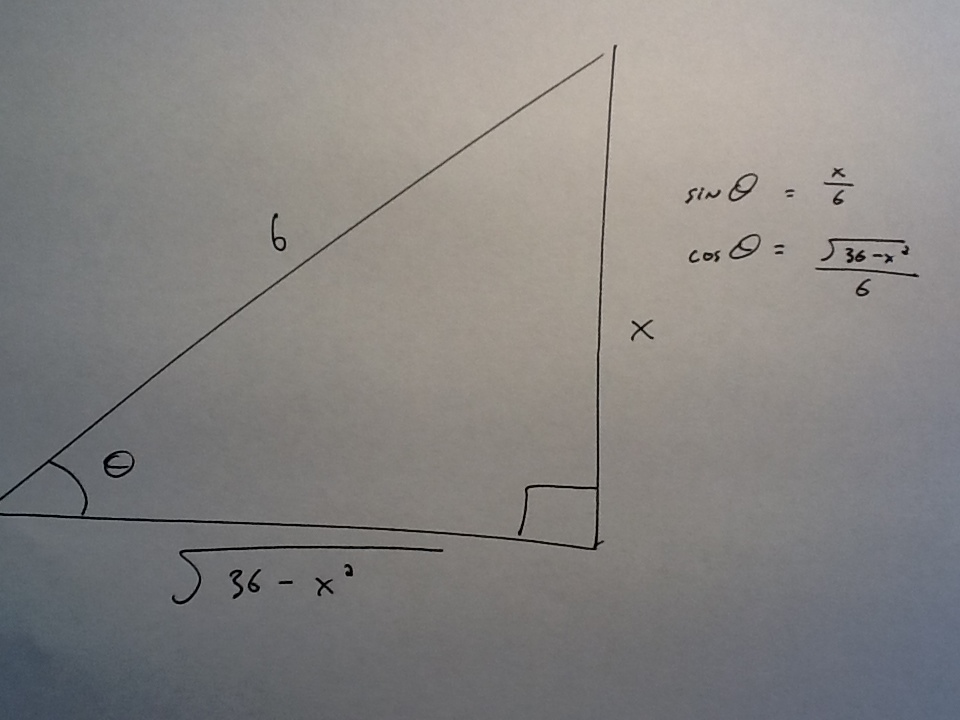
This is a post for my math 100 calculus class of fall 2013. In this post, I give the 4th week’s recitation worksheet (no solutions yet – I’m still writing them up). More pertinently, we will also go over the most recent quiz and common mistakes. Trig substitution, it turns out, is not so easy. […]
This is a post for my Math 100 class of fall 2013. In this post, I give the first three weeks’ worksheets from recitation and the set of solutions to week three’s worksheet, as well as a few administrative details. Firstly, here is the recitation work from the first three weeks: (there was no recitation […]
This is a post written for my fall 2013 Math 100 class but largely intended for anyone with knowledge of what a function is and a desire to know what calculus is all about. Calculus is made out to be the pinnacle of the high school math curriculum, and correspondingly is thought to be very […]
July has been an exciting and busy month for me. I taught number theory 3 hours a day, 5 days a week, for 3 weeks to (mostly) devoted and motivated high school students in the Summer@Brown program. In the middle, I moved to Massachusetts. Immediately after the Summer@Brown program ended, I was given the opportunity […]
This post picks up from the previous post on Summer@Brown number theory from 2013. Now that we’d established ideas about solving the modular equation , solving the linear diophantine equation , and about general modular arithmetic, we began to explore systems of modular equations. That is, we began to look at equations like Suppose satisfies […]
We’ve covered a lot of ground this first week! I wanted to provide a written summary, with partial proof, of what we have done so far. We began by learning about proofs. We talked about direct proofs, inductive proofs, proofs by contradiction, and proofs by using the contrapositive of the statement we want to prove. […]
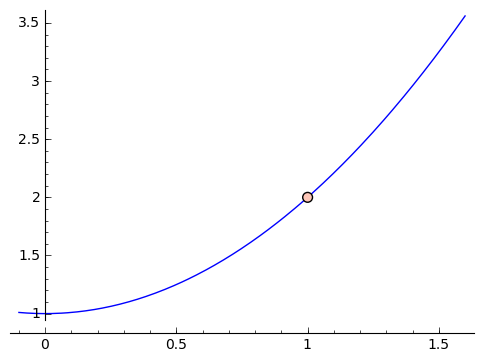
In class today, we were asked to explain what was wrong with the following proof: Claim: As increases, the function approaches (gets arbitrarily close to) 1. Proof: Look at values of as gets larger and larger. These values are clearly getting closer to 1. QED Of course, this is incorrect. Choosing a couple of numbers […]
It has been a busy two weeks all over the math community. Well, at least it seemed so to me. Some of my friends have defended their theses and need only to walk to receive their PhDs; I completed my topics examination, Brown’s take on an oral examination; and I’ve given a trio of math […]
It’s been a while since I’ve posted – I’m sorry. I’ve been busy, perhaps working on a paper (let’s hope it becomes a paper) and otherwise trying to learn things. This post is very closely related to some computations that have been coming up in what I’m currently looking at (in particular, looking at h-th […]
I read a lot of popular science and math books. Scientific and mathematical exposition to the public is a fundamental task that must be done; but for some reason, it is simply not getting done well enough. One day, perhaps I’ll write expository (i.e. for non-math folk) math. But until then, I read everything I […]
At least three times now, I have needed to use that Hurwitz Zeta functions are a sum of L-functions and its converse, only to have forgotten how it goes. And unfortunately, the current wikipedia article on the Hurwitz Zeta function has a mistake, omitting the $varphi$ term (although it will soon be corrected). Instead of […]
Some may have heard me talk about this before, but I’ve caught the open source bug. At least, I’ve caught the collaboration and free-dissemination bug. And I don’t just mean software – there’s much more to open source than software (even though the term open source originated in reference to free access to source code). […]
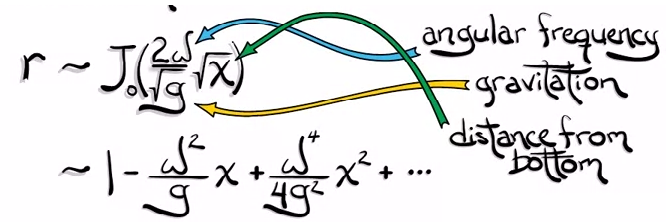
This is a continuation of a previous post. I’ve been following the two Coursera calculus MOOCs: the elementary introductory to calculus being taught by Dr. Fowler of Ohio State University, and a course designed around Taylor expansions taught by Dr. Ghrist of UPenn, meant to be taken after an introductory calculus course. I’ve completed the […]
I like the idea of massive online collaboration in math. For example, I am a big supporter of the ideas of the polymath projects. I contribute to wikis and to Sage (which I highly recommend to everyone as an alternative to the M’s: Maple, Mathematica, MatLab, Magma). Now, there are MOOCs (Massice open online courses) […]
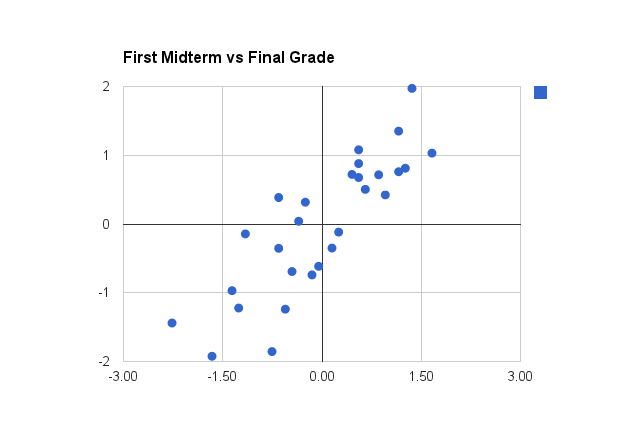
All is said and done with Math 90 for 2012, and the year is coming to a close. I wanted to take this moment to write a few things about the course, what seemed to go well and what didn’t, and certain trends in the course. that I think are interesting and illustrative. First, we […]
We had a midterm this week, and did more review during recitation. The solutions are now available below the fold Solutions to the midterm are now closed. But I can send a copy of them if you ask me. A copy of the Midterm: (actually just a draft) If you have any questions, please let […]
In this note, I consider an application of generalized Mobius Inversion to extract information of arithmetical sums with asymptotics of the form for a fixed and a constant , so that the sum is over both and . We will see that . For completeness, let’s prove the Mobius Inversion formula. Suppose we have an […]
We deviated from our regular course of action this week, so we did not have preset examples to do in classes. So instead, I will say a few things, and this can be the new posthead for questions. We will have a test next week, but I will not have office hours on Monday and […]
research.io
Sign up to keep scrolling
Create your feed subscriptions, save articles, keep scrolling.











 research.io