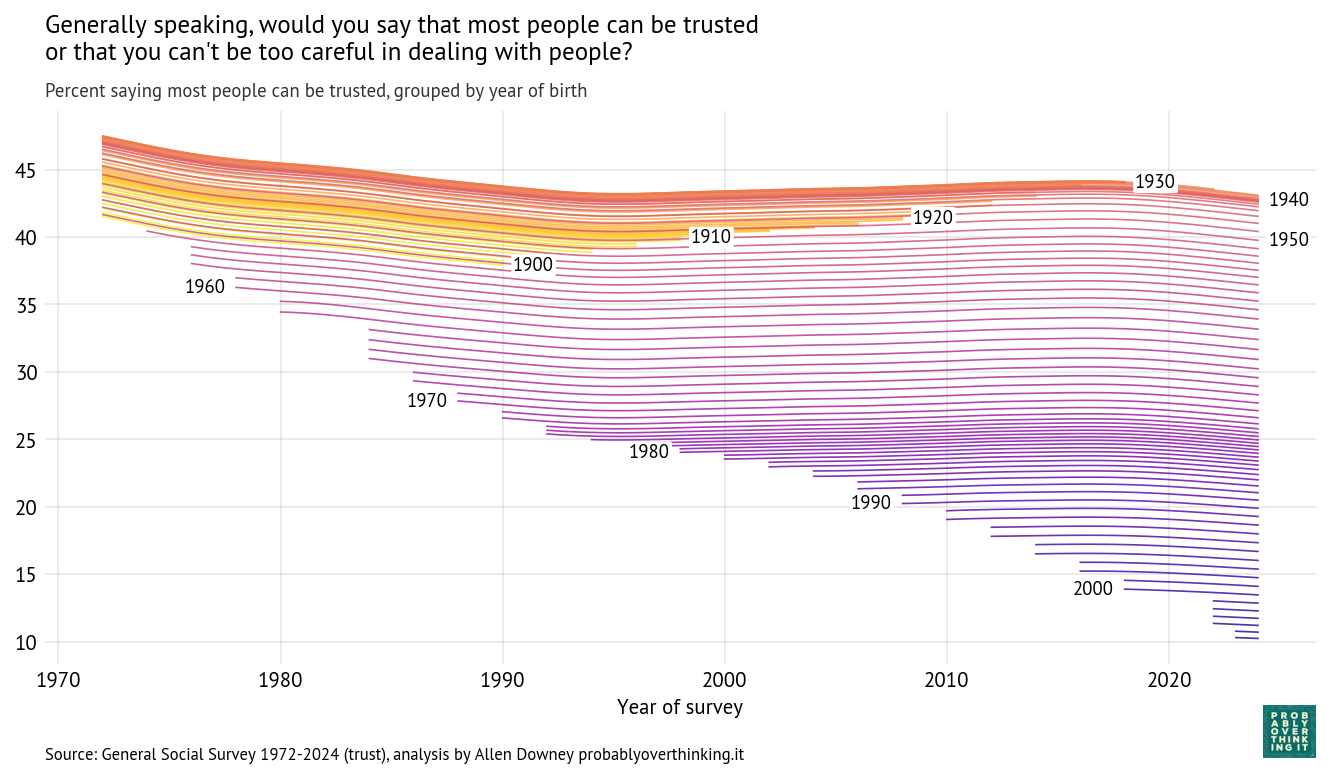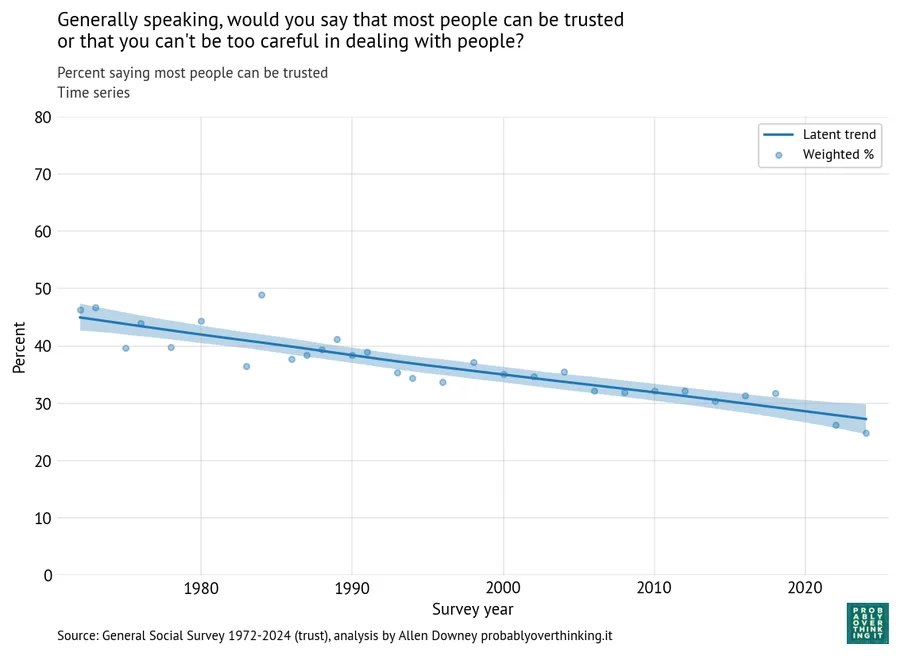
When I go crawling around in data from the General Social Survey, sooner or later I run into Ryan Burge, who writes Graphs About Religion. In his most recent post, he wrote about changes in interpersonal trust, as measured by this GSS question: Generally speaking, would you say that most people can be trusted or that you can’t be too careful in dealing with people? Among other analyses, he looks …
Probably Overthinking It
Here’s a probability puzzle from a TED-Ed video called Can you solve the frog riddle? by Derek Abbott. It came up recently in this Reddit thread: You’re stranded in a rainforest after accidentally eating a poisonous mushroom. To survive the poison, you need to lick a certain species of frog. Only female frogs produce the antidote. Male and female frogs occur in equal numbers and look identical, b…
mathematicsprobability
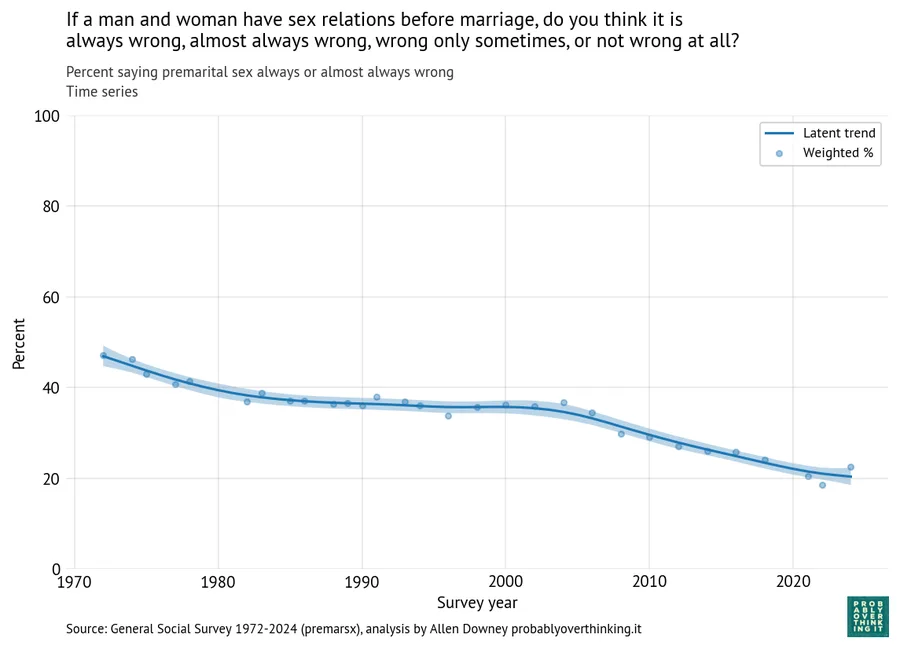
This article is one of a series looking at changes in public opinion over the last 50 years, with a focus on culture war topics. In this installment, we’ll look at responses to four questions in the General Social Survey (GSS) related to sexual activity: As we’ll see, answers to these questions have diverged in the last 50 years. A large majority answer that extramarital and teen sex are wrong, a…
This article is one of a series exploring responses to core questions in the General Social Survey (GSS), estimating period and cohort effects, and looking for historical events that might explain the trends we see. Confidence in American institutions In this installment, we’ll look at 13 questions related to confidence in institutions. We’ll start with a detailed look at confidence in “the peopl…
social-sciencesociology
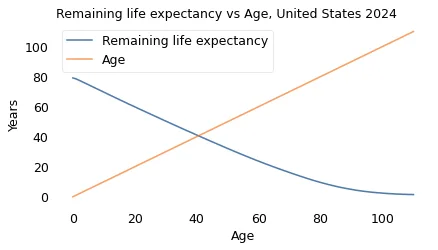
Yesterday I presented a talk at ODSC East 2026, called “Counterfactual Analysis with Bayesian Models: What Drives the Life Expectancy Gap?” Here’s the abstract Across nearly every country in the world, women live longer than men—but the size of this gap varies from about two years in some countries to more than twelve in others. What explains these differences, and how much of the gap can be clos…
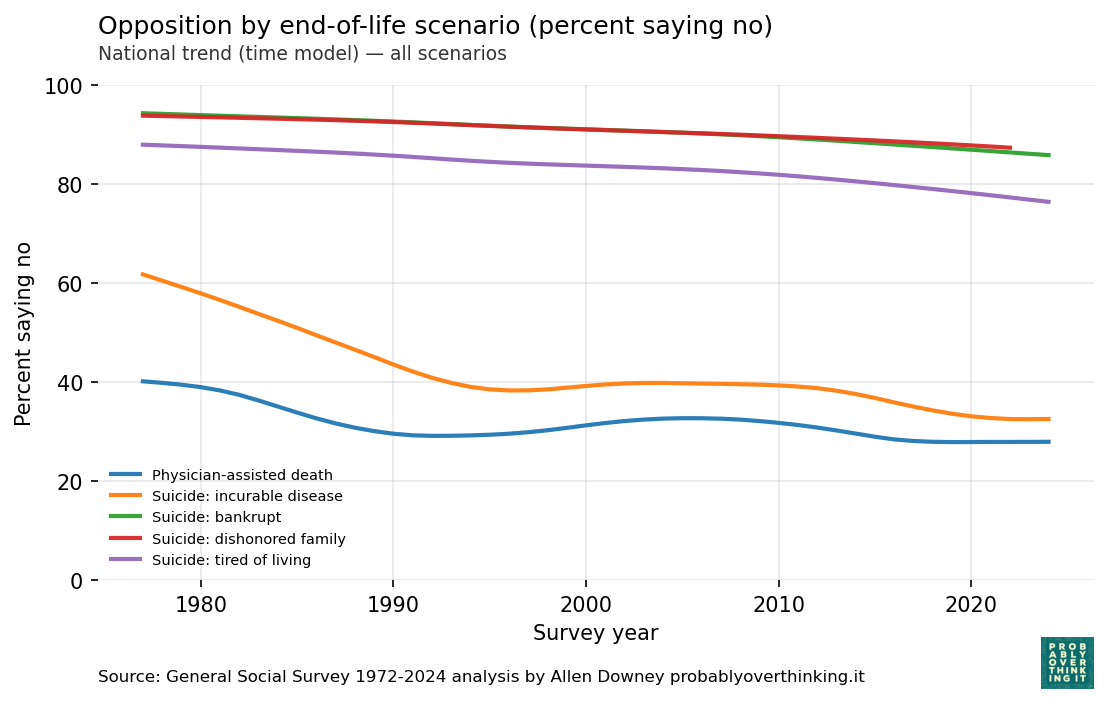
In Graphs About Religion, Ryan Burge recently wrote about changing opinions about assisted suicide and how they relate to religion. As always, when I see survey responses changing over time, I wonder whether it is driven primarily by period or cohort effects. And if you’ve read my last few posts, you know I’ve been working on a Bayesian model to answer that question. Ryan’s analysis is based on f…
social-sciencesociology
In a previous article, I claimed that Young adults are not very happy. Now the World Happiness Report 2026 has confirmed that young people in North America and Western Europe are less happy than they were fifteen years ago, and less happy than previous generations. In this article, we’ll look at results from three related questions in the General Social Survey (GSS): - Trust: “Generally speaking,…
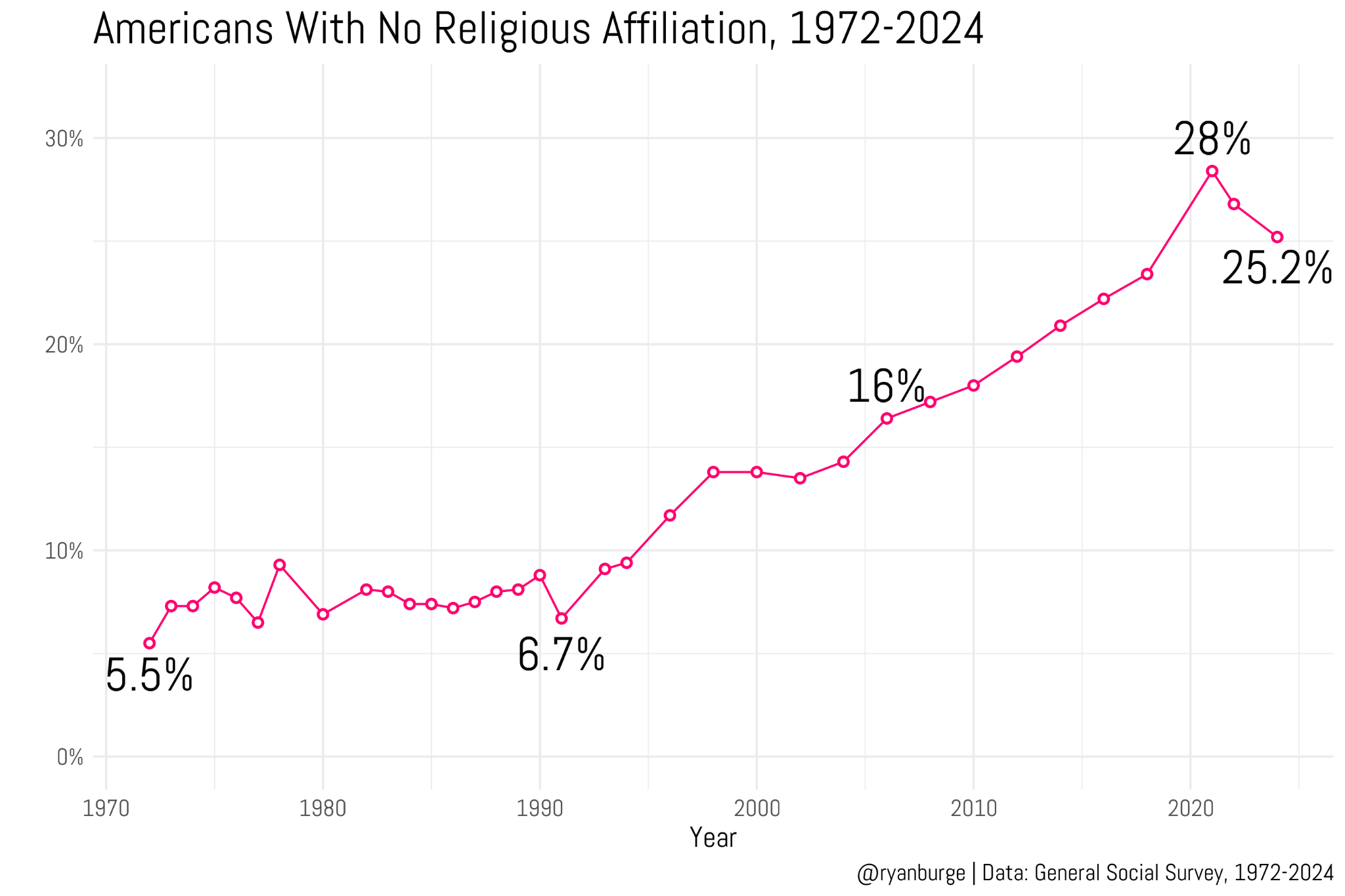
Someone asked me recently why I stopped writing about religion, and I said there were two reasons: One is that the primary dataset I was following stopped updating; the other is that Ryan Burge is doing such a good job, I felt redundant. His most recent article presents evidence that the Nones have hit a ceiling — that is, that the percentage of people in the U.S. with no religious affiliation, w…
demographysocial-sciencesociology
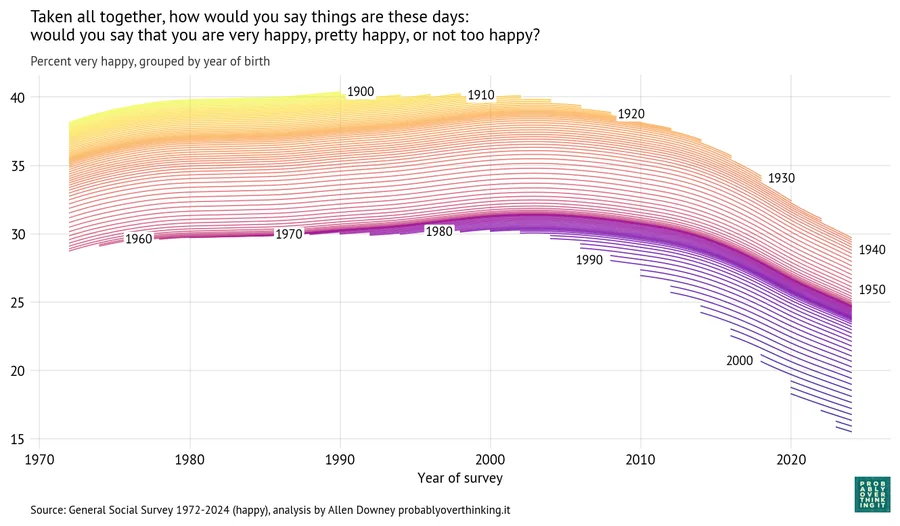
Since 1972, the General Social Survey has asked respondents: “Taken all together, how would you say things are these days—would you say that you are very happy, pretty happy, or not too happy?” The following figure shows how the responses have changed over time and between birth cohorts. Each line represents one birth year. People born in 1900 were 72 years old when the survey started; at that po…
cognitive-psychologypsychology
In Chapter 9 of Probably Overthinking It I wrote about Drug Recognition Experts (DREs), who are law enforcement officers trained to recognize impaired drivers. I reviewed the research papers that were supposed to evaluate the accuracy of DREs and I summarized my impressions like this: What I found was a collection of studies that are, across the board, deeply flawed. Every one of them features at…
cognitive-psychologypsychology
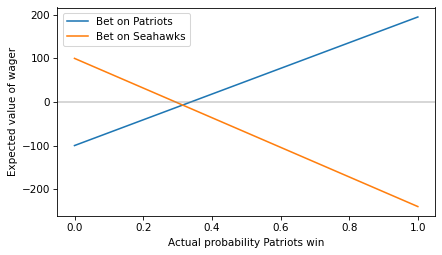
If you have studied probability, you might be familiar with fractional odds, which represent the ratio of the probability something happens to the probability it doesn’t. For example, if the Seahawks have a 75% chance of winning the Super Bowl, they have a 25% chance of losing, so the ratio is 75 to 25, sometimes written 3:1 and pronounced “three to one”. But if you search for “the odds that the …
mathematicsprobability
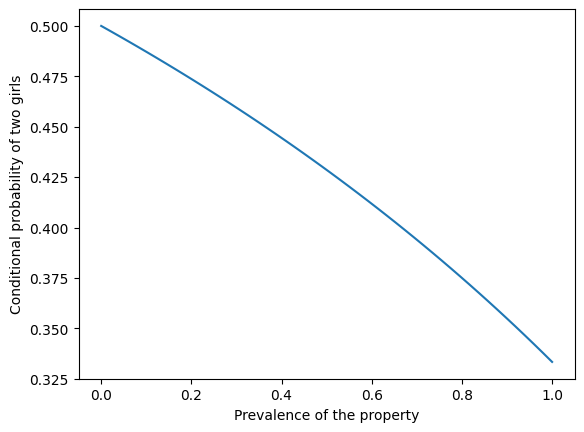
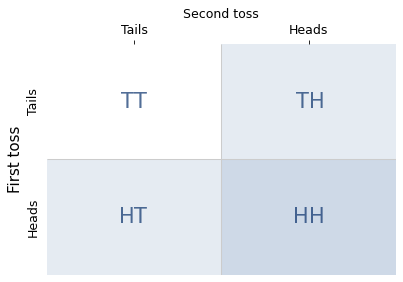
Some people have strong opinions about this question: In a family with two children, if at least one of the children is a girl born on Tuesday, what are the chances that both children are girls? In this article, I hope to offer - A solution to one interpretation of this question, - An explanation of why the solution seems so counterintuitive, - A discussion of other interpretations, and - An impl…
At PyData Global 2025 I presented a workshop on Bayesian Decision Analysis with PyMC. The video is available now. This workshop is based on the first session of the Applied Bayesian Modeling Workshop I teach along with my colleagues at PyMC Labs. If you would like to learn more, it is not too late to sign up for the next offering, starting Monday January 12. Resources: - The slides are here - The…
mathematicsstatistics
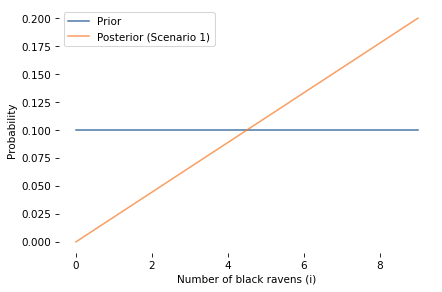
Suppose you are not sure whether all ravens are black. If you see a white raven, that clearly refutes the hypothesis. And if you see a black raven, that supports the hypothesis in the sense that it increases our confidence, maybe slightly. But what if you see a red apple – does that make the hypothesis any more or less likely? This question is the core of the Raven paradox, a problem in the philo…
philosophyphilosophy-of-science
The video from my PyData Boston talk is up now: Resources - The slides are here - Run the first notebook (Poincaré problem) on Colab - Run the second notebook (analysis of SAT data) on Colab If you want to learn to do this kind of analysis, you can sign up for the January 2026 offering of the Applied Bayesian Modeling Workshop, which I teach along with my colleagues at PyMC Labs. And as always, y…
mathematicsstatistics
I’m happy to report that Probably Overthinking It is available now in paperback. If you would like a copy, you can order from Bookshop.org and Amazon (affiliate links). To celebrate, I’m publishing The Lost Chapter — that is, the chapter I cut from the published book. It’s about The Girl Named Florida problem, which might be the most counterintuitive problem in probability — even more than the Mo…
I have started work on a second edition of Think DSP! You can see the current draft here. I started this project in part because of this announcement: Once in a while, a few of the Scicloj friends will meet to learn about signal processing, following the Think DSP book by Allen B. Downey, and implementing things in Clojure. Our notes will be published at Clojure Civitas. If you know some Clojure …
algorithmscomputer-science
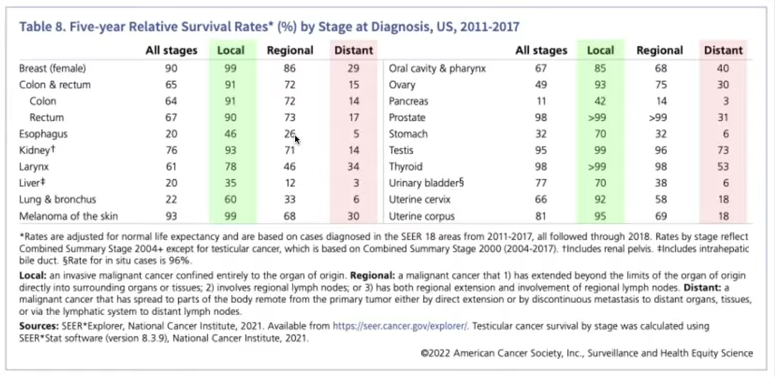
UPDATE: I submitted a more formal version of this article to the UMAP Journal (Undergraduate Mathematics and Its Applications), which publishes articles that use mathematical modeling for real-world problems, often with a pedagogical or expository angle. A preprint is available on arXiv at: https://arxiv.org/abs/2603.19945 Five-year survival might be the most misleading statistic in medicine. For…
medicineoncology
At Olin College recently, I met with a group from the Kyiv School of Economics who are creating a new engineering program. I am very impressed with the work they are doing, and their persistence despite everything happening in Ukraine. As preparation for their curriculum design process, they interviewed engineers and engineering students, and they identified two recurring themes: passion and disa…
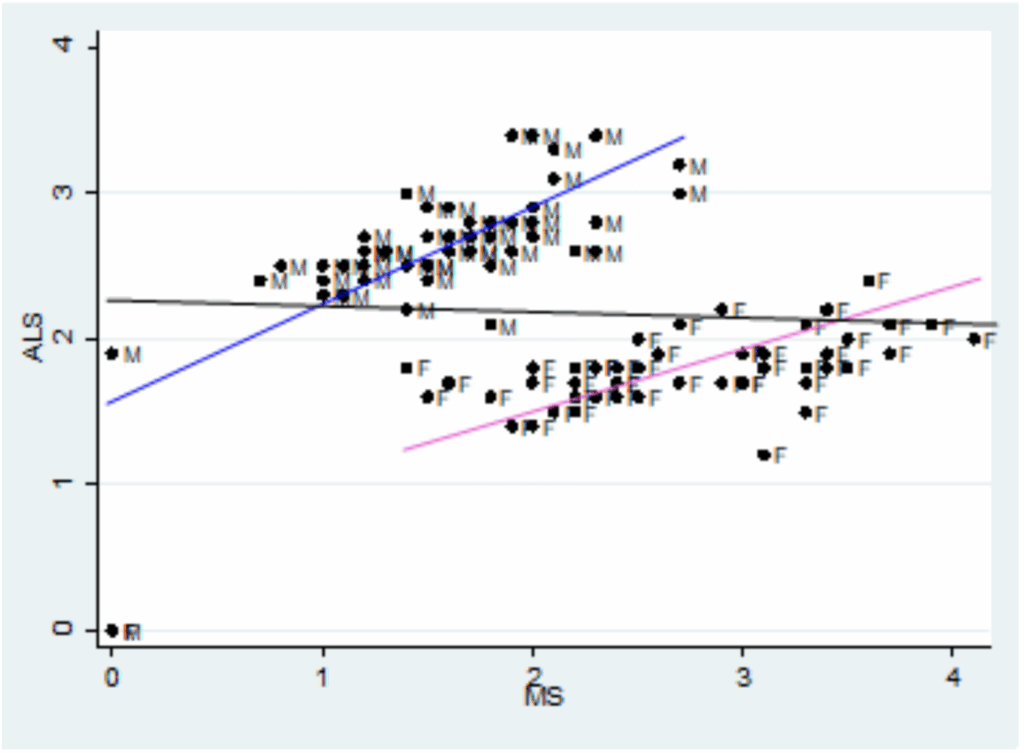
I like Simpson’s paradox so much I wrote three chapters about it in Probably Overthinking It. In fact, I like it so much I have a Google alert that notifies me when someone publishes a new example (or when the horse named Simpson’s Paradox wins a race). So I was initially excited about this paper that appeared recently in Nature: “The geographic association of multiple sclerosis and amyotrophic l…
mathematicsstatistics
research.ioSign up to keep scrolling
Create your feed subscriptions, save articles, keep scrolling.
Already have an account?