Let A be a magma, a set with a binary operation. A complete mapping for A is a bijection θ on A such that the map ψ defined by ψ(a) = a·θ(a) is also a bijection, where · is the operation. It … Continue reading →
Yesterday Simeon Ball sent me notices, in New Scientist and phys.org, of his paper with Robin Simoens on quantum solutions to Euler’s 36 officers problem: Given 36 officers belonging to six different ranks and six different regiments, each rank-regiment combination … Continue reading →
In 1981, the Soviet mathematician V. I. Arnold wrote a little book attempting to explain catastrophe theory to a general audience. It was translated into English by R. K. Thomas and published with the title Catastrophe Theory by Springer in … Continue reading →
Last night some of the strands of gamgee inside my skull connected up and I remembered something I learned nearly 14 years ago, which I think is relevant to the discussion of AI in mathematics, and in particular to the … Continue reading →
I have not been well for a while; my brain has turned to gamgee, and I find it difficult to concentrate on hard mathematics. So let me try to get things working by an easier warm-up exercise. There has been … Continue reading →
A week in the Oude Abdij Drongen, near Ghent in Belgium, accompanying Rosemary to the mODa14 conference. The name of this conference gives a double role to the initials OD: model-oriented design and analysis, and optimal design, hence the typography. … Continue reading →
Not THE famous ABC conjecture, but a conjecture of mine with Mohammed Aljohani and John Bamberg. A simple counting argument shows that, in any vertex-transitive graph, the product of the clique number and the independence number is at most the … Continue reading →
I am now retired, and nearly 80. My brain does not work at the same clock speed that it used to, and I am no longer paid for things which were part of the job sucuh as refereeing, conference attendance … Continue reading →
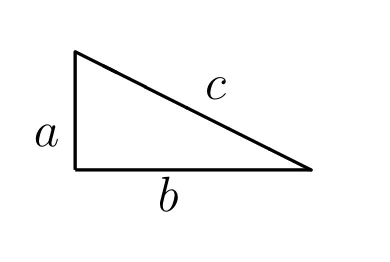
Take a right-angled triangle with hypotenuse c and the other two sides a and b. Pythagoras’ Theorem tells us that c2 = a2+b2. Let the area of the triangle be A. We know that A = ab/2 (since an a×b rectangle is cut into … Continue reading →
Imagine you are in the following situation. You are the foreign minister of your country. You are in New York for a meeting of the General Assembly of the United Nations. A powerful enemy has been deploying troops on the … Continue reading →
Graphs and groups, in my view, are two subjects engaged in a wide-ranging dialogue at present. Graphs can be used to describe interesting classes of groups, and groups to construct interesting graphs. But I am delighted that recently, in a … Continue reading →
The latest newsletter from the International Mathematical Union urges mathematicians to attend this year’s ICM in Philadelphia. It will help our beleaguered collleagues in the USA by showing support, and the organisers guarantee our personal safety.
Well, I will not be there. But after moral pressure like that, I feel called on to justify my decision. So here goes.
- I believe I do a certain amou…
I believe Eugene Plotkin has died. I read this on the AGTA website but I have no details.
I met him for the first and only time at Daniela Nikolova’s birthday conference in Deerfield Beach, Florida, four years ago. We got on very well. Outside of mathematics, one of his hobbies is finding beautiful “works of art” in natural stones; he sent me some of the extraordinary videos he had produced.
I have spent a lot of time recently thinking about graphs on groups. To recall the rules: the vertex set must be the group (in general, but not here, I allow an automorphism-invariant subset or the quotient by an automorphism-invariant equivalence relation); the graph must be defined in terms of the group structure with no arbitrary choices; so the automorphism group of the group acts as automorp…
I have been, and remain, sceptical about AI. At best, it is saiad to be good at writing programs, and finding specific facts; but it has a tendency to lie, to invent, and to tell you what it thinks you want to hear, so you have to check very carefully everything it tells you.
But I was sent a manuscript by Donald Knuth where he claims that Anthropic’s robot Claude (named after Claude Shannon, the…
As the tagline for this blog says, I like counting things. Reading my Iran diary reminded me of a counting problem I solved then, of which I am quite proud. But like all good problems, it leaves a loose end, which you might like to try.
THe problem came from Charles Johnson, one offour pairs of my coauthhors with the same surname. He was interested in properties of a matrix which are at least par…
Last month I was in Vienna, at AAA108. This was the 108th meeting of the Arbeitsgruppe Allgemeine Algebra (or Workshop on General Algebra), which has been going since 1971, with usually two meetings a year. The meetings are held at weekends, to maximise the chance that people can attend without disrupting their lecturing schedules too much (Friday, Saturday and Sunday morning).
It was founded by …
The set Q of rational numbers is obviously an interesting topological space. In 1920, Waclaw Sierpiński gave a lovely characterisation of it. The simplest way to state it is to say that a countable, metrisable, space without isolated points is homeomorphic to Q. (Sierpiński also gave a purely topological characterisation: a countable, second countable, 0-dimensional, T1 topological space without …
Two brief topics. My resolution to publish in diamond open-access journals is already in tatters. I assumed this would happen because I had coauthors who were compelled to publish in certain journals. But the other plausible reason for it to … Continue reading →
research.io
Sign up to keep scrolling
Create your feed subscriptions, save articles, keep scrolling.













 research.io