Exoplanets

CEHW Professor Renyu Hu explored the surface composition of a bare planet’s hot crust 50 light-years from Earth using NASA’s James Webb Space Telescope. Read more from Penn State press release, Max Planck Institute, or the paper in Nature Astronomy. Image caption: This high-resolution photo of the planet Mercury may resemble the rocky exoplanet LHS […]

astronomyastrophysicsexoplanets

Konstantin Getman and Eric Feigelson’s recent work on how Dimming X-rays could be boon for life on planets around young sun-like stars was highlighted by NASA Chandra Observatory. Read the full paper on X-Ray Evolution of Young Stars: Early Dimming and Coronal Softening in Solar-mass Stars with Implications for Planetary Atmospheres in the Astrophysical Journal.

astronomyastrophysicsplanetary-science
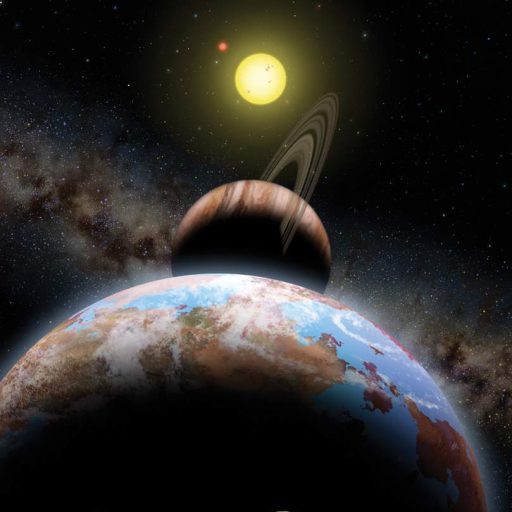
“We look for these types of planets because they are our best chance at finding life elsewhere,” said Suvrath Mahadevan, the Verne M. Willaman Professor of Astronomy at Penn State and co-author on a paper about the discovery published today (Oct. 23) in The Astronomical Journal. “The exoplanet is in the habitable or the ‘Goldilocks Zone,’ the right distance from its star that liquid water could e…

astrobiologyastronomyexoplanets

Astronomers at Penn State use data from NASA’s James Webb Space Telescope and theoretical modeling to study a distant, irradiated protoplanetary disk The fundamental building blocks for planet formation can exist even in environments with extreme ultraviolet radiation, according to a new study by an international collaboration led by Penn State astronomers. The study leveraged the unparalleled ca…

astronomyastrophysicsplanetary-science
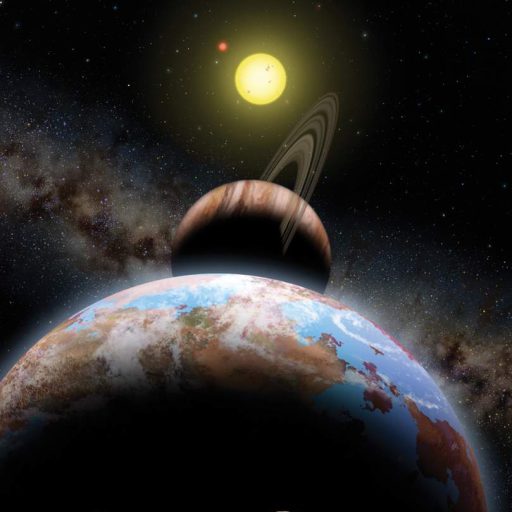
Dr. Alessandro Morbidelli from the Collège de France will give this year’s Friedman lectures, “The Diversity of Planetary Systems: How Singular Is Our Own?” at 7 p.m. on Tuesday, April 15, in Freeman Auditorium, HUB-Robeson Center, and a more-specialized lecture, titled “Formation and Evolution of a Protoplanetary Disk: Combining Observations, Simulations, and Cosmochemical Constraints” at 3:45 p…

astronomyastrophysicsplanetary-science
Read the story about how CEHW Professor Kevin Luhman took the picture on a recent postage stamp. CEHW faculty’s JWST Image on postage stamp by Eric Ford | Mar 17, 2025 | News, Press Coverage | 0 comments by Eric Ford | Mar 17, 2025 | News, Press Coverage | 0 comments

Penn State Presidential and CEHW Postdoc Dr. Rachel Fernandes led a study to better understand the processes shapes the size and location of sub-Neptunes. Read the press release or the paper published in the Astronomical Journal. Penn State Presidential and CEHW Postdoc Dr. Rachel Fernandes led a study to better understand the processes shapes the size and location of sub-Neptunes. Read the press…

astronomyexoplanets

New theory proposes that humans — and analogous life beyond Earth — may represent the probable outcome of biological and planetary evolution Adrienne Berard 17 February 2025 Humanity may not be extraordinary but rather the natural evolutionary outcome for our planet and likely others, according to a new model for how intelligent life developed on […]

biologyevolution

Using data from the European Space Agency’s Gaia mission, and the Habitable Zone Planet Finder and NEID Spectrometers developed at Penn State, scientists, including Penn State astronomers, have found a huge exoplanet and a brown dwarf. This is the first time a planet has been uniquely discovered by Gaia’s ability to sense the gravitational tug […]

astronomyexoplanets

The unusual system of three ‘super puff’ planets has at least one more planet, revealed by its gravitational tug on other planets An unusual planetary system with three known ultra-low density “super-puff” planets has at least one more planet, according to new research led by researchers from Penn State and Osaka University. The research team […]

astronomyexoplanetsspace-exploration

Overview In protoplanetary disks dust grains can grow into planetesimals, then rocky planets or planetary cores and sometimes gas-rich giant planets. Understanding this remarkable growth is an extremely challenging. Planet forming regions are typically enshrouded in dust and gas, obscuring the planet formation process. The large range of sizes and timescales makes first-principles numerical simul…

astronomycosmologyexoplanetsplanetary-science
Overview Penn State professor Suvrath Mahadevan led the development of the NEID spectrograph that is searching for low-mass planets around sun-like stars using the WIYN Telescope. Penn State professors Suvrath Mahadevan and Larey Ramsey led the development of the Habitable Zone Planet Finder, a new instrument for the Hobby-Eberly Telescope that is enabling high-precision Doppler planet surveys us…

astronomyexoplanets

Overview Our solar system has long shaped humankind’s understanding of the cosmos. We are able to characterize the properties of the planets, moons and other small bodies in our solar system in much greater detail than other planetary systems. Researchers at the Center for Exoplanets and Habitable Worlds aim to integrate our detailed knowledge of our solar solar system with astronomical observati…

astronomyplanetary-science

Research Areas - Exoplanet & Brown Dwarf Surveys - Instrumentation - Life Beyond Earth & Astrobiology - Orbital Dynamics - Our Solar System - Planet-forming & Debris Disks - Planetary Atmospheres & Interiors - Planets around Evolved Stars & Stellar Remnants - Star & Planet Formation - Stellar Characterization & Variability - Statistical Methodology & Data Analysis

astrobiologyastronomyexoplanetsplanetary-science
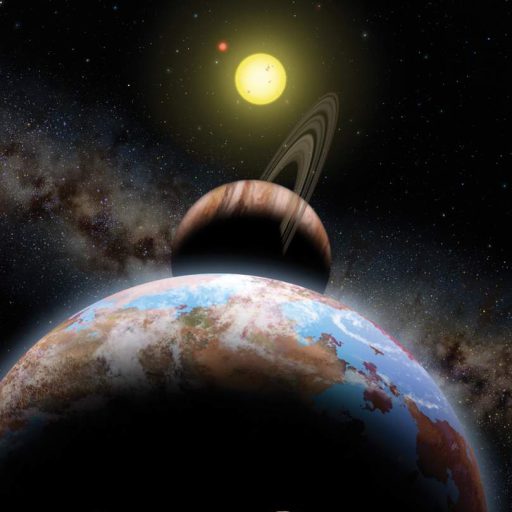
Overview The Center for Exoplanets and Habitable Worlds works closely with the Penn State Astrobiology Research Center to promote research related to understanding the origins of life on Earth and the potential for life elsewhere in the solar system and the universe. Areas of Specialty - Search for habitable planets (Mahadevan, Wright, Ford) - Modeling climate on exoplanets (Kasting, Williams, Fo…

astrobiologyastronomy

Overview Collecting astronomical data is one of many important steps in the scientific process. Successful scientific interpretation requires sound data analyzing and statistical methodologies. Often astronomers reinvent methods that have previously been developed and studied extensively by statisticians or scientists in other fields. Thus, astronomers can benefit greatly from awareness and inter…

astronomyexoplanets

Research Areas - Exoplanet & Brown Dwarf Surveys - Instrumentation - Life Beyond Earth & Astrobiology - Orbital Dynamics - Our Solar System - Planet-forming & Debris Disks - Planetary Atmospheres & Interiors - Planets around Evolved Stars & Stellar Remnants - Star & Planet Formation - Stellar Characterization & Variability - Statistical Methodology & Data Analysis

astrobiologyastronomyexoplanetsplanetary-science

research.ioresearch.io

Sign up to keep scrolling

Create your feed subscriptions, save articles, keep scrolling.

Already have an account?