Acoustics Insider Blog
TL;DR: Ten studios, two years of testing, one consistent lesson: where you place the AVAA matters far more than how many you buy. It only absorbs frequencies with high sound pressure at its location, so parking it in the right corner is everything. The unit also improves recordings (not only monitoring), and the price makes sense when you realize 80% of any serious studio build budget goes toward…
TL;DR: Stop judging acoustic treatment by that first impressive listen. Pay attention to the invisible stuff that shows up weeks later: fewer headphone checks, less second-guessing on the low end, fewer reference tracks mid-session, and sharper decisions made upstream before cleanup is even on the table. First impressions of acoustic treatment aren't wrong. When you finally put in the work to pro…
Is the PSI AUDIO AVAA Worth $3,300? I Tested It in 10 Studios. Everyone asks if active bass traps work. After testing them in 10 studios over two years, I finally have an answer backed by actual data. The PSI AUDIO AVAA C214 is the only commercially available, fully automatic active bass absorber on the market. A cylinder about the size of a trash can that claims to deliver the equivalent of 45 t…
No One Understands How the PSI AVAA Works. So I Asked Its Creator. There's a gap between knowing how sound should behave and knowing how it actually behaves in your room. That gap is where most acoustic treatment projects go to die. I sat down recently with Yvan Becher, the R&D manager at PSI Audio. He's the engineer who was hired specifically to develop the digital version of the AVAA C214, the …
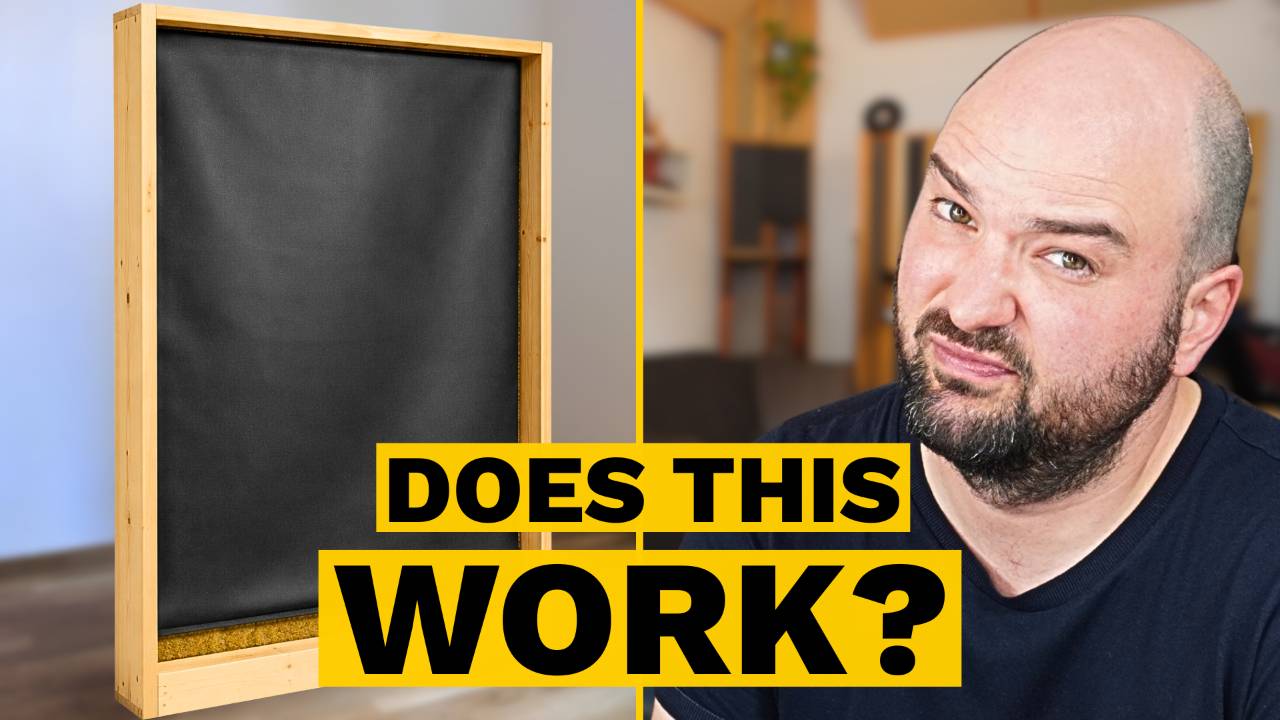
Free-Hanging Limp Mass: Bass Trap or Bass Myth? The worst bass trap isn't the one that does nothing. It's the one that makes you think it's working. Every few years, this same design pops back up in forums and magazine articles. The idea: hang a heavy sheet of mass loaded vinyl a few inches off the wall, maybe stuff some insulation behind it, and let the vinyl vibrate with the sound to absorb bas…
Do Your Neighbors Hear Your Room Modes? (The Answer Might Surprise You) It's 10 PM. Your kick drum is booming. You measured a 12 dB peak at 100 Hz last week. And now you're wondering: did I just wake up my neighbors? I got an email from a subscriber recently that captures this exact anxiety perfectly: "I live in an apartment, third floor. I'm standing in my room, and at that place there's a boost…
Treating A Studio Start-To-Finish #4: Do Membrane Traps Work? Sub-bass control with resonance traps. The holy grail of studio acoustics. When it comes down to it, the lowest of the lowest audio frequencies can really only be properly absorbed with targeted, tuned resonance absorbers. For most of us DIY audio engineers, this tends to be outside the scope of what we can do. The price-performance ra…
Recording Room Acoustic Treatment With Jesco Lohan - The Self Recording Band Podcast #49 Usually I’d have another video for you today. But something weird I’ve noticed about video is that the time it takes to produce it seems to go up proportionally with the length of the video. So I try and keep my videos short, somewhere around the 10min mark. But I could cover soooo much more in longer content…
Tube traps. VPRs. Helmholtz resonators. Membrane traps. There are a lot of options when it comes to controlling the low end in your studio. But we hardly ever see them pitted against each other. That’s because the effort involved is HUGE. And so much can go wrong. But someone who didn’t shy... When was the last time you optimized your workflow in your studio? Because if you want consistent result…
How to best deal with an angled ceiling Let’s say you are setting up a new home studio and the shape of the room is a bit odd. This particular room has a sloped ceiling. It starts off low on one end and rises up towards the other end of the room. How do you best deal with that from an acoustics perspective? Is there anything special to consider when setting up your speakers? And how does it affec…
How to build mastering grade DIY speakers for Dolby Atmos (with Present Day Production) So you know Dolby Atmos, right? It’s been quite the hype lately. And justifyingly so. Some things tell me it’s here to stay. But it’s a new technology! For us sound engineers, there’s still quite a barrier to entry. Price is a major problem. A Dolby Atmos system with even just decent speakers can easily cost $…
When to use absorption, and when diffusion? Amongst all the voodoo in studio acoustics, I don’t think there’s anything more voodoo than diffusion. And I don’t mean like with sound crystals. Diffusion does absolutely work. But amongst the stuff that is part of the standard acoustics toolkit, it’s definitely the thing with the most myth surrounding it. To the point where there are people out there …
These Acoustic Treatment Hacks will help you get a Reliable, Repeatable Reference Sound from your room EVERY TIME… So you can crank out professional sounding mixes faster than you ever thought possible… Even if you’re in a small, difficult, hard-to-treat space. 00 DAYS 00 HOURS 00 MINS 00 SECS Featured on... Dear Friend, If you want to stop spending all your time researching when, where, and how …
THE PHANTOM SPEAKER TEST "Finally nail your speaker placement in any room. Even if it's the wrong shape, wrong size, or you can't move your desk" Tired of mixes that sound great in your room but fall apart everywhere else? You've probably spent hours moving speakers around, tweaking EQ, second-guessing every mix decision... only to hear your track in the car and think "What the hell happened to m…
What’s a good frequency response in a treated room? (measurements) Have you ever wondered what a GOOD frequency response in a studio actually looks like? Cause it's not like you see a lot of them floating around. Pro studios and acousticians definitely seem to like keeping 'em under wraps.. How much does it actually improve with treatment? And what changes exactly? Well, let me show you. I think …
“Are my mixes too bright because my high end is overdamped?” Have you been in this situation: You are mixing in your room, maybe with some basic treatment, and whenever you take your mixes outside of the studio, they turn out a little bit harsh, just a bit too bright? There's just a little bit too much high end in your mixes. Consistently with every other mix, you're just obviously boosting the h…
Let’s say you are setting up a new home studio and the shape of the room is a bit odd. This particular room has a sloped ceiling. It starts off low on one end and rises up towards the other end of the room. How do you best deal with that from an acoustics perspective? Is there anything specia... Have you heard about the 38 percent rule? This is something that pops up a lot when you're researching…
Don’t confuse “DEAD” and “DRY” room sound I think we’ve all heard the stories of people plastering their rooms with pyramid foam from Amazon. Maybe you were even one of the lucky ones to try such a masterpiece yourself..? (high five) Then you’ll know how bad such a “dead” space can be. It’s absolutely awful. It feels awful, it looks awful, it sounds awful. And the natural consequence is to think:…
Audieum Modal: Calculating room modes for odd rooms When was the last time you tried to figure out what is causing those nasty bass issues in your studio? Yesterday? Two hours ago? Like, right now? 😛 Somehow it seems like it’s an on-going, never-ending problem.. And if you’re anything like me, you landed on one of a gazillion available “room mode calculators” sooner or later. And also like me, yo…
research.ioSign up to keep scrolling
Create your feed subscriptions, save articles, keep scrolling.