QUANTITATIVE RESEARCH AND TRADING
A Practical Guide to Attention Mechanisms in Quantitative Trading Introduction Quantitative researchers have always sought new methods to extract meaningful signals from noisy financial data. Over the past decade, the field has progressed from linear factor models through gradient-boosting ensembles to recurrent architectures such as LSTMs and GRUs. This article explores the next step in … Contin…
The Quest for Portfolio Optimization The quest for optimal portfolio allocation has occupied quantitative researchers for decades. Markowitz gave us mean-variance optimization in 1952,¹ and since then we’ve seen Black-Litterman, risk parity, hierarchical risk parity, and countless variations. Yet the fundamental challenge remains: markets are dynamic, regimes shift, and static optimization method…
In my recent piece on Kronos, I explored how foundation models trained on K-line data are reshaping time series forecasting in finance. That discussion naturally raises a follow-up question that several readers have asked: what about the architecture itself? The Transformer has dominated deep learning for sequence modeling over the past seven years, but a … Continue reading "State-Space Models fo…
Time Series Foundation Models for Financial Markets: Kronos and the Rise of Pre-Trained Market Models The quant finance industry has spent decades building specialized models for every conceivable forecasting task: GARCH variants for volatility, ARIMA for mean reversion, Kalman filters for state estimation, and countless proprietary approaches for statistical arbitrage. We’ve become remarkably go…
Introduction If you’ve been trading anything other than cash over the past eighteen months, you’ve noticed something peculiar: periods of calm tend to persist, but so do periods of chaos. A quiet Tuesday in January rarely suddenly explodes into volatility on Wednesday—market turbulence comes in clusters. This isn’t market inefficiency; it’s a fundamental stylized fact … Continue reading "Volatili…
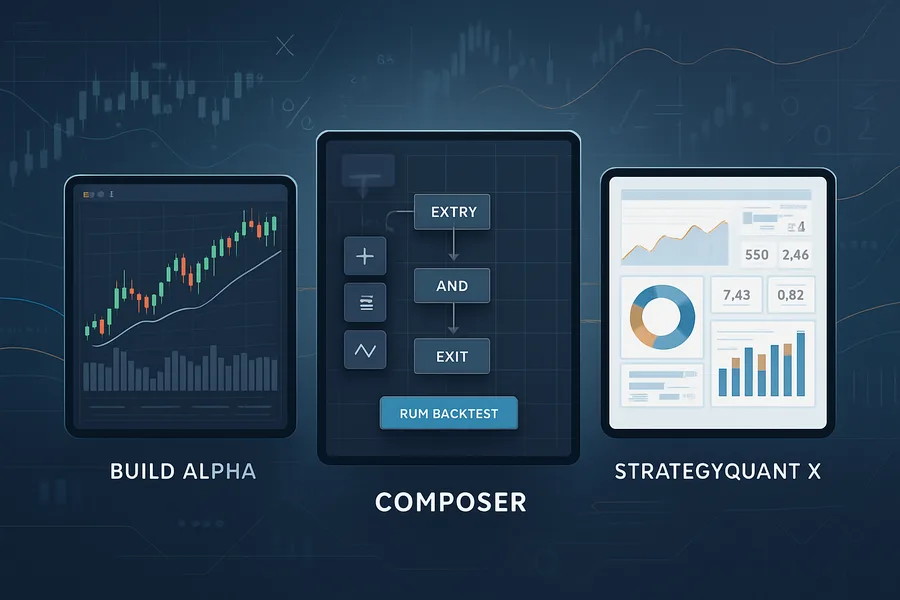
Summary This comprehensive analysis examines three leading algorithmic trading platforms—Build Alpha, Composer, and StrategyQuant X—across five critical dimensions: comparative reviews and rankings, asset class applicability, ensemble strategy capabilities, walk-forward testing and robust optimization, and strategy implementation with broker connectivity. Through extensive research of platform do…
Introduction When we launched the Equities Entity Store in Mathematica, it revolutionized how financial professionals interact with market data by bringing semantic structure, rich metadata, and analysis-ready information into a unified framework. Mathematica’s EntityStore provided an elegant way to explore equities, ETFs, indices, and factor models through a symbolic interface. However, the indu…
“The first rule of investing isn’t ‘Don’t lose money.’ It’s ‘Recognize when the rules are changing.'” UPDATE: MAY 1 2025 The February 2025 European semiconductor export restrictions sent markets into a two-day tailspin, wiping $1.3 trillion from global equities. For most investors, it was another stomach-churning reminder of how traditional portfolios falter when geopolitics overwhelms … Continue…
Key takeaways from “Night Trading: Higher Returns with Lower Risk”: • Overnight returns show strong long-term persistence (up to 5 years!)• Some stocks consistently outperform overnight• Overnight trading strategies can be profitable even after costs• Potential for lower risk AND higher returns for select stocks The Overnight Bias Parameter (OBP) model, integrated into the Equities … Continue rea…
The post A Proposed Double Slit Experiment Using Momentum Entangled Photon Pairs appeared first on QUANTITATIVE RESEARCH AND TRADING .

The post Advanced Course on Equity Analytics appeared first on QUANTITATIVE RESEARCH AND TRADING .
Scenario Description Consider a financial asset whose price, Xt, follows a mean-reverting stochastic process. A common model for mean reversion is the Ornstein-Uhlenbeck (OU) process, defined by the stochastic differential equation (SDE): Objective The trader aims to maximize the expected cumulative profit from trading this asset over a finite horizon, subject to transaction costs. The … Continu…
How to Beat Buy-and-Hold with Less Risk What is Market Timing? – Common Misconceptions Market timing has a very bad press and for good reason: the inherent randomness of markets makes reliable forecasting virtually impossible. So why even bother to write about it? The answer is, because market timing has been mischaracterized and misunderstood. It … Continue reading "The Misunderstood Art of M…
Introduction: Financial modeling has long sought to develop frameworks that accurately capture the complex dynamics of asset prices. Traditional models often focus on either momentum or mean reversion effects, struggling to incorporate both simultaneously. In this blog post, we introduce a two-factor model that aims to address this issue by integrating both momentum and mean … Continue reading "A…
The post Intelligent Technologies appeared first on QUANTITATIVE RESEARCH AND TRADING .
High-frequency statistical arbitrage leverages sophisticated quantitative models and cutting-edge technology to exploit fleeting inefficiencies in global markets. Pioneered by hedge funds and proprietary trading firms over the last decade, the strategy identifies and capitalizes on sub-second price discrepancies across assets ranging from public equities to foreign exchange. At its core, statisti…
In a previous article I made a detailed comparison of Mathematica and Python and tried to identify areas where the former excels. Despite the many advantages of the Python technology stack, I was able to pinpoint a few areas in which I think Mathematica holds the upper hand. Whether those are sufficient to warrant the … Continue reading "Matlab vs. Python" The post Matlab vs. Python appeared firs…
Python vs. Wolfram Language As an avid user of both Python and Wolfram Language for technical computing, I’m often asked how they compare. Python’s strengths as an open-source language are clear: In summary, Python offers benefits in ubiquity, breadth, approachability, and seamless interoperability with external systems. Together, they show the value of domain-specific and general-purpose … Conti…
The post Momentum & Mean Reversion in Discrete and Continuous Time Processes appeared first on QUANTITATIVE RESEARCH AND TRADING .
research.ioSign up to keep scrolling
Create your feed subscriptions, save articles, keep scrolling.