


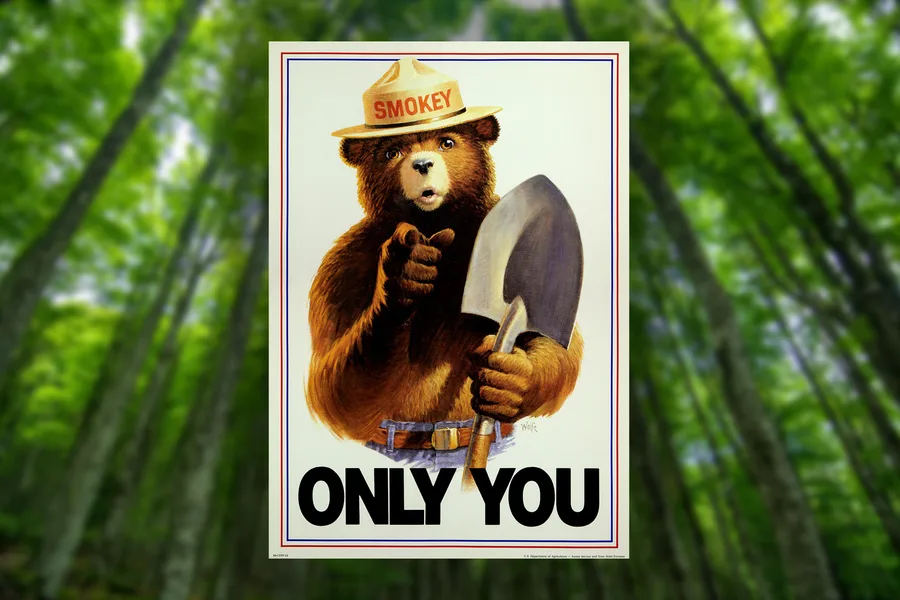
Fight fire . . . with fire? August 17, 2026 Above: In 1944 the Forest Service created a new campaign with a bear resembling an upstanding and charismatic forest ranger: Smokey. A history of fire suppression in the United States Wildfires have been the story of Utah's summer where, as of August 10, a record 514,000 acres have burned. Of that figure, 290,000 acres of woodland forest alone have succumbed—a figure being tracked closely by Phil Dennison, professor in the School of Environment, Society & Sustainability at the University of Utah—which shatters the previous record by more than 50,000 acres. And the fire season isn't over yet. Since national tracking of wildfires in the US began in the 1980s, the average number of fires has remained constant at 70,000 annually, according to the National Interagency Fire Center. However, the acreage has increased by 43%—on average a fire is more destructive than it was 40 years ago. So why is this happening? Climate change is one aspect of the issue. But as with most things, the story is more complex than that. In fact, our fear of fire itself might be largely to blame. Historical stewards Brent Steele, distinguished professor of political science at the University of Utah, recently published the paper with Professor of International Relations at the University of Queensland Matt McDonald "On Fire: Western and Indigenous Approaches to Nature in Settler Colonial Societies" which tells the story of how these lands used to be managed and how that has affected our current situation. According to Steele and McDonald, for thousands of years Indigenous Fire Stewardship (IFS) involved seasonal prescribed burns of forests and woodlands. IFS was seen not as a destructive force to the land but as a medicine. Fire was akin to water or earth and seen as a spirit which freely exists in nature. Indigenous Peoples saw nature as an interconnected ecosystem of which they were just one part. In instances where fire does not exist because it is...
Fight fire . . . with fire?
u0578661
7 min read