


In math, it’s very common to see two objects that look superficially different on the outside, but are actually the same on the inside. We’ll look at two such examples in this post:
- the 2-D plane
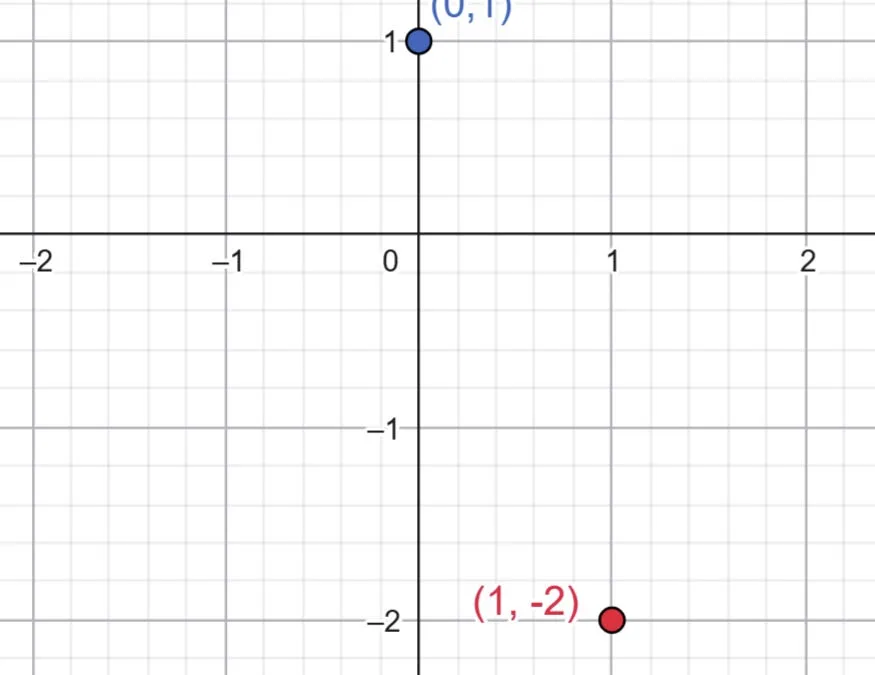
- the set of real-valued continuous functions on [0,1] These two objects look different but actually have a deep underlying similarity. Rather than studying each object in isolation, we’ll define a general structure that captures what they have in common. Once you define that structure, you can prove theorems that apply to all such objects at once. That structure is called a vector space. In this post, we’ll dive into what that is. meet: the 2-dimensional plane In the picture here, I’ve highlighted two elements in the plane. It has certain properties that we know and love.
- (Closed under addition) Given two points in the plane, we can add them (coordinate-wise), and their sum is still in the plane
- (Closed under scalar multiplication) Given a point in the plane, we can scale it by a real number. This scaled element is still in the plane.
- (Zero element) There is a “zero element”, namely the point (0,0). If you add it to any element, it does nothing.
- (Additive inverses) Every point in the plane (a,b) has an additive inverse, namely (-a,-b). If you add them together, you get zero. You might say: “Adithya, these properties are obvious! Why make such a big deal out of them?” And you’re absolutely right: they are obvious. But it turns out that many objects in math satisfy the same properties, many of which look quite different from the plane! now meet: continuous functions Consider the set of all continuous functions from [0,1] to the real numbers: This set also satisfies certain very nice properties:
- (Closure under addition) If you add two continuous functions on [0,1], the sum is a continuous function on [0,1].
- (Closure under scalar multiplication) If you multiply a continuous function on [0,1] by a constant, you get a continuous function on [0,1].
- (Zero element)...