


how it works
      A drumhead clamped at its rim can only vibrate in certain shapes, at certain frequencies.
      Those shapes and frequencies are the solutions of

    −∇²u = λu  inside the shape,  u = 0 on the edge

      Each solution u is a mode, a standing wave, and each λ gives a frequency
      proportional to √λ. This is an eigenvalue problem, and for almost every shape it has no
      formula. So Eigendrum solves it numerically: it covers your shape with a mesh of
      triangles, builds the finite element stiffness and mass matrices, and finds the smallest
      eigenvalues of Kφ = λMφ.

    why you can trust the numbers

      A few shapes have spectra that can be written down exactly, and the solver is tested
      against them on every change. A circle's frequencies are the zeros of Bessel functions; a
      rectangle's are π²(m²/a² + n²/b²). The solver reproduces both to
      better than a tenth of a percent, and because a conforming finite element method minimises
      energy over a restricted space, its answers are guaranteed slight
      overestimates, never under. The measured error is in “the numbers”.

    where you strike it matters

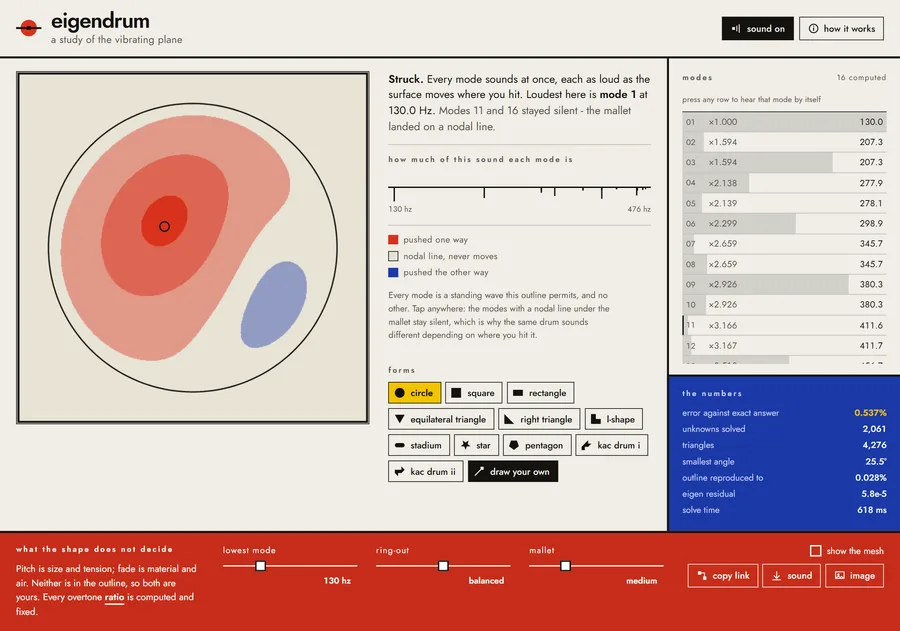
      Striking a spot drives each mode in proportion to how much that mode moves there. Hit a
      line where a mode stands still and you cannot excite it at all. That was not programmed
      in; it falls out of projecting the mallet onto the modes.


      So a strike is never one mode: it is every mode at once, in a mixture set by where your
      mallet landed. The rules along the mode list are that mixture, and the modes marked with a
      square were the ones your mallet could not reach. Pressing a row instead plays that single
      mode alone - something no mallet can do, and the only way to hear what one
      frequency of a shape...