

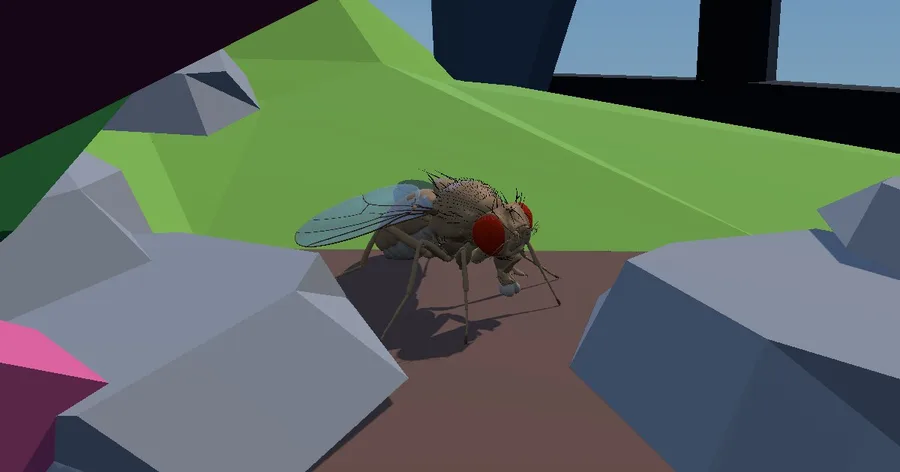

We believe this may be of note as a solution to moral philosophy. As technology advances, we may be able to simulate pleasant lives for increasingly complex forms of life. Technical summary Some movements use supplied patterns driven by neural activity. There is no learning or habituation, so there is no mechanism for The whole brain emulation uses a simplified leaky integrate-and-fire model of 139,255 neurons and 2,700,513 connections. The terrarium provides a scenic environment for The neural view samples real FlyWire positions and connections. Blue marks sensory neurons, pink internal neurons, and yellow motor neurons and descending commands. Flashes follow simulated spikes, briefly extended for visibility; a connection lights when its source fires. Lines join representative positions and do not trace the shapes of neurons.
  Made possible by
  FlyWire · Dorkenwald et al. and Schlegel et al. (2024). Connectome data: CC BY-NC 4.0.
  FlyBody · Vaxenburg et al. (2025), via MuJoCo Menagerie. MuJoCo, three.js and cannon-es.
  LIF implementation informed by Shiu et al. (2024) and desktop-fly by Denis Shiryaev.
  “Flowery Terrarium” by Elionardo Feliciano, “Beach ball” by the_normalgamer, “Gunny Sack” by Oliver Herklotz, and “Fish Tank” by J-Toastie. CC-BY, via Poly Pizza.