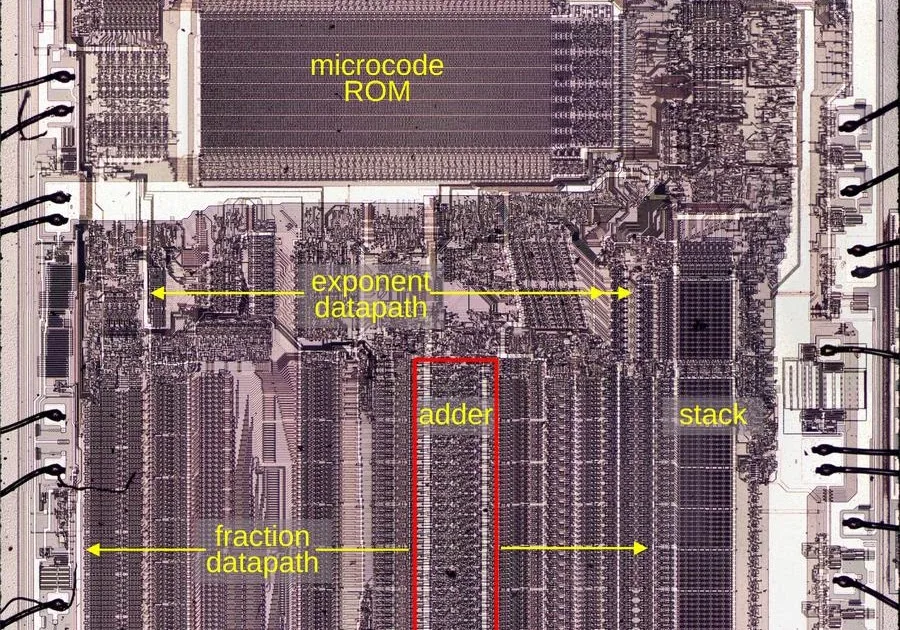
In 1980, Intel released the Intel 8087 floating-point coprocessor, a chip that could make math up to 100 times faster. As well as arithmetic and square roots, the 8087 computed transcendental functions including tangent, exponentiation, and logarithms. But it all depended on a 69-bit adder: "The arithmetic heart of the floating-point execution unit is centered about a nanomachine comprised of the adder and its related registers, shifters and control circuitry," as the patent describes it. In...