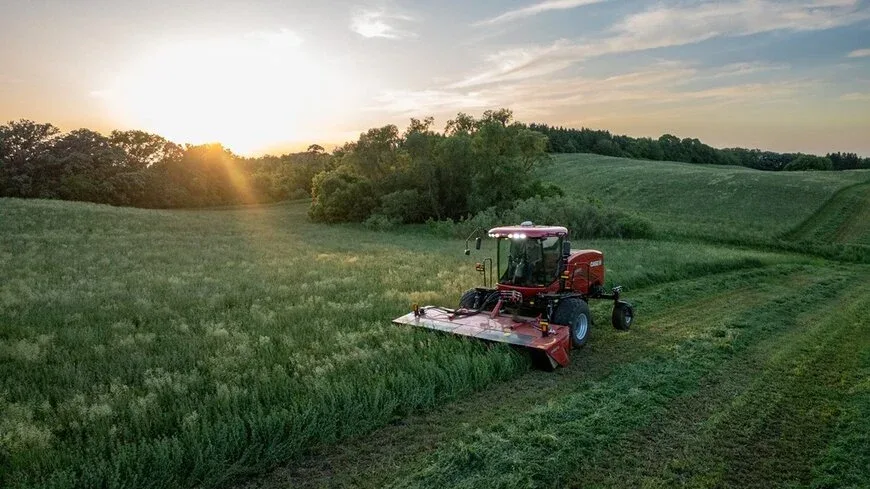
Case IH integrates subscription-free yield mapping into windrowers and expands automated guidance architectures within mid-sized combines to optimize harvesting efficiency. www.casece.com The WD6 series windrower integrates a spatial data collection architecture designated as Relative Yield Mapping. The system tracks in-field crop density variations during harvesting passes, transmitting relative yield distribution data directly to the FieldOps telematics platform without recurring subscription fees. Agronomists and fleet managers utilize these spatial data layers to evaluate field uniformity and optimize nutrient management programs across subsequent growing seasons. Mechanical and hydraulic updates to the windrower platform support operational field speeds up to 20 mph (32 km/h) and transport travel speeds up to 30 mph (48 km/h). To maintain uniform cutting height at elevated speeds, the machine incorporates an active hydraulic flotation system. The electro-hydraulic control loop dynamically adjusts hydraulic circuit pressure to maintain constant ground contact force across variable field contours, reducing header wear and crop contamination. Guidance Integration and Sensor Automation in Combine Harvesters Model Year 2027 Axial-Flow 160 series combine harvesters incorporate factory-integrated positioning and automated machine guidance hardware. Spatial tracking utilizes the Vector Pro GNSS receiver, which interfaces with RowGuide Pro mechanical-optical row sensors and AccuGuide Pro automated steering routines to maintain path tracking without manual steering intervention. The AccuTurn module automates headland turn paths to minimize skipped passes and overlap, while AccuSync synchronizes operational coverage maps and AB guidance lines across multiple networked machines in the same operational boundary. Operator control interfaces feature Pro 1200 dual displays capable of streaming machine telemetry via Remote Display View. The machine automation suite updates the Harvest Command control algorithm, incorporating real-time optical grain camera feeds. The system processes direct visual feedback of grain samples to autonomously adjust rotor speed, cage vane angles, cleaning fan velocity, and sieve openings based on crop flow characteristics and grain quality metrics. Additional Context This section details technical specifications and competitive benchmarking not included in the original product announcement. Windrower Spatial Yield Tracking Direct spatial yield estimation on self-propelled windrowers represents an emerging capability in forage harvesting. John Deere offers precision guidance and telematics across the W200 series platforms via Operations Center, but real-time yield density mapping has historically remained exclusive to self-propelled forage harvesters fitted with near-infrared (NIR) sensors (such as John Deere HarvestLab 3000 or Claas Quantimeter). The WD6 system provides relative density tracking directly within the windrower cab interface. Combine Automation Architectures The Axial-Flow 160 series directly competes with mid-range platforms such as the John Deere S7 600 series and the Claas Lexion 6000 series. John Deere integrates Predictive Ground Speed Automation alongside Active Yield sensors, while Claas utilizes the Cemos Automatic suite (Cemos Auto Clean, Cemos Auto Crop) to autonomously govern threshing and separation parameters based on acoustic and optical throughput sensors. Telematics and Connectivity Costs Industry telematics access models differ across original equipment manufacturers (OEMs). While agricultural manufacturers historically utilized tiered recurring software licensing, Case IH FieldOps and John Deere Operations Center have shifted standard machine telemetry, data synchronization, and remote diagnostic visibility to subscription-free base machine configurations. Edited by Evgeny Churilov, Induportals Media - Adapted by AI. www.cnh.com Powered by Induportals Media Publishing