


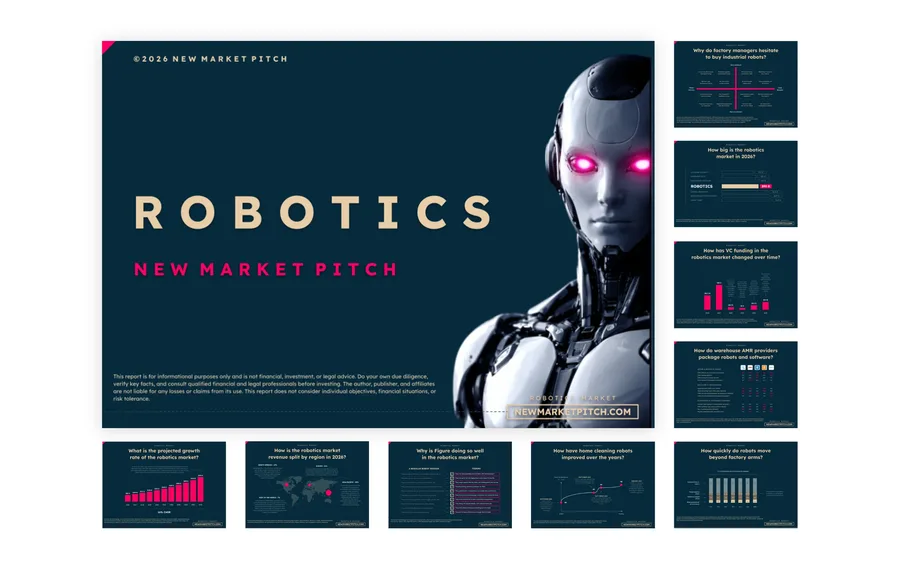
Can specialized robots beat humanoids? Last updated: 31 July 2026 In our robotics market deck , you will find everything you need to understand the market SUMMARY Specialized robots can beat humanoids, and they are likely to keep producing most of the world’s paid robotic output even as humanoids become a major new category. The gap is already huge. Industrial and professional service robots are deployed in the hundreds of thousands each year, while humanoid production is still measured in tens of thousands and only a small share of those machines reaches real operations. Humanoids have nevertheless crossed an important line: Figure and Agility Robotics have published measurable factory and warehouse output, not just choreographed demonstrations. The remaining question is whether those results can spread across customers and tasks without a large support team. The central humanoid promise is reuse. One adaptable machine could beat several low-volume systems when jobs happen at different times, but that advantage disappears when tasks overlap or one repetitive job keeps a dedicated machine busy all day. Human-shaped access is valuable in old factories, mixed warehouses and other places that are expensive to redesign. Yet wheels, mobile manipulators and collaborative arms already capture much of that advantage with less energy and mechanical complexity. Specialized robots keep a basic engineering edge: they remove every joint, sensor and movement the job does not need. That usually produces better cycle times, payload, uptime and maintenance economics. Dexterous hands could become a real humanoid advantage in mixed-object work, but known objects still favor simple grippers. A cheap suction cup with a near-perfect success rate remains a brutal competitor. Better physical-AI models do not automatically favor humanoids. The same planning and perception systems can control arms, wheeled robots, quadrupeds and mobile manipulators, allowing customers to put general intelligence into specialized bodies. Humanoids are most likely to win first in the gaps between existing automation systems: moving totes, feeding parts, handling carts and using human-designed tools where volumes are too low or layouts change too often for fixed equipment. The final economic test is not whether a humanoid can perform many skills in a demo. It is whether fleets can switch between several paid tasks, run full shifts, recover from errors and deliver a clear payback period. Until that happens, specialized robots remain the stronger default for most robotic work. This market map, featured in our robotics market deck , highlights top companies and startups in the robotics market What does it mean for specialized robots to beat humanoids? Specialized robots beat humanoids when they deliver more paid output per dollar across the jobs customers actually automate. That gives us a practical test. We should compare completed work, uptime, safety, integration cost and payback periods. Unit sales alone can mislead us because a research robot, an entertainment robot and a machine running two shifts in a factory do not create the same economic value. There are also two different markets hiding inside the question. Specialized robots compete for stable work that happens thousands of times in a controlled setting. Humanoids are chasing variable work inside places built for people. A welding arm can dominate welding while a humanoid becomes valuable for moving parts between several workstations. Humanoids could therefore become a major robot category without taking the overall lead. To beat specialized robots broadly, they would need to win enough real workloads that customers start choosing one adaptable body over several faster, simpler machines. Why is the specialized robots versus humanoids debate serious now? The specialized robots versus humanoids debate is serious now because humanoids have entered repeat production work and manufacturers are finally building them in hundreds rather than handfuls. Figure reported that Figure 02 handled more than 90,000 parts during 1,250 operating hours at BMW’s Spartanburg plant and contributed to more than 30,000 vehicles. Figure 03 has now returned to the same plant for a new logistics assignment. The company also signed a commercial agreement with Catalyst Brands to deploy humanoids in a distribution center, giving it a customer beyond automotive manufacturing. Agility Robotics has built a second body of evidence. Digit passed 100,000 tote moves in a live GXO operation, and Agility now reports more than 65,000 operating hours across commitments at nine customer facilities. Those figures cover a wider deployment base than one carefully managed pilot. Manufacturing is moving as well. Figure says its BotQ facility delivered more than 350 Figure 03 robots and lifted its production rate from one unit per day to one per hour. China is scaling faster: IDC counted more than 18,000 global humanoid shipments in 2025, with Chinese vendors supplying most of them, while TrendForce expects Chinese output to rise another 94% in 2026. The commercial picture remains much smaller than the production headlines suggest. IDC found that more than 85% of 2025 humanoid shipments went into performances, education, data collection and guided tours. Humanoids have crossed the line into useful products, but factory and warehouse adoption is still early. As this chart shows, and as featured in our robotics market deck , search interest in robot costs has increased significantly How far ahead are specialized robots today? Specialized robots still lead humanoids by tens of times in annual deployment and by far more in cumulative productive work. The International Federation of Robotics counted 542,000 industrial robot installations in 2024, the fourth straight year above 500,000. It also counted almost 200,000 professional service robot sales. Interact Analysis estimates that humanoid production exceeded 20,000 units in 2025, with only about 10% entering real-world operations. The years and definitions do not line up perfectly, so the ratio shows scale rather than precision. Even then, roughly 742,000 industrial and professional service robots represent about 37 times total humanoid production and around 370 times the estimated number of humanoids placed in real operations. The installed base makes the gap more visible. China currently operates around two million industrial robots. Amazon has deployed more than one million robots in its logistics network. Intuitive Surgical placed another 468 da Vinci systems in its latest quarter while da Vinci procedure volume grew about 15% from the previous year. Measure Specialized robots Humanoids Current reading Recent annual deployment or production About 742,000 industrial and professional service robots More than 20,000 produced Specialized robots lead by roughly 37 times Estimated real-world use Most reported units are sold for professional work Around 10% of production The productive deployment gap is much wider Large installed fleets Millions in factories and logistics Early fleets measured in hundreds or low thousands Specialized robots have the stronger operating base Repeated commercial output Manufacturing, picking, surgery, cleaning and transport Mostly material-handling deployments Humanoids remain concentrated in a few tasks If you want more recent data on this point, please see our latest robotics market report . Are humanoid robots already doing real work? Humanoid robots are doing real paid work today, although almost every verified deployment still revolves around one tightly defined job. Figure’s BMW numbers give us a useful benchmark. More than 90,000 component placements over 1,250 hours work out to roughly 72 placements per operating hour, or one every 50 seconds. The robot ran on a production schedule and generated measurable output. That is enough to establish industrial usefulness for one workflow. Digit’s record at GXO points in the same direction. Moving 100,000 totes requires repeated navigation, grasping and delivery under live operating conditions. Agility’s 65,000 accumulated hours across nine facilities adds breadth, although the company has not published a detailed breakdown of autonomous time, interventions, failure rates and completed work at each site. Current deployments therefore prove reliability on selected workflows. They do not yet prove that a humanoid can arrive at a customer site, learn several jobs quickly and move between them without a robotics team nearby. That is the claim that would justify buying a general-purpose humanoid. This chart, featured in our robotics market deck , shows annual venture capital investment in robotics startups Can one humanoid replace several specialized robots? One humanoid cannot currently replace a mixed fleet of specialized robots because customers have yet to show profitable task switching inside the same shift. Imagine a plant that needs continuous machine tending, pallet movement every 20 minutes and inspection twice per shift. One adaptable humanoid sounds cheaper than three machines. In practice, the tasks may overlap. The humanoid can become a bottleneck while a fixed arm, a mobile robot and a camera station work at the same time. Idle capability creates another problem. Customers pay for legs, hands, cameras and software whether they use each feature or not. A machine that can perform ten jobs has weak economics when the customer needs one job for seven hours and the other nine only occasionally. The humanoid case becomes convincing when the same unit completes several paid tasks in one operation, switches with little engineering and stays busy for most of the day. Public demonstrations already show broad skill libraries. Public fleet data has not yet shown that those skills produce better utilization than several simpler machines. If you want more recent data on this point, please see our latest robotics market report . Are humanoids cheaper than redesigning the workplace? Humanoids can save a customer from rebuilding an old site, although specialized mobile robots already solve much of that problem more cheaply. Factories, warehouses and homes were designed around human reach, doors, stairs, tools and shelves. A humanoid can approach a human workstation without forcing the customer to move every control or install a conveyor. That advantage grows in older facilities, short production runs and processes that change every few months. A plant manager still has several cheaper options. Autonomous mobile robots can use existing aisles. Collaborative arms can sit beside people and change tools. Amazon’s Proteus moves safely around workers, while Vulcan adds touch sensing for awkward picking and stowing tasks. Both preserve the parts of the human environment they need without carrying a full bipedal body. Stable volume changes the calculation quickly. Once a warehouse knows that it will move the same bins for years, a purpose-built storage or conveyor system can deliver much higher throughput. Humanoids have their best chance where the layout is difficult to change, the task mix keeps moving and the required speed is moderate. This chart, featured in our robotics market deck , breaks down Figure’s playbook in robotics Do specialized robots still win on speed, uptime and payload? Specialized robots currently win on speed, uptime and payload because every motor, wheel and gripper is chosen for one job. A fixed arm can run from mains power. A mobile robot can carry most of its mass as batteries and payload. A warehouse shuttle avoids the energy cost of balancing a tall body. A humanoid spends power on walking, posture, hands, perception and constant balance corrections before it completes useful work. Two legs earn their cost on stairs, broken ground and workstations designed around standing people. Smooth factory and warehouse floors strongly favor wheels. That is why several companies are developing wheeled humanoids or mobile manipulators alongside full bipeds. Battery swapping can narrow the uptime gap. UBTECH says Walker S2 can replace its own battery in about three minutes and carry 15 kilograms. That solves charging downtime more directly than trying to stretch one battery across an entire shift. It still adds a swapping station, spare batteries and another maintenance system. Figure’s BMW deployment averaged roughly 72 component placements per operating hour. We should avoid comparing that figure directly with a storage robot moving standardized bins, yet it shows the trade-off clearly: humanoids gain flexibility while specialized systems keep the advantage in cycle time and mechanical efficiency. Operating need Better body today Why Fast repetition at one station Fixed arm or dedicated machine Short movements, fixed power and task-specific tooling Heavy transport on a flat floor Wheeled mobile robot More payload and less energy spent on balance Stairs and human-only access Biped or legged robot Legs can cross spaces that wheels cannot use Long continuous operation Fixed systems or rotating mobile fleets Charging and maintenance are easier to schedule Frequent changes across nearby tasks Humanoid or mobile manipulator One body may reuse the same perception and manipulation stack Can humanoid hands beat specialized robot grippers? Humanoid hands will beat specialized grippers only in mixed-object work; for known objects, simpler grippers remain faster and easier to maintain. Human workplaces contain handles, cables, packaging, switches and tools designed for fingers. A dexterous hand lets one robot approach many of them without a custom end effector. Figure’s household demonstrations and the latest high-degree-of-freedom hands from several suppliers show real progress in object handling. Hands also create a dense failure surface. More joints mean more actuators, sensors, cables and contact points. Reliable manipulation needs touch, force control and fast recovery when an object slips. A suction cup picking the same carton all day avoids most of that complexity. Amazon’s Vulcan is a useful reminder that touch does not belong only to humanoids. Amazon added force sensing to a specialized warehouse machine so it could reach difficult inventory locations. That route may spread quickly: keep the body narrow, then add the intelligence and sensing required for a broader version of the same job. Humanoid hands become economically compelling when the object mix changes too often for custom tooling. Until then, a cheap gripper with a near-perfect success rate remains difficult to displace. This chart, featured in our robotics market deck , shows annual funding in robotics startups Does physical AI favor humanoids or specialized robots? Physical AI currently helps every robot shape, so better models do not automatically hand the market to humanoids. Google DeepMind describes Gemini Robotics as a model family for robots of different shapes and sizes. Its newer embodied-reasoning model can plan tasks, interpret instruments and decide when to retry. Those abilities can guide a humanoid, a pair of arms, a quadruped or a mobile manipulator. NVIDIA is investing heavily in humanoid foundation models through GR00T, simulation tools and synthetic data. The same company also supports industrial arms, autonomous machines and mobile robots through its wider physical AI stack. Amazon is following a similar pattern internally by pairing specialized robots with fleet-level models such as DeepFleet. General intelligence can sit above specialized hardware. A customer may use one planning system across several robot bodies and still choose wheels for transport, arms for assembly and legs for stairs. Humanoids benefit greatly from better models because software has been their largest constraint. Specialized robots benefit as well, and they begin from stronger mechanics for their target jobs. If you want more recent data on this point, please see our latest robotics market report . Can one humanoid robot really learn many jobs? A humanoid robot can now learn and demonstrate many jobs, but no supplier has published fleet data showing routine, profitable switching between them. Figure’s Helix demonstrations cover dishwashing, laundry and room tidying with one body and one broader control system. Google DeepMind has reported that Gemini Robotics can adapt to short tasks with around 100 demonstrations and transfer capabilities across different embodiments. These results reduce the amount of task-specific programming required. A customer needs much more than a good demo. A robot needs to learn the new job, reach an acceptable speed, survive edge cases and recover from mistakes. The customer then needs enough demand across those jobs to keep the machine occupied. We can separate the progress into three levels. Humanoids have clearly reached multi-task demonstrations. They are beginning to show faster learning for new tasks. Multi-task fleet economics remains unproven, and that final level will decide whether the general-purpose label has commercial meaning. This chart, featured in our robotics market deck , compares the main business model options for warehouse AMR robotics providers Who has the stronger robot data flywheel today? Specialized robots have the stronger commercial data flywheel today, while humanoids have access to the broader but messier pool of human video. Amazon’s fleet of more than one million robots produces repeated data on routing, congestion, picking and failures. Intuitive Surgical reached more than 20 million patients treated with da Vinci systems by the end of 2025, including 3.1 million procedures during that year. Every operation is linked to a defined machine, workflow and outcome. Humanoid developers can learn from an enormous range of human activity. Figure’s data strategy includes internet video and access to residential environments through its Brookfield partnership. NVIDIA mixes human video, real robot trajectories and synthetic data for GR00T. This gives humanoid models wider coverage than any single industrial fleet. The weakness is precision. Video often misses forces, tactile information, joint states and failed attempts. Commercial robot logs are narrower, but they record exactly what the machine did. The strongest training systems will probably combine both: broad human behavior for concepts, then real robot data for control and recovery. That combination also favors specialized robots. Once a model learns a general manipulation concept, engineers can transfer it into the cheapest body that performs the target job reliably. Will safety standards slow humanoid robots? Safety will slow humanoid robot adoption for years because a mobile, task-switching biped creates more failure modes than a fixed arm or wheeled cart. Industrial robotics already has mature design and integration rules. The latest ISO 10218 standards cover industrial robot design, protective measures and system integration. Companies know how to use guarding, scanners, emergency stops and collaborative speed limits. Humanoids can walk into new areas, pick up different objects and fall when balance or power fails. A safe deployment must consider the robot’s full body, whatever it is carrying and every new task loaded into the system. The International Federation of Robotics has highlighted that standards for legged robots without intrinsic stability are still developing. The first deployments therefore favor controlled routes, predictable objects and some separation from workers. Wider human contact will require better fall control, task-level safety checks and certification methods that remain valid as the robot learns new behavior. The hardest safety problem appears in the place humanoids are supposed to shine: crowded spaces built for people. Progress will continue, but safety testing will keep commercial adoption behind demonstration capability. This ch
Can specialized robots beat humanoids?
NewMarketPitch Team