


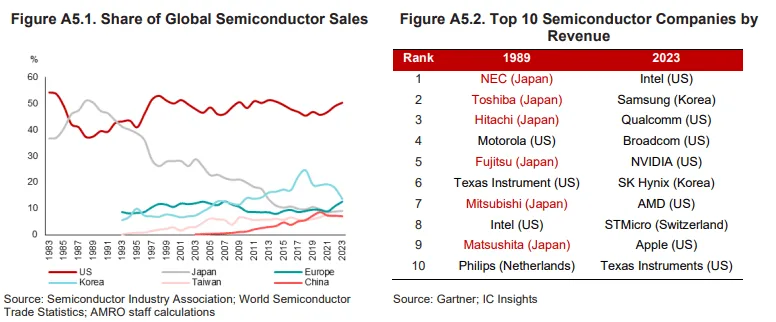
Published on June 1, 2026 1:11 PM GMT This post is part of a comparative project on East Asia compute governance, initiated as part of the inaugural round of AI Gov Sprints . Many thanks to David Sanchez Garcia , who led this project and whose feedback greatly benefited this piece, and to all who gave feedback on earlier drafts. This post was lightly edited for flow using Claude; all ideas and arguments are my own. All mistakes, too, are my own. A lot of compute governance discourse focuses on the US-China dynamic, alongside Taiwan sometimes emerging too. Japan, meanwhile, tends to show up merely as a supporting character. I think this framing undersells its actual position. Japan sits at several critical chokepoints in the global compute supply chain , is currently making large public bets on semiconductor revival, and is navigating a difficult tension between US-aligned export controls and unavoidable commercial dependence on China. This could make it a revealing case for “middle powers” navigating compute and its governance, which is reason enough to look. Hence, this post is an attempt to map Japan's position in global compute supply chains (alongside its strengths, bets, and vulnerabilities) as a starting point. Epistemic status I am a complete non-expert writing this out of curiosity. I have no prior background in semiconductors, supply chain policy, or Japanese industrial history. Whilst I’m currently more certain about the broad narrative arc for Japan and its relevance, I’m less confident about some precise figures (which occasionally varied across sources). I’ve tried to be accurate by gleaning and linking adequate sources throughout, but I always welcome corrections. Some background: Japan’s decline, and the road to (partial) recovery Once home to six of the world's ten largest semiconductor firms, Japan has watched its global market share collapse in three decades. In the 1980s, Japan was the undisputed semiconductor superpower. Six of the top ten semiconductor companies in the world in 1989 were Japanese, and Japan commanded over 50% of global chip sales. By 2023, that share had collapsed to below 10%. Image source The proximate causes for this decline were mostly external. The Plaza Accord's yen appreciation devastated the price competitiveness of Japanese exports, and a series of US-imposed trade barriers compounded the damage, especially the 1986 Semiconductor Agreement , which restricted Japan's access to American markets. In 1987, the US imposed 100% tariffs on Japanese memory chips , delivering a blow from which several firms never recovered. Yet some structural causes also were internal. Japanese firms clung too long to the “Integrated Device Manufacturer” model, maintaining fully in-house operations from design to fabrication at a moment when American and Taiwanese firms were pivoting toward the specialised fabless-and-foundry model that now dominates the global industry. The consequences, ultimately, were pretty much catastrophic. Once-legendary semiconductor divisions were forced into bankruptcy or consolidation, exemplified by the merger of the DRAM departments of Hitachi and NEC into Elpida Memory, which itself later failed. Japan's story thus stands as a cautionary tale about the cost of institutional rigidity for middle powers making the transition to a digitalised society. It is precisely this history that frames today's revitalisation. Where Japan still dominates the supply chain Today, Japan still controls several critical segments of the compute supply chain. In materials, Japan's position is extraordinary, as mapped in this CSIS piece . The Japanese firms Shin-Etsu and Sumco are the world's largest silicon wafer manufacturers, holding 29.4% and 21.9% global market shares respectively . Japan also holds the world's second-largest semiconductor manufacturing equipment (SME) industry, capturing 29% of global sales. This makes Japan second to only the United States for SME production, and places the nation far above other East Asian nations: China, Taiwan, and South Korea make up merely 2%, 0.4%, and 4.8% of the global market share respectively. The concentration of Japanese dominance in specific niches is even more pronounced: Japan controls a large proportion of the market for coaters and developers (the tools that apply and develop photoresist layers on wafers). Tokyo Electron has a near dominant share for EUV developers , which is equipment used in the most advanced chipmaking processes in existence. Japan's public investment in semiconductors is unusually large The scale of Japan's financial commitment to compute infrastructure is, by any measure, extraordinary. Japanese fiscal support amounts to approximately 0.71% of GDP (roughly 26bn); over ¥50 trillion (23 billion factory. Government subsidies cover two-fifths of capital costs . Together, these facilities are expected to achieve a total production capacity of more than 100,000 12-inch wafers per month, using process technologies ranging from 40nm to 6/7nm. The economic ripple effects are projected to be substantial : a US4 billion in fresh funding has been approved by METI (Ministry of Economy, Trade and Industry), bringing total cumulative government R&D support to ¥2.35 trillion. The total project cost estimated to require around ¥5 trillion (2.1 billion for AI overall , of which only roughly 28 billion in Japan, reshaping the national power grid's requirements in ways utilities are ill-equipped to meet. While Tokyo and Osaka remain the primary data centre hubs, severe power grid constraints in inner Tokyo (where connection waits can last five to ten years) are forcing a shift toward secondary markets. Grid projects take seven to ten years to complete, failing to meet the five-year deployment window demanded by investors. These delays have already pushed major data centre and foundry projects back to 2029 . There is a fundamental disconnect between hyperscaler needs and utility timelines that I reckon no subsidy can easily resolve. Besides energy, another question remains: who will build the fabs? Japan's demographic challenge is well-documented; its specific consequences for the semiconductor industry are acute. Japan faces a domestic talent gap of approximately 40,000 semiconductor engineers, and only ~35% of Japanese students graduate with STEM degrees , which is somewhat behind international competitors. Policy recommendations include immigration reform to create dedicated visas for international semiconductor workers, but Japan's historically restrictive immigration framework makes this a slow and contested path. Moreover, capital expenditure amongst Japanese front-end manufacturers is well below that of international firms, a gap that ought to be reversed if Japan is to re-establish manufacturing competitiveness. Even within its revitalisation strategy, Japan faces a stark comparative disadvantage in advanced logic manufacturing. Japanese industry lags global leaders by an estimated 10 years . Another under-discussed vulnerability is Japan's back-end supply chain gap. Even if front-end fabrication (the making of wafers) succeeds in Japan, those wafers must currently be sent back to Taiwan for assembly and testing. This means Japan's supply chain resilience remains incomplete even in success scenarios, dependent on the very geography it is trying to diversify away from. In the power semiconductor segment (which is
Who controls compute supply chains? Looking into Japan as an underexplored case
Mahi
Tags