


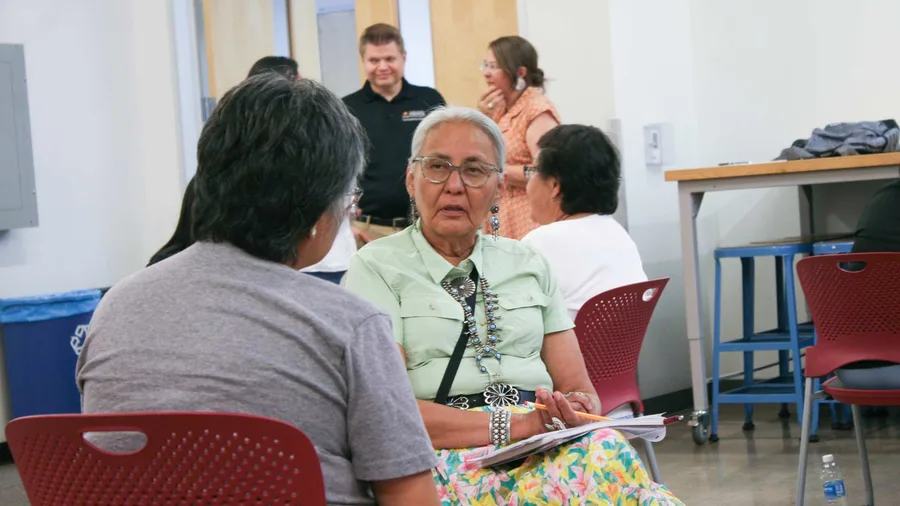
In the middle of the Arizona summer, a small walking robot struggles to climb an icy hill as a group of teachers from across the Navajo Nation gather around a table, brainstorming tiny snowshoe designs that might give it enough traction to reach the top. The hill is nothing more than a cookie sheet covered in ice, and the tiny robot serves as a stand-in for a person navigating icy terrain. The engineering challenge asked the teachers to step into the role of students, designing tiny "snowshoes" to improve the robot's traction while modeling the winter conditions some communities on the Navajo Nation experience. For the teachers, the activity is an opportunity to reimagine how engineering is taught, turning familiar community challenges into classroom lessons that help students see themselves as problem-solvers. Moments like that defined this summer's Diné Engineering Education Pathways, or DEEP, Fellowship. Diné is the Navajo people's own name for themselves, reflecting the project's emphasis on engineering education grounded in community, culture and lived experience. Co-hosted by the Ira A. Fulton Schools of Engineering at Arizona State University and the Mary Lou Fulton College for Teaching and Learning Innovation at ASU, the DEEP Fellowship brought together K-12 teachers from across the Navajo Nation to co-develop engineering curriculum. The goal wasn't simply to introduce teachers to engineering curriculum. It was to help them shape it. Led by Shawn Jordan , interim director of the School of Integrated Engineering and associate professor in The Polytechnic School , both part of the Fulton Schools, and Michelle Jordan , an associate professor in the Mary Lou Fulton College for Teaching and Learning Innovation, the project positions teachers as co-designers who adapt engineering lessons to reflect the challenges, cultures and experiences their students already know, rather than simply implementing curriculum developed at the university. "I'm an expert in engineering design. I'm not an expert in teaching in Navajo classrooms," Shawn Jordan says. “And so, by looking at it as a two-way collaboration rather than a one-way, I think it results in a better product and also a more respectful, collaborative relationship.” Shawn Jordan (left), interim director of the School of Integrated Engineering and associate professor in The Polytechnic School, listens as K–12 teachers from across the Navajo Nation share ideas during the DEEP Fellowship. The fellowship positions teachers as co-designers of engineering curriculum rooted in their students' communities. Photographer: Erika Gronek/ASU The approach aims to create engineering pathways that continue growing long after the grant ends by equipping teachers to develop, share and lead engineering learning within their own schools and communities. Gerri Moses, a third-grade teacher from Farmington, New Mexico, says the fellowship reinforced that engineering doesn't have to feel separate from everyday life. Lessons about friction became opportunities to explore vehicles stuck in sandy roads, while discussions about solar energy connected to challenges many students already recognize in their own communities. "I didn't know these things that are part of everyday life on the Navajo Reservation are a part of engineering," Moses says. "It comes back to science." That shift in perspective is central to the DEEP Fellowship approach. The project recognizes the teachers as partners whose understanding of their students and communities helps shape engineering education itself. Local knowledge is one of the fellowship's greatest strengths. Ieshya Anderson , an assistant research scientist in The Polytechnic School, said teachers understand classroom logistics, state standards and the practical realities of instruction, helping ensure the curriculum is both meaningful for students and realistic for educators to use. "Teachers have firsthand knowledge of their students' cultural backgrounds and the realities of implementing curriculum in their classrooms," Anderson says. "Their established relationships with their students and community provide valuable insights into local contexts and community priorities." The impact extends beyond individual classrooms. Co-principal investigator Michelle Jordan says the fellowship gives teachers time to learn from one another while adapting lessons for their own students. "The feedback and reflection discussions were rich and rewarding, with respectful pauses signifying deep listening and many expressions of appreciation for one another's perspectives," Michelle Jordan says. She said those conversations help teachers carry new knowledge back to their schools and communities. "Teachers are not just individuals; they are also powerful agents in larger systems," Michelle Jordan says. Participants in the DEEP Fellowship created illuminated versions of the Great Seal of the Navajo Nation using simple electrical circuits. The hands-on engineering activity encouraged teachers to explore ways of connecting electrical engineering circuits with culturally relevant classroom experiences. Photographer: Erik Wirtanen/ASU For Arlene Tsosie, an elementary school teacher in the Piñon Unified School District with more than two decades of experience, the fellowship offered new ways to connect science, culture and hands-on learning. "I am looking at finding more ideas and helping my students learn more about science that relates to culture and also a lot of hands-on activities," Tsosie says. "The kids love doing hands-on learning." The fellowship builds on years of engineering education partnerships Shawn Jordan developed with schools across the Navajo Nation. Earlier work produced engineering curriculum for middle school classrooms, while the DEEP Fellowship expands that model by positioning elementary and high school teachers as co-designers and leaders who can continue adapting and sharing the curriculum long after the grant ends. The project also builds on Michelle Jordan's experience designing teacher professional development programs and research partnerships across Arizona, including with educators from the Navajo Nation. As co-principal investigator, she has focused on creating collaborative partnerships where teachers help shape both the curriculum and the research itself. Her work focuses on amplifying teachers' voices, supporting them as leaders beyond their own classrooms and encouraging them to contribute to educational research. "A particularly important feature of my work is collaborating with teachers, not just designing for teachers," Michelle Jordan says. That collaborative philosophy has shaped more than the curriculum. It has also shaped the people helping build it. Anderson first joined Shawn Jordan's research group as an undergraduate student. At the time, she said she struggled to connect engineering to her Diné culture, which became especially apparent when she found it difficult to explain engineering in a culturally meaningful way to her daughter. "Being part of the STEAM Labs™ Center for Research and Engagement research group, I began to recognize how my family, community and culture influenced my approach to problem-solving and design," Anderson says. "Even without formal training, I saw how my grandparents, parents and other family members were, in fact, engineers solving problems with limited resources and devising creative solutions." For students, those curriculum changes mean engineering begins with problems they already recognize. One lesson asks students to investigate friction by designing ways to free a vehicle stuck in deep sand. Rather than searching for a single correct answer, students test different materials, compare possible solutions and connect concepts in physics and materials science to situations they may have already encountered with family members. “That lesson can get students to be thinking and knowing that they can go back to their elders and ask, ‘Hey, what about this?’ A lot of the elders maybe didn't go to college, but they have so many ways they use the land and the resources around them to create different things,” Moses says. The recognition that engineering already exists in students' homes and communities is exactly what the fellowship hopes to cultivate. "Students are already doing engineering," Shawn Jordan says. "They just don't think of it as engineering." K–12 teachers from across the Navajo Nation gather with ASU faculty and researchers during the DEEP Fellowship. The fellowship brought educators together to co-design engineering curriculum that connects learning with challenges and experiences familiar to their students. Photographer: Erik Wirtanen/ASU Helping students recognize the engineering already present in their own lives is at the heart of the team's vision for the fellowship. While the fellowship begins with individual classrooms, its long-term goal reaches far beyond them. By helping teachers develop curriculum together and share what they learn, the project is designed to strengthen engineering education across schools and communities. Shawn Jordan hopes the fellowship, which is supported through a U.S. National Science Foundation grant, will eventually create a community of teacher leaders who continue developing, adapting and sharing culturally sustaining engineering curriculum across the Navajo Nation, with ASU serving as a long-term partner rather than the primary driver of the work. He says that building capacity means more than expanding curriculum. It means helping teachers develop the knowledge, confidence and opportunities to share their expertise with colleagues across the Navajo Nation. "My vision is for there to be a cohort of teacher leaders who are regularly doing professional development workshops for other teachers across the Navajo Nation on culturally sustaining curricula," Shawn Jordan says. For teachers, creating curriculum in a way that embraces their culture can be emotional. Tsosie, whose first language is Navajo, said that when she attended boarding school she was punished for talking Navajo, but now she teaches her students in Navajo. Her work as a teacher extends beyond engineering alone. It is also about helping students see that science, culture and language can coexist in the classroom. “I am most proud that I'm teaching our children. I call my students my children; in Navajo culture, they are like your children,” Tsosie says. “When you start teaching, you call them ‘sha'áłchíní’, or my children, and they addressed me as ‘my grandma’ to me, when I'm there, they'll say, ‘shimásání’ to me in Navajo, so I think that's the thing that I'm so proud of, that I'm teaching the children our language and also teaching them about science at the same time.” Related people Featured topics The post Navajo Nation teachers help reshape engineering education appeared first on Engineering News .
Navajo Nation teachers help reshape engineering education
Erik Wirtanen