

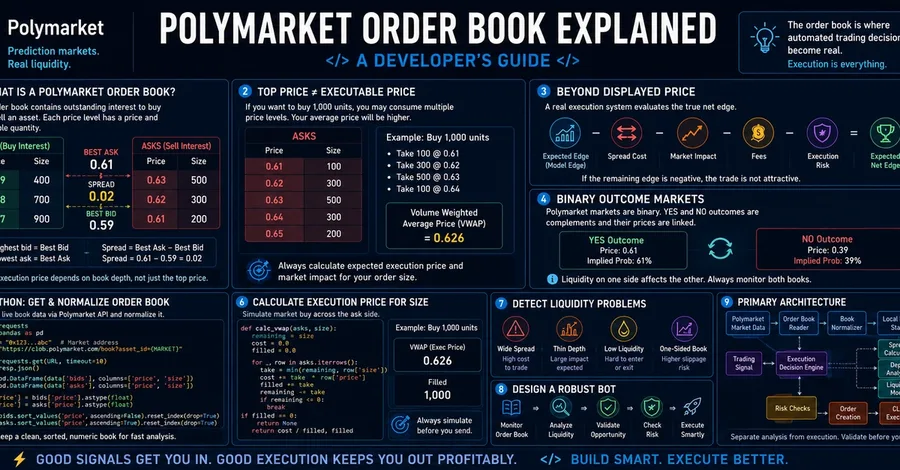

Polymarket Order Book Explained The Polymarket order book is where automated trading decisions become real. A trading signal can tell your bot that a market is mispriced. A probability model can estimate fair value. A momentum engine can predict a short-term move. But none of that answers the most important execution question: Can you actually enter or exit the position at the price your model expects? That answer is inside the order book. For developers building Polymarket trading bots, the book is not just a UI component showing prices. It is a live representation of available liquidity. It tells your system what can potentially be bought or sold, where liquidity is concentrated, how much size is available, and how your own order may interact with the market. Polymarket provides developer resources and APIs for market discovery and trading infrastructure, while its CLOB architecture is the core environment relevant to order-book-driven trading systems. ([Polymarket Help Center][1]) This guide explains the mechanics that matter for implementation: bids, asks, spread, depth, complementary outcomes, execution-aware signals, local book state, and Python-based analysis. What You'll Learn By the end of this article, you should understand: How a Polymarket order book is structured The difference between best bid, best ask, spread, and depth Why displayed price is not always executable price How binary outcome markets affect order-book interpretation How to retrieve and normalize order-book data in Python How to calculate executable prices for different order sizes How to detect liquidity problems before placing an order How to design a basic order-book monitoring service Common failure modes in automated execution How to improve the system for production trading What Is a Polymarket Order Book? An order book contains outstanding interest to buy and sell an asset. Conceptually, each price level contains two pieces of information: Price Available quantity A simplified book might look like this: ASKS
Price Size 0.63 500 0.62 300 0.61 200
Price Size 0.59 400 0.58 700 0.57 900
BIDS The highest bid is the best bid . The lowest ask is the best ask . The difference between them is the bid-ask spread . spread = best_ask - best_bid For example: Best bid = 0.59 Best ask = 0.61
Spread = 0.02 This looks simple, but execution systems need more information than the top price. Suppose your strategy wants to buy 1,000 units. The best ask may only contain 100 units. The rest of the order may need to consume liquidity at progressively worse prices. Your actual execution price is therefore determined by book depth , not only by the best ask. Why the Polymarket Order Book Matters to Trading Bots A naive trading system might use: market_price < model_fair_value as a buy signal. For example: Model fair value: 0.64 Displayed market price: 0.60
Expected edge: 0.04 That is incomplete. A real execution system should ask: Which price is being compared? Is the price a bid, ask, midpoint, or last trade? How much liquidity exists at the desired execution price? How much price impact occurs for the required size? Can the strategy still exit efficiently? A better model is: expected edge
-
spread cost
-
expected market impact
-
fees
-
execution risk = expected net edge If the remaining edge is negative, the trade should not be treated as attractive simply because the displayed market price appears cheap. Primary Architecture A production system should separate market analysis from execution. flowchart LR A[Polymarket Market Data] --> B[Order Book Reader] B --> C[Book Normalizer] C --> D[Local Book State]
D --> E[Spread Calculator] D --> F[Depth Analyzer] D --> G[Liquidity Model]
H[Trading Signal] --> I[Execution Decision Engine]
E --> I F --> I G --> I
I --> J[Risk Checks] J --> K[Order Creation] K --> L[CLOB Execution] The important idea is that your signal engine should not directly send orders. Instead: Signal ↓ Expected opportunity ↓ Order-book validation ↓ Risk validation ↓ Execution decision This prevents a theoretically good signal from becoming a bad trade because the available liquidity is insufficient. Understanding Bids and Asks Bids A bid represents interest to buy. For example: Buy 500 YES shares at 0.58 The trader does not want to pay more than 0.58 . Higher bids are generally closer to immediate execution. Asks An ask represents interest to sell. For example: Sell 300 YES shares at 0.62 The seller will not accept less than 0.62 . Lower asks are generally closer to immediate execution. The Bid-Ask Spread The spread is: spread = best_ask - best_bid A Python helper: from decimal import Decimal def calculate_spread ( best_bid : Decimal , best_ask : Decimal ) -> Decimal : if best_bid <= 0 : raise ValueError ( " Best bid must be positive " ) if best_ask < best_bid : raise ValueError ( " Ask cannot be lower than bid in a valid book snapshot " ) return best_ask - best_bid You can also calculate the spread relative to the midpoint: def spread_percentage ( best_bid : Decimal , best_ask : Decimal ) -> Decimal : midpoint = ( best_bid + best_ask ) / Decimal ( " 2 " ) if midpoint == 0 : return Decimal ( " 0 " ) return ( best_ask - best_bid ) / midpoint A wide spread may indicate: Limited liquidity Increased uncertainty Low market activity Market-making risk Greater execution cost A narrow spread does not automatically mean deep liquidity. There may be very little quantity available at the top of the book. Order Book Depth Is More Important Than Many Bots Realize Consider this ask side: Price Size
0.60 100 0.61 100 0.62 300 0.64 500 If you want to buy: 50 shares your expected price may be close to: 0.60 But buying: 1,000 shares is completely different. You may consume multiple levels. A simple implementation: from decimal import Decimal def calculate_vwap_for_buy ( asks , quantity ): """ asks: iterable of { " price " : Decimal, " size " : Decimal} quantity: requested quantity """ remaining = Decimal ( str ( quantity )) total_cost = Decimal ( " 0 " ) for level in sorted ( asks , key = lambda x : x [ " price " ]): if remaining <= 0 : break available = level [ " size " ] executed = min ( remaining , available ) total_cost += executed * level [ " price " ] remaining -= executed if remaining > 0 : raise ValueError ( " Insufficient displayed liquidity " ) return total_cost / Decimal ( str ( quantity )) Example: asks = [ { " price " : Decimal ( " 0.60 " ), " size " : Decimal ( " 100 " )}, { " price " : Decimal ( " 0.61 " ), " size " : Decimal ( " 100 " )}, { " price " : Decimal ( " 0.62 " ), " size " : Decimal ( " 300 " )}, ] A small order and a large order may therefore have very different expected execution prices. This is one of the most important differences between: signal price and: tradable price Step-by-Step: Build a Python Order Book Analyzer Step 1: Use Official Polymarket Developer Resources Start from the official documentation rather than copying endpoint URLs from outdated tutorials. Polymarket's developer documentation is the primary reference for current API behavior, and the Builders resources point developers toward current platform tooling. ([Polymarket Help Center][1]) A practical Python project structure: polymarket-bot/ │ ├── main.py ├── orderbook.py ├── execution.py ├── risk.py ├── config.py │ └── tests/ Install only the dependencies your implementation requires. For HTTP-based examples: pip install requests python-dotenv For production systems, you may also want: pip install httpx tenacity Step 2: Normalize Book Data Never allow raw API responses to spread through your entire trading system. Normalize data immediately. from dataclasses import dataclass from decimal import Decimal @dataclass ( frozen = True ) class OrderLevel : price : Decimal size : Decimal Then parse values safely: def parse_level ( level : dict ) -> OrderLevel : price = Decimal ( str ( level [ " price " ])) size = Decimal ( str ( level [ " size " ])) if price < 0 : raise ValueError ( " Negative price " ) if size <= 0 : raise ValueError ( " Non-positive size " ) return OrderLevel ( price = price , size = size ) Using Decimal is preferable to binary floating-point arithmetic for financial price calculations. Avoid: 0.1 + 0.2 when exact decimal comparisons matter. Step 3: Calculate Top-of-Book Metrics def top_of_book ( bids , asks ): if not bids or not asks : return None best_bid = max ( bids , key = lambda x : x . price ) best_ask = min ( asks , key = lambda x : x . price ) midpoint = ( best_bid . price + best_ask . price ) / Decimal ( " 2 " ) spread = best_ask . price - best_bid . price return { " best_bid " : best_bid , " best_ask " : best_ask , " midpoint " : midpoint , " spread " : spread , } The midpoint is useful for analysis: midpoint = (best_bid + best_ask) / 2 But do not assume it is executable. A model that compares fair value against midpoint should separately account for the cost of crossing the spread. A Practical Liquidity Check Before trading, estimate the price required for the requested quantity. def executable_buy_price ( asks , quantity ): remaining = Decimal ( str ( quantity )) cost = Decimal ( " 0 " ) for ask in sorted ( asks , key = lambda x : x . price ): fill = min ( remaining , ask . size ) cost += fill * ask . price remaining -= fill if remaining <= 0 : break if remaining > 0 : return None return cost / Decimal ( str ( quantity )) Now the strategy can compare: model fair value against: estimated execution VWAP For example: fair_value = Decimal ( " 0.64 " ) estimated_execution = Decimal ( " 0.615 " ) edge = fair_value - estimated_execution print ( edge ) This is much more useful than comparing fair value to an arbitrary displayed price. Failure Modes and Common Mistakes 1. Trading the Midpoint The midpoint is an analytical value. It is not necessarily an executable price. A bot that calculates: fair value - midpoint without considering the spread may overestimate its edge. 2. Assuming the Best Ask Contains Enough Liquidity The best ask may contain only a small amount of size. Always estimate execution across multiple levels when trading larger quantities. 3. Using a Stale Snapshot An order book can change after you retrieve it. A production system should treat snapshots as time-sensitive. Before execution, consider: Data age Current best price Book changes Remaining expected edge A useful pattern is: Receive signal ↓ Fetch or update market state ↓ Estimate execution ↓ Check risk ↓ Submit order 4. Ignoring Partial Execution A large order may not behave like a simple all-or-nothing transaction. Your system should track: Requested quantity Filled quantity Remaining quantity Average fill price Order status Never assume: submitted_order == completed_position These are different states. 5. Mixing Market Discovery With Execution Logic Do not let a market-discovery process directly control trading. Separate: Market discovery from: Token selection from: Order-book monitoring from: Execution This makes failures easier to isolate. Performance Considerations Order-book systems are usually more sensitive to architecture than raw Python speed. The expensive operations are often: Network I/O Data parsing Repeated REST polling Excessive logging Duplicate calculations Avoid rebuilding the entire analytical pipeline for every small update. A better design: Incoming update ↓ Update local state ↓ Recalculate only affected metrics ↓ Notify strategy For a larger system, maintain: Local order book Best bid Best ask Spread Depth profile Estimated execution prices as continuously updated state. The exact streaming interfaces and message formats should be taken from the current official Polymarket documentation rather than hard-coded from old tutorials, because API implementations can change. ([Polymarket Help Center][1]) Security Considerations A market-data service usually requires less sensitive information than an order-execution service. Keep them separate. For trading credentials: POLYMARKET_API_KEY POLYMARKET_API_SECRET POLYMARKET_API_PASSPHRASE if applicable to the current official authentication flow, should be stored in environment variables or a secret manager. Example: import os api_key = os . getenv ( " POLYMARKET_API_KEY " ) if not api_key : raise RuntimeError ( " Missing API configuration " ) Never: Commit credentials to Git Paste secrets into logs Hard-code private keys Store seed phrases in source files Send credentials to third-party monitoring systems For production infrastructure, isolate: Market data process Signal process Risk engine Execution service The component with signing or trading authority should have the smallest possible attack surface. Testing Strategy Test your order-book calculations without depending entirely on live markets. Create deterministic fixtures. def test_best_bid (): bids = [ OrderLevel ( Decimal ( " 0.50 " ), Decimal ( " 100 " )), OrderLevel ( Decimal ( " 0.55 " ), Decimal ( " 200 " )), OrderLevel ( Decimal ( " 0.53 " ), Decimal ( " 300 " )), ] best = max ( bids , key = lambda x : x . price ) assert best . price == Decimal ( " 0.55 " ) Test at least: Empty books Crossed or invalid books Insufficient liquidity Multiple price levels Very small quantities Large quantities Decimal precision Partial fills Duplicate updates Stale data For execution logic, paper trading is safer than immediately connecting a new strategy to capital. Monitoring and Observability A production bot should answer: Is the market data fresh? Is the local book valid? What is the current spread? How much depth exists near the target price? What execution price does the system expect? What did the order actually fill at? Useful metrics include: orderbook_update_age_seconds bid_ask_spread estimated_buy_vwap estimated_sell_vwap available_depth order_rejection_count partial_fill_count execution_price_difference The last metric is particularly useful: actual execution price
expected execution price If this difference becomes consistently large, your execution assumptions may be wrong. Practical Example: Turning a Signal Into an Execution Decision Suppose your model estimates: Fair probability: 0.68 The current best ask is: 0.64 At first glance: 0.68 - 0.64 = 0.04 edge Now estimate the actual execution price for your desired position: Expected VWAP: 0.665 The trade now has: 0.68 - 0.665 = 0.015 That remaining edge still needs to account for: Fees Execution uncertainty Market movement Model error Exit liquidity The correct question is therefore not: Is the best ask below my fair value? It is: Can I execute enough quantity at a price that leaves sufficient edge after realistic costs and risks? That is the order-book question every automated trading system eventually has to solve. Advanced Improvements Once the basic system works, consider adding: Order Book Imbalance A simple imbalance measure: bid_volume - ask_volume or normalized: (bid_volume - ask_volume) / (bid_volume + ask_volume) This can help describe the distribution of displayed liquidity. However, displayed liquidity is not a guarantee of future price direction. Depth Buckets Instead of looking only at the best level: ±1 tick ±2 ticks ±5 ticks Calculate cumulative available liquidity. This helps estimate market impact for different position sizes. Execution Simulation Before submitting an order: Load the current book Simulate fills Calculate expected VWAP Compare with model value Apply risk limits Decide whether to trade This creates a more realistic bridge between research and live execution. Frequently Asked Questions What is the Polymarket order book? It is the market structure used to represent outstanding buying and selling interest for tradable outcomes, allowing developers to analyze prices, spreads, and available liquidity. What is the difference between best bid and best ask? The best bid is the highest currently displayed buying price. The best ask is the lowest currently displayed selling price. Why is the midpoint not always tradable? The midpoint is calculated from the best bid and best ask. Unless there is an order available at that exact price, it is an analytical estimate rather than a guaranteed execution price. How should a Polymarket trading bot use order-book depth? The bot should estimate how much liquidity is available across price levels and calculate an expected execution price for the intended order size. Should I use floats for Polymarket price calculations? For financial calculations where exact decimal behavior matters, Python's Decimal is generally safer than binary floating-point values. Conclusion The Polymarket order book is where prediction-market analysis meets execution reality. A strategy can have a strong probability model and still fail operationally if it ignores: Spread Available depth Partial execution Market impact Stale data Exit liquidity For a basic bot, start by calculating: Best bid Best ask Spread Midpoint Available depth Estimated VWAP Then make your strategy trade on expected executable prices , not simply on the most attractive number displayed in a market interface. That architectural change is small, but it separates a theoretical signal generator from a real execution-aware trading system. Trading risk disclaimer: This article is for educational and technical purposes only. Prediction-market and algorithmic trading involve substantial risk, including model error, execution risk, liquidity risk, adverse selection, and potential loss of capital. No strategy is guaranteed to be profitable. Useful Resources Polymarket Official Website — Explore live markets and the platform. Polymarket Developer Documentation — Primary technical reference for current API and CLOB behavior. Polymarket API Help Center Guide — Official overview pointing developers toward available APIs and documentation. Polymarket Builders — Useful for developers building applications and tools on the ecosystem. Polymarket CLOB API YouTube Tutorial — A third-party walkthrough of fetching markets, liquidity, orders, and cancellation; useful for implementation context but not authoritative over official documentation. Official Polymarket X: @Polymarket on X Related Articles 1. How Polymarket CLOB Works Suggested anchor text: How the Polymarket CLOB works Why link: Readers need the underlying exchange architecture before optimizing order-book execution. 2. Building a Polymarket Trading Bot With Python Suggested anchor text: build a Polymarket trading bot with Python Why link: Natural next step after understanding market data and order books. 3. Building a Basic Limit Order Integration Suggested anchor text: place limit orders on Polymarket Why link: Connects book analysis with actual order submission. 4. Polymarket TWAP Trading Bot Suggested anchor text: Polymarket TWAP trading bot Why link: Shows how order-book execution interacts with time-based trading strategies. 5. Polymarket CLOB API Explained Suggested anchor text: Polymarket CLOB API Why link: Provides deeper API-level context. 6. Polymarket Market Data API Guide Suggested anchor text: Polymarket market data API Why link: Supports the market-discovery layer required before monitoring books. 7. How to Calculate Slippage in Prediction Markets Suggested anchor text: calculate prediction-market slippage Why link: Extends depth analysis into execution-cost modeling. 8. Polymarket Trading Bot Risk Management Suggested anchor text: risk management for Polymarket bots Why link: Completes the execution pipeline with position and exposure controls. About the Author Soulcrancerdev I write about Polymarket trading bots, prediction-market infrastructure, algorithmic trading, Python automation, Web3 development, and quantitative strategies. Contact: X: [ https://x.com/soulcrancerdev ] Youtube: [ https://youtube.com/@soulcrancerdev ] Telegram: [ https://t.me/soulcrancerdev ]