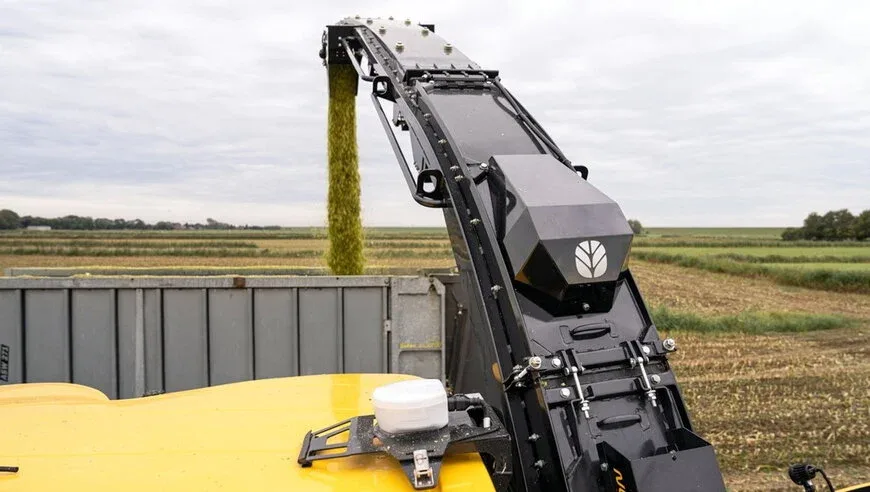
New Holland North America integrates optical sensing into forage harvesters to automate kernel processing monitoring for livestock feed production. www.newholland.com New Holland North America has introduced an optical monitoring system designed to determine kernel processing scores in real time during forage harvesting. The system applies industrial automation principles to feed production, enabling continuous evaluation of crop flow directly on harvesting machinery. Operational Challenge in Forage Processing In livestock feed production, starch availability depends on the thorough mechanical cracking of corn kernels. Traditionally, measuring the kernel processing score required manual sampling and off-site laboratory testing, or visual estimation by the equipment operator. These methods introduce latency into field operations, resulting in inconsistent processing quality, unnecessary machine wear, and increased fuel consumption when processing rolls are misaligned or excessively tightened. Optical Sensing and Automated Adjustment The system uses a camera assembly mounted on the machine discharge spout. Computer vision algorithms evaluate the continuous stream of chopped corn to detect the proportion of fully cracked kernels against target parameters established for dairy or beef livestock. The optical data connects to the machine control architecture, allowing automatic, closed-loop adjustments of the kernel processor during operation. Operators monitor operational data within the cabin via the primary terminal interface, while spatial mapping layers and performance reports export directly to farm management software platforms for post-harvest analysis. Impact on Harvesting Efficiency and Nutrition Automating the processor adjustments maintains target processing levels throughout variable field conditions without manual intervention. This technical control loop prevents underprocessing, optimizes mechanical energy expenditure, and reduces unnecessary component friction. At the nutritional level, consistent kernel breakdown facilitates starch availability and nutrient absorption in livestock digestion. Patrick Weitzel, forage harvester marketing manager for New Holland North America, stated: "For dairy and beef producers, feed quality is the most important indicator of forage harvester performance. With ForageCam, producers and custom operators are getting a real-time KPS and can assess right away if the quality is high enough the moment their forage is running through the harvester. In the past, we had to guess from the cab what the score was or send samples to the lab to determine the KPS. Now, we instantly know the forage score and quality." The system will be deployed across commercial forage harvester fleets beginning in the 2027 production cycle. Edited by Evgeny Churilov, Induportals Media - Adapted by AI. www.cnh.com Powered by Induportals Media Publishing