


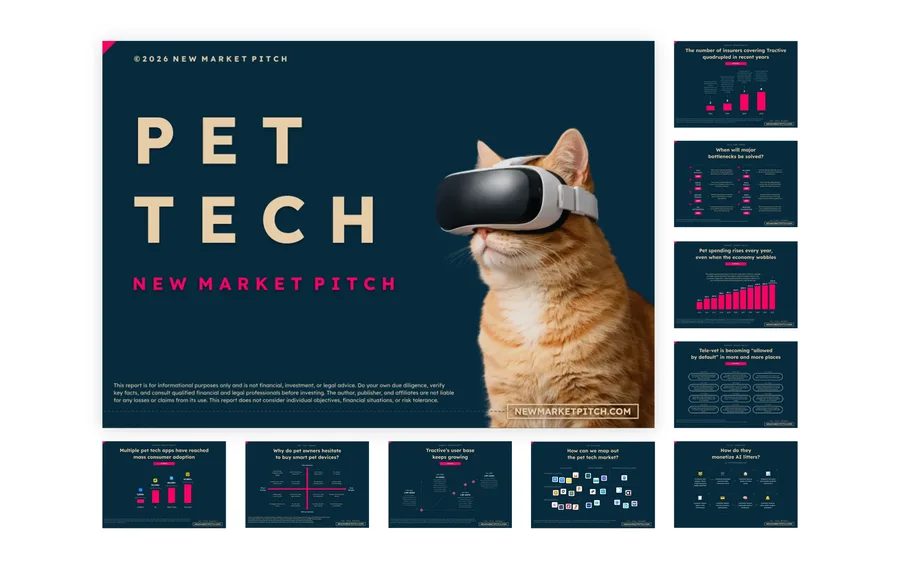
Pet health trackers: which startup is ahead? Last updated: 31 July 2026 In our Pet Tech market deck , you will find everything you need to understand the market SUMMARY Tractive is clearly ahead in pet health trackers today. Fi is the strongest independent consumer challenger, while PetPace leads the medical side of the market. Tractive's lead is built on a real subscription business, not just product reviews or brand recognition. More than 1.4 million active users, over €100 million in recurring subscription revenue and coverage across more than 175 countries put it in a different commercial tier. Fi is not close to matching that proven scale yet, but it has built some of the category's best hardware. Its long-battery-life collars and new satellite-enabled Ultra make it the most credible rival for owners who care first about escape prevention and remote tracking. The market is splitting into two races. Tractive and Fi compete for everyday safety and wellness, while PetPace, Invoxia and Maven are trying to make the collar useful for medical monitoring. PetPace has the deepest health product. Its vital-sign measurements, veterinarian dashboard and clinical research make it more useful for sick, elderly or recovering animals than a normal consumer GPS tracker. Invoxia may have the strongest technical position among the smaller companies. Its cardiac sensing and long-term study of 703 dogs give it a dataset that is difficult to reproduce with standard GPS and activity hardware. Maven is smaller, but it has found a sensible middle ground. Peer-reviewed respiratory monitoring, personalized baselines and one subscription covering several pets make it a credible health-first challenger without the cost of a full clinical platform. Connected hardware economics matter more than they first appear. Tractive's recurring revenue can support cellular fees, replacement devices, software development and customer service at a scale that smaller rivals still have to fund carefully. Life360 is the biggest outside threat because it already has distribution. Its pet tracker is medically basic, but placing pet location inside an app used by more than 97 million people could pressure GPS-focused brands quickly. The ranking depends on what pet wearables become. If owners mainly want escape alerts and location, Tractive and Fi should stay in front; if veterinary care and insurance begin using continuous pet data routinely, PetPace, Invoxia and Maven become much more valuable. For now, the order is clear: Tractive first, Fi second, PetPace third, Invoxia fourth, Maven fifth, Petcube sixth and FitBark seventh. Which pet health tracker startups actually belong in the race? The real pet health tracker race currently has seven credible companies: Tractive, Fi, Invoxia, PetPace, Maven Pet, Petcube and FitBark. We include companies that sell an active wearable and track at least one health or behavioral metric. That covers broad GPS products that monitor activity and sleep, as well as health-first collars measuring heart rate, breathing or temperature. The companies are still solving different problems. Tractive and Fi began with location and safety, then added health features. PetPace and Maven started with health monitoring. Invoxia sits between the two, combining GPS with unusually advanced cardiac measurements. Tractive remains essential to the comparison even though Bending Spoons has acquired it. It may no longer be independent, but it still sets the benchmark every startup has to beat. Whistle is excluded because Tractive acquired the business and closed the separate Whistle platform. We also exclude Halo and SpotOn because containment and training remain their main functions. Apple AirTags and similar Bluetooth tags can help locate an animal nearby, but they do not monitor health. Life360 appears later as an outside threat because it is an established consumer platform entering pet tracking, rather than a pet health startup. Funding figures need some caution. Fi has raised slightly more disclosed venture funding than Tractive raised before its acquisition. Invoxia and PetPace have less complete public records, so their totals should be read as approximate rather than exact. Startup What it currently does Disclosed cumulative funding Tractive GPS, activity, sleep, behavior and vital-sign tracking for dogs and cats About 40 million Invoxia GPS, activity, sleep, heart rate, respiratory rate and heart-rate variability Precise total not publicly disclosed PetPace Clinical monitoring of vital signs, behavior, pain-related patterns and location Previously described as below 13.8 million Maven Pet Health-first tracking of heart rate, respiratory rate, activity, sleep and behavior About 125,000 publicly recorded Is there already a clear leader in pet health trackers? Tractive is clearly ahead in pet health trackers today, with Fi as the strongest consumer challenger and PetPace and Invoxia leading narrower medical niches. The gap is larger than the number of competing brands suggests. Tractive reported more than 1.4 million active users after absorbing Whistle and has sold trackers across more than 175 countries. It had already passed €100 million in annual recurring subscription revenue before hardware sales. No independent competitor has published a similar combination of paying users, recurring revenue and international reach. Fi has a strong brand and a growing product range, but it does not disclose subscriber or revenue figures that place it close to Tractive. Invoxia reports more than 400,000 users across its entire tracking business, although that figure also includes vehicles, bicycles and valuables. The smaller health specialists lead where Tractive remains less advanced. PetPace monitors a wider set of clinically useful measurements and gives veterinarians their own dashboard. Invoxia has built one of the category's best real-world cardiac datasets. Maven has added peer-reviewed evidence to a relatively accessible consumer subscription. The market shape is pretty clear. Tractive leads the overall category by a wide margin. Fi is the most credible independent consumer rival. PetPace is the health-monitoring specialist, while Invoxia and Maven are the smaller companies most likely to challenge it. If you want more recent data on this point, please see our latest Pet Tech market report . This market map, featured in our Pet Tech market deck , highlights top companies and startups in the pet tech market Which pet health tracker has built the biggest real business? Tractive has built by far the biggest pet health tracker business, with more than €100 million in annual recurring subscription revenue before counting device sales. That revenue level changes the comparison. Tractive is already operating a large subscription company, while most rivals still reveal their progress through product launches, reviews, partnerships or research projects. The company has also said it remained cash-flow positive through nearly all of its history. That is unusual in connected hardware, where companies have to subsidize devices, pay cellular fees, replace faulty units and keep improving an app long after the original purchase. Tractive's reported revenue and user numbers also fit together reasonably well. Dividing €100 million in recurring revenue by 1.4 million active users gives roughly €71 per user annually. The dates and definitions do not align perfectly, so this is only a rough check. Still, the result sits within the range of Tractive's subscription pricing and suggests the figures describe a real, functioning customer base. Fi says its products are trusted by millions of pet parents and has accumulated tens of thousands of customer reviews. Those figures show broad awareness, but they do not reveal how many subscriptions remain active or how much revenue Fi earns. Petcube has an established camera and pet-services business, although it does not separate tracker revenue. Maven's hundreds of reviews show early commercial demand, while PetPace and FitBark disclose very little about active paid users. Tractive can now finance software, support, connectivity and new devices from its own customer base. Its smaller rivals still have to protect cash, charge premium prices or stay focused on a narrower group of owners. Is Fi actually close to catching Tractive in pet health trackers? Fi still trails Tractive by a wide margin on proven scale, even though Fi currently leads on battery design and remote-location tracking. Fi's regular Series 3+ collar can last up to three months under favorable conditions. The hardware is built directly into the collar, which feels cleaner and more durable than attaching a separate tracker to a normal collar. Fi also monitors barking, licking, scratching, eating, drinking, sleep and activity. The Fi Mini has expanded the brand beyond larger dogs. It is designed for small dogs, puppies and cats, giving Fi a much broader addressable market than it had a few years ago. Fi's most distinctive product is the Ultra. It combines normal GPS and cellular tracking with T-Mobile's Starlink-powered direct-to-cell service. During testing by The Verge, the tracker successfully sent locations from an area with no normal LTE reception. That makes Fi the strongest option for dogs travelling through remote parts of the United States. The limitation is battery life. Fi's regular products can run for weeks or months, while the Ultra generally lasts only one or two days because it uses several radios and checks location much more often. Fi has created a useful premium product, especially for hikers, hunters and owners living near cellular dead zones. It has not produced public commercial figures suggesting that the wider company is close to Tractive. Tractive still has the larger dog and cat range, the broader international operation and a far more visible subscription business. Fi can narrow the gap through better hardware, but it still has to prove that those products are creating comparable customer scale. If you want more recent data on this point, please see our latest Pet Tech market report . As this chart shows, and as featured in our Pet Tech market deck , search interest in pet cameras has risen sharply Which pet health tracker monitors the most meaningful health data? PetPace is currently the strongest pure health tracker, while Tractive covers the widest mix of pets and everyday tracking needs. PetPace continuously follows temperature, pulse, respiratory rate, heart-rate variability, activity, sleep, body position and behavioral patterns linked with pain or stress. Veterinarians can review the same information through a clinical dashboard and use it for recovery, chronic disease or senior-pet monitoring. That clinical connection gives PetPace more depth than a normal consumer tracker. The system is built for situations where a change in breathing, posture or resting heart rate could affect a medical decision. Invoxia provides the strongest consumer alternative for cardiac monitoring. Its Biotracker estimates heart rate and respiratory rate from collar movement and now adds heart-rate variability. Invoxia uses those measurements to identify changes in stress, recovery and possible discomfort. Maven occupies a simpler middle ground. It tracks heart rate, resting respiratory rate, activity, sleep, itching and drinking behavior, then compares each animal with its own normal baseline. It lacks GPS, which makes it less useful for escape prevention but keeps it focused on health. Tractive now measures resting heart and respiratory rates on compatible trackers. It also monitors activity, sleep, barking, scratching and roaming. Its advantage is breadth: the company supports both dogs and cats and combines health changes with live location and escape alerts. Fi tracks more visible behaviors than most competitors, including licking, barking, scratching, eating and drinking. Those features can help owners notice a problem, although Fi currently provides less physiological detail than PetPace or Invoxia. For owners with a sick, elderly or recovering pet, PetPace offers the deepest monitoring. Tractive is the stronger everyday product for households wanting location, wellness and health changes in one place. Invoxia and Maven are more focused choices for owners who care about biometrics but do not need a full clinical system. Which pet health tracker has the strongest clinical evidence? PetPace has the broadest clinical evidence in pet health trackers, while Invoxia has completed the strongest large real-world biometric study. PetPace has appeared in peer-reviewed research covering activity measurement, osteoarthritis pain, body position and physiological monitoring. Researchers have compared its activity data with validated monitors and tested whether its measurements can help distinguish healthy dogs from dogs experiencing pain. The studies do not prove that every PetPace alert is medically accurate. They do show that independent veterinary researchers have used the system repeatedly across different clinical questions. Invoxia's AI-COLLAR study followed 703 dogs from 113 breeds in 29 countries, with a median monitoring period of 189 days. The researchers used the data to build reference ranges for resting heart rate and respiratory rate across different ages, body sizes, health conditions and times of day. That sample is far larger and longer than most pet-wearable studies, which often follow a few dozen animals for a short period. Invoxia employees were among the authors, so the research was commercially connected, but it still went through peer review and produced a valuable dataset. Maven has also moved beyond company claims. A prospective study compared its resting-respiratory-rate measurements with manual counts and was published through the American Veterinary Medical Association. The results supported Maven's use for home respiratory monitoring, although the initial research focused mainly on apparently healthy dogs. FitBark remains widely used for activity research. More than 150 research institutions and veterinary schools have reportedly used the device in studies involving mobility, osteoarthritis, rehabilitation, nutrition, sleep, skin problems and anxiety. Its measurements are narrower than those offered by PetPace or Invoxia, but researchers know the platform well. Tractive may have the largest volume of real-world pet data, yet the company has published less independent validation for its newer heart and respiratory features. Fi also has a large consumer product and detailed behavioral monitoring, but its public clinical evidence remains limited. Startup Strongest research evidence What we can reasonably conclude PetPace Multiple published studies across activity, pain, posture and vital signs Broadest clinical research base Invoxia International long-term study of 703 dogs Strongest large biometric dataset Maven Pet Peer-reviewed comparison of collar and manual respiratory measurements Most credible emerging health-first challenger FitBark Use by more than 150 research institutions and veterinary schools Strong research utility for activity and behavior Tractive Very large consumer dataset but limited independent validation of newer vital-sign features Strong data scale, weaker public clinical proof Fi Detailed behavioral monitoring with little published clinical validation Strong consumer product, limited medical evidence If you want more recent data on this point, please see our latest Pet Tech market report . This chart, included in our Pet Tech market deck , shows annual VC investment in pet tech startups Which pet health tracker is best at finding a lost pet? Tractive is the best all-round lost-pet tracker today, while Fi Ultra is better for remote US areas without normal cellular coverage. Tractive combines live GPS, virtual fences, escape notifications, location history and Wi-Fi power-saving zones. Its trackers work across more than 175 countries, and the company has years of experience dealing with different mobile networks, battery conditions and pet-owner alerts. The company's large installed base also reduces the risk of buying an experimental product that could lose support. Lost-pet tracking depends heavily on app reliability, billing, replacement hardware and customer service, not only the accuracy of the GPS chip. Fi has a clear advantage when a dog leaves cellular coverage. The Ultra can connect through T-Mobile's direct-to-cell satellite service using Starlink, allowing it to send a location from places where a standard LTE tracker becomes unreachable. The trade-off is charging. Fi Ultra generally lasts one or two days, compared with much longer battery life from the normal Fi Series 3+ and several competing trackers. Owners need to remember to charge it before a remote trip. Invoxia's latest Biotracker also improves the lost-pet experience with one-second updates in live mode and LTE-M connectivity. Petcube offers a dedicated lost-dog mode and relatively inexpensive service. FitBark supports multiple LTE networks and stores several years of location history. For normal daily use, Tractive remains the safer choice because it combines proven international coverage, mature software and reasonable battery life. Fi Ultra is better for hiking, hunting or living in areas where cellular coverage regularly disappears. Which pet health tracker gives owners the best value? Tractive gives most owners the best value today, while Invoxia is the strongest subscription-free health option and Maven works well for multi-pet homes monitoring chronic conditions. Tractive's hardware usually costs less than 168 per year on its annual plan and can cover as many as three pets. The price looks high beside a basic activity tracker, but it becomes much more reasonable for a household with several older animals. Fi's standard annual membership costs about $189. Owners are paying for long battery life, polished integrated collars and detailed behavior monitoring. Fi offers real advantages, although many ordinary households can get the essential safety features for less through Tractive. PetPace sits at the premium end because it combines advanced sensors, cellular service, telemedicine and veterinarian access. The cost makes sense for a dog with heart disease, chronic pain or a complicated recovery. A healthy young pet is unlikely to need that level of monitoring. FitBark and Petcube remain cheaper alternatives for owners mainly interested in GPS and activity. Their health features are lighter, so the lower price comes with a narrower view of the animal. This chart, included in our Pet Tech market deck , looks at Tractive’s strategy in pet tech Which pet health tracker has the strongest business model and support operation? Tractive has the strongest pet health tracker business model and the only support operation already proven at large international scale. Connected pet hardware cr
Pet health trackers: which startup is ahead?
NewMarketPitch Team