


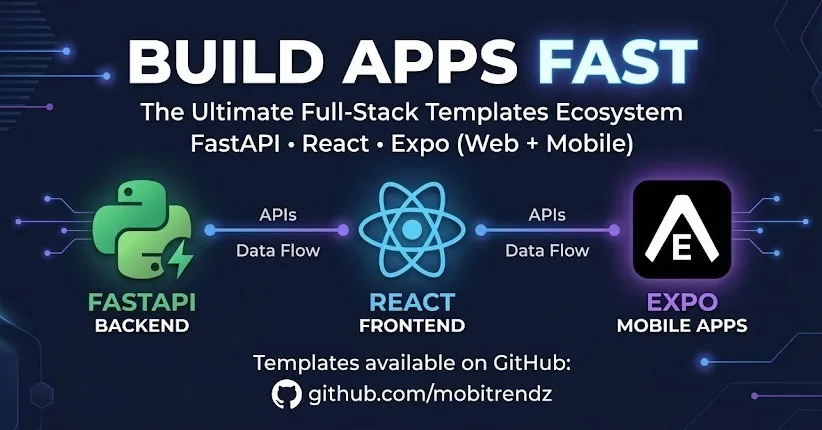
description: Three production-ready templates — FastAPI backend, React 19 web frontend, and Expo mobile app — pre-wired to talk to each other. Auth, Docker, type-safe API clients, RBAC, and CI/CD included. Just clone and ship. tags: webdev, python, react, reactnative We've all been there. You have a great app idea. You sit down, open a blank terminal, and immediately lose two days configuring auth, wiring up CORS, generating API clients, setting up Docker, choosing a linting strategy, and arguing with yourself about folder structure. The idea hasn't even started yet. That setup tax is real, and it compounds across every project. This post introduces a three-repository boilerplate ecosystem built for the way modern teams actually ship: a FastAPI backend , a React 19 web frontend , and an Expo mobile app — all pre-configured, pre-connected, and ready to clone. Whether you're building a SaaS, a hackathon project, or a production internal tool, this stack gets you to your first meaningful feature commit in under an hour. Let's break it down. The Architecture at a Glance ┌────────────────────────────────────────────────────────────┐ │ FastAPI Backend │ │ PostgreSQL 18 · Alembic · JWT/RBAC · Prometheus · Traefik│ │ https://github.com/mobitrendz/fastapi-backend-template │ └───────────────────────┬────────────────────────────────────┘ │ REST API (/api/v1) ┌─────────────┴──────────────┐ ▼ ▼ ┌─────────────────────┐ ┌──────────────────────────┐ │ React 19 Frontend │ │ Expo Mobile App │ │ Vite · TanStack │ │ React Native · SDK 54 │ │ shadcn/ui · Zod │ │ AsyncStorage · TypeScript│ │ mobitrendz/react- │ │ mobitrendz/expo-mobile- │ │ frontend-template │ │ template │ └─────────────────────┘ └──────────────────────────┘ All three repos share one source of truth: the OpenAPI schema exported by FastAPI. Both frontends generate their type-safe API clients from that schema with a single command. Change a backend endpoint? Regenerate. TypeScript errors surface immediately. No hand-rolled fetch calls, no runtime surprises. Why FastAPI + React + Expo? This trio isn't random. It's opinionated by design: FastAPI is async-native, generates OpenAPI docs automatically, and ships Pydantic validation out of the box. It's the fastest way to build a self-documenting, type-safe REST API in Python. React 19 with TanStack Query makes server state a first-class citizen — no Redux boilerplate, automatic cache invalidation, and optimistic updates with minimal ceremony. Expo lets you target iOS and Android from one TypeScript codebase, using the same API client generation pattern as the web frontend. The result: one backend schema drives three platforms , and refactoring is a compiler problem, not a grep-and-pray exercise. Deep Dive: The Three Templates 1. FastAPI Backend Template Repo: mobitrendz/fastapi-backend-template This isn't a toy "hello world" FastAPI app. It implements a full Layered Modular Architecture : Layer What lives here app/api Versioned route controllers, OpenAPI docs app/services Business logic, multi-step orchestration app/crud Atomic, reusable database operations app/models SQLModel definitions — DB tables and Pydantic DTOs in one app/core Security, config, observability Out of the box you get: RBAC with three roles — SUPER , ADMIN , and USER — enforced via FastAPI dependency injection. Protect any route in one line: from app.api.deps import AllowAdmin @router.get ( " /admin-only " ) async def secure_route ( current_user : AllowAdmin ): return { " message " : " Hello, Admin! " } Enterprise observability — structured JSON logging via Structlog, real-time metrics via Prometheus, and Sentry integration for error tracking. Rate limiting via SlowAPI and Argon2 password hashing via pwdlib. PostgreSQL 18 with Alembic migrations, psycopg3 binary driver, and full Docker Compose orchestration including pgAdmin and MailCatcher for local development. uv for dependency management — reproducible, lightning-fast installs. Security scanning via Bandit, type-checking via Mypy, formatting via Ruff. Testcontainers + Hypothesis for property-based testing and isolated infra in CI. The full local stack spins up with one command: docker compose up --build Or run the database in Docker while iterating on the API natively: docker compose up -d db pgadmin mailcatcher uv run fastapi dev --host 0.0.0.0 Local endpoints after boot: Service URL API docs (Swagger) http://localhost:8000/docs Prometheus metrics http://localhost:8000/metrics pgAdmin http://localhost:5050 MailCatcher http://localhost:1080 Health check http://localhost:8000/health 2. React 19 Frontend Template Repo: mobitrendz/react-frontend-template 92.66% test coverage. That's not a vanity metric — the CI pipeline enforces it via GitHub Actions, and a failing coverage gate blocks the merge. Tech stack highlights: Concern Tool Framework React 19 + TypeScript Build Vite 8 Server state TanStack Query Routing React Router 7 UI components shadcn/ui + Lucide icons Styling Tailwind CSS 4 Validation Zod Testing Vitest + React Testing Library The frontend ships with a Zod-validated environment schema — the app simply won't start if a required env variable is missing or mistyped. This eliminates an entire class of "works on my machine" bugs: cp .env.example .env # VITE_API_URL, VITE_ENV, VITE_ENABLE_ANALYTICS — all validated at startup API integration uses @hey-api/openapi-ts to generate a fully type-safe SDK from the FastAPI OpenAPI spec. Pair it with TanStack Query and you get declarative data fetching with zero boilerplate: import { useQuery } from " @tanstack/react-query " ; import { readTodosApiV1TodosGet } from " ./client/sdk.gen " ; const { data , isLoading , error } = useQuery ({ queryKey : [ " todos " ], queryFn : () => readTodosApiV1TodosGet (), }); What's included out of the box: JWT auth with login/signup, token persistence, and role-based route protection Admin dashboard: user management, status toggling, admin account creation, search and role filtering Task management: inline editing, priority filtering, real-time search Account lifecycle: profile editing, password change, account deletion with password verification Premium dark-mode design system with glassmorphism and Tailwind 4 Pre-commit hooks for ESLint, Prettier, and TypeScript type checks before every commit GitHub Actions API sync guardrail: if the backend schema changes without a regenerated SDK, CI fails 3. Expo Mobile Template Repo: mobitrendz/expo-mobile-template Built on Expo SDK 54 with React Native 0.81, React 19, and full TypeScript. Targets regular user accounts only — admin and super roles are rejected at sign-in, keeping the mobile surface clean and focused. Features: Sign in / sign up with JWT stored in AsyncStorage and automatic session restore on launch Full todo/task manager: create, edit, delete, pull-to-refresh, tap to cycle status Task fields: title, description, priority (Low/Medium/High), status (Pending/In Progress/Completed), due date & time Profile screen: edit name/email, change password, delete account, sign out Modal-based create/edit forms throughout Like the web frontend, API calls are generated from the same openapi.json via @hey-api/openapi-ts : npm run generate-api API URL configuration is flexible — app.json , env variable, or automatic fallback: Environment URL iOS Simulator http://localhost:8000 Android Emulator http://10.0.2.2:8000 Physical device http://:8000 Production https://your-api.example.com/ Native android/ and ios/ folders are gitignored; generate them on demand: npx expo prebuild How They Work Together: The Connection Story The three repos share one integration contract: openapi.json . Here's the flow: Backend starts and exposes http://localhost:8000/openapi.json Both frontends download this schema and run their code generator: Web: npm run generate-client Mobile: npm run generate-api Fully typed SDK files appear in src/client/ in both repos Every API call is now type-checked — wrong argument types or missing fields are compile errors, not runtime crashes When you change a backend model or add an endpoint, the frontends surface the mismatch immediately. Your TypeScript compiler becomes your integration test. Quick Start: Get the Whole Stack Running Locally Prerequisites: Docker, Node.js 22+, uv (Python package manager) Step 1 — Backend git clone https://github.com/mobitrendz/fastapi-backend-template cd fastapi-backend-template cp .env.example .env # Edit .env: set SECRET_KEY, POSTGRES_PASSWORD, SUPER_USER_PASSWORD docker compose up --build The API is live at http://localhost:8000 . Swagger docs at http://localhost:8000/docs . Step 2 — Web Frontend git clone https://github.com/mobitrendz/react-frontend-template cd react-frontend-template npm install pre-commit install npm run generate-client # pulls from localhost:8000/openapi.json npm run dev # http://localhost:5173 Step 3 — Mobile App git clone https://github.com/mobitrendz/expo-mobile-template cd expo-mobile-template npm install # Set your local IP in app.json → expo.extra.apiUrl # or: export EXPO_PUBLIC_API_URL=http://:8000 npm run generate-api npm start # Press 'a' for Android, 'i' for iOS, or scan QR for Expo Go That's it. Three terminals, one full-stack cross-platform app with auth, RBAC, observability, and type safety. What This Stack Is Great For SaaS MVPs — ship web + mobile simultaneously from day one Hackathons — spend your weekend on the actual idea, not the plumbing Internal tools — RBAC and admin dashboard included, no plugins required Learning projects — the architecture is documented, layered, and readable; great reference for production patterns What's Next on the Roadmap The backend README is clear: this is active development (beta) . Features landing soon include expanded observability integrations, additional auth strategies, and further AI-assisted developer tooling. The architecture is already production-grade — it just keeps getting better. Conclusion Full-stack boilerplates are only useful if they don't become a liability. These three templates are designed to stay out of your way: generate, extend, ship. No lock-in — standard FastAPI, standard React, standard Expo No magic — every integration is explicit and readable No cutting corners — Argon2 passwords, RBAC deps, type-safe API clients, 92%+ test coverage If you're starting your next project this week, don't write the auth layer again. ⭐ Star the repos and fork them for your next build: fastapi-backend-template react-frontend-template expo-mobile-template Found a bug? Have a feature idea? PRs and issues are open. The contributing guide is in each repo. Built with FastAPI, React 19, Expo SDK 54, and a deep hatred of repetitive project setup.
Stop Writing Boilerplate. Ship a Full-Stack App in Minutes with FastAPI + React + Expo
Sreeraj Sreenivasan