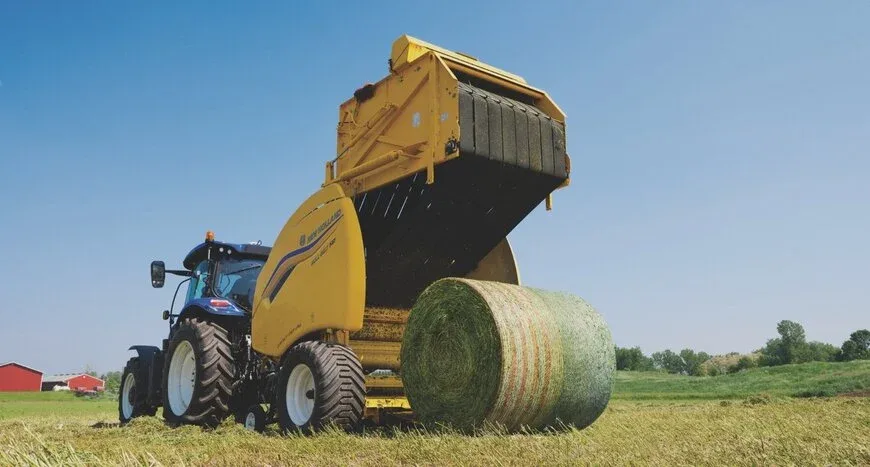
New Holland presents automated forage processing and fleet connectivity solutions to optimize forage quality and machine efficiency in commercial livestock operations. www.newholland.com New Holland introduces automated forage harvesting systems, baling automation, and retrofit precision agriculture solutions designed for commercial cattle operations and mixed farming enterprises. The release focuses on integrating artificial intelligence, real-time sensing, and bidirectional telematics across mechanical harvesting equipment to increase feed quality and operational throughput during narrow harvest windows. Automated Forage Analysis and Processing Control Modern forage harvesting requires precise management of moisture levels, crop flow, and kernel processing to maximize nutritional value. The FR Forage Cruiser lineup incorporates artificial intelligence via image analysis sensors to continuously measure kernel processing efficiency. By scanning crop flow directly in the discharge stream, the system automatically adjusts processor roll clearance without requiring manual operator intervention or machine stoppages. Complementing the imaging platform, near-infrared spectroscopy sensors monitor crop moisture, crude protein, starch, and acid detergent fiber in real time. Integrated speed control mechanisms adjust machine ground speed based on crop load density, maintaining constant engine load and minimizing throughput bottlenecks during dense crop feeding. Self-Propelled Windrowing and Yield Mapping Integration For mowing and swathing operations, the updated self-propelled windrower series integrates relative yield monitoring systems linked directly to telematics platforms. The system calculates crop mass variations across individual field zones during cutting, generating georeferenced yield maps prior to baling or chopping. The machines feature expanded engine output ratings, modified cooling package configurations to handle higher thermal loads in heavy forage, and factory-integrated telematics hardware providing lifetime machine data transfer. Baling Automation and Fleet Retrofit Architectures In round baling operations, baler automation utilizes ISOBUS Class 3 protocols to automate tractor stopping, net wrapping, and bale ejection cycles, thereby reducing operator fatigue and cycle time variability. Mechanical revisions include reinforced drive components, an updated net-tie protection housing, and updated moisture sensing circuits. To address mixed-generation machinery fleets, aftermarket precision kits allow legacy tractors to interface with current satellite guidance and telemetry networks. This modular retrofit architecture enables operators to deploy automated steering, rate control, and cloud-based field mapping on older mechanical platforms without requiring complete equipment turnover. Compact utility tractors also receive factory-installed telematics connections to facilitate mixed-fleet monitoring via centralized farm management software. Additional Context This section details technical specifications and competitive benchmarking not included in the original product announcement. The integration of optical analysis in forage harvesters benchmarks directly against systems such as the Claas Auto Fill and NIR sensor systems on the Claas Jaguar, as well as the John Deere HarvestLab 3000 constituent sensing and Kernel Processing Score analysis suites. While conventional systems often rely on post-harvest manual sampling or stationary NIR analysis to evaluate kernel processing scores, real-time optical processing adjustments adjust shear bar clearance and roll spacing dynamically under ISO 11783 communication standards. In baling automation, bidirectional implement-to-tractor control corresponds to Tractor Implement Management standards certified by the Agricultural Industry Electronics Foundation, standardizing automated stop-wrap-eject sequences across multi-brand tractor-implement combinations. Edited by Evgeny Churilov, Induportals Media - Adapted by AI. www.cnh.com Powered by Induportals Media Publishing