


Intel has bounced back from its, at one point, seemingly existential crisis. When I wrote this post back in August 2024 the situation seemed bleak. Today Intel’s share price has risen to almost $100. Central to Intel’s resurgence is surging demand for the product that has sustained Intel over almost five decades: the CPU or more specifically x86 CPUs. So it seems like a good time then to go back to the design that represents the real start of Intel’s CPU story; a CPU architecture that Intel didn’t create and was almost shut down before it got started. An Intriguing But Useless Product Robert Noyce was torn. The co-inventor of the integrated circuit, co-founder and CEO of Intel, the ‘Mayor’ of Silicon Valley, had patiently sat in his office listening to the proposal for three uninterrupted hours. Finally he stood up and put his hands on his desk. The answer was ‘no’: ‘It’s intriguing and we can do it. We can take a shot at it - but it’s a useless product, and making it would not be in our business interest.’ The proposal? An 8-bit microprocessor. More precisely, the first 8-bit microprocessor. Across the table from Noyce were Gus Roche and Jack Frassanito from Computer Terminal Corporation (CTC) of San Antonio Texas. CTC had already announced the innovative Datapoint 3300, one of the first computer terminals with a cathode-ray-tube-based display. Now, early in 1970, they were working on the 3300’s successor, the Datapoint 2200, a slimmed-down terminal in a box the size of an IBM Selectric typewriter. At the heart of the 2200 would be a simple computer whose architecture had been designed over Thanksgiving weekend in 1969 by engineers Vic Poor and Harry Pyle. Squeezing that computer - constructed using the Transistor-Transistor Logic (TTL) and Medium Scale Integration (MSI) components then widely available - into the limited space available in the 2200’s casing would be a major challenge.
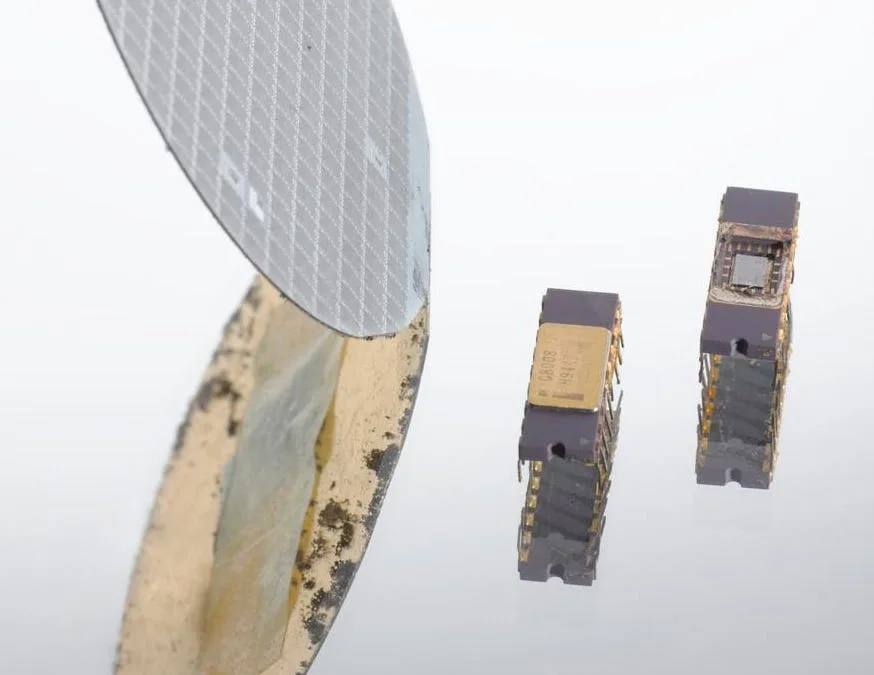
Intel Inside the Micro Revolution: 8008 Origins
Babbage
2 min read