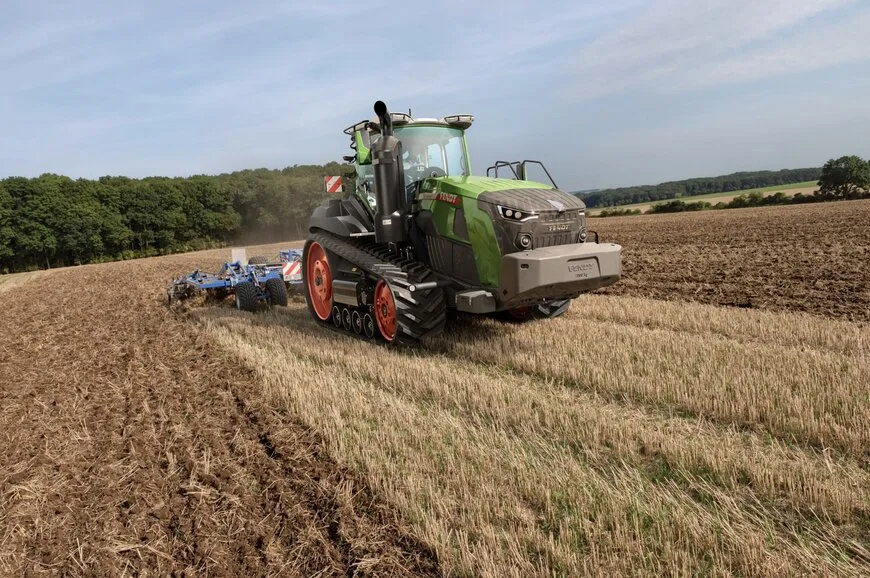
Fendt has upgraded its 1100 Vario MT tracked tractor series with reinforced transmissions, FendtONE driver workstations, and advanced chassis suspension systems. www.fendt.com Fendt has launched the new generation of the Fendt 1100 Vario MT tracked tractor series, spanning power outputs from 521 to 680 hp for broad-acre field operations. The machines feature an upgraded continuous variable transmission paired with an updated cab, integrated FendtONE digital architecture, and self-cleaning air filtration options. Workstation Ergonomics and Smart Controls Manufactured at the Fendt cab plant in Asbach-Bäumenheim, the revised cab incorporates the FendtONE driver's workstation, aligning its operating layout with the manufacturer's wheeled tractor line. Standard cab fittings include a 12-inch armrest terminal, a 3L-joystick, a digital instrument cluster behind the steering wheel, a laminated safety glass (LSG) front window, an integrated rearview camera, and multi-function controls. An optional secondary roof terminal is available. Onboard digital architecture incorporates standard ISOBUS implement control, telemetry, task management, and documentation. Operational automation is expanded via the optional Fendt Guide guidance system and Fendt TI Headland management, which automates turn sequences through TI Auto and TI Turn Assistant functions to reverse or redirect implements independently at the boundary. The Fendt Workgroup system allows machine-to-machine data communication for fleets ranging from two to ten connected units. Illumination, Cab Filtration, and Climate Options The lighting architecture offers Vision or UltraVision LED packages with roof-mounted work lights and beacons. The UltraVision package incorporates 12 work lights producing 55,800 lumens, alongside 6,400 lumens from the bonnet fixtures, an optional 11,600 lumens from the upper hood, and four TechRail C-pillar spotlights generating 4,400 lumens each, reaching a maximum system output of 84,300 lumens. Up to four lighting profiles can be stored within FendtONE, enabling dimming on individual flanks during multi-machine operations such as grain cart unloading, with mirror configurations available for parallel field operations. For extreme environments, the tractor offers an optional reversible radiator fan, an engine intake passive dust extraction setup, and optional passive cyclone cab air filter cleaning driven by continuous vacuum separation. Operator environment options also include three integrated footrests and a compressor cooler. Chassis Suspension, Ballast, and Implement Attachment Chassis stability is maintained via the SmartRide suspension system, which decouples both track assemblies for independent vertical movement over ground contours, supported by bogie-mounted mid-rollers and an optional SmartRide+ hydraulic self-levelling system. The running gear uses rear drive wheels, front idlers, dual four-roller bogies, and Michelin rubber track belts with deep lugs. Differential steering manages track speed divergence without mechanical braking during turns. Implement hitching options feature a hydraulically pivoting rear linkage and two pivoting Category 5 drawbars designed to align hitch geometry with the tractor's natural turning center. A fourth hydraulic control mode dynamically synchronizes the swing angle of the drawbar or rear linkage directly to the steering angle of the tractor. Ballasting options include front frame weights, chassis weights, and wheel weights up to a cumulative mass of approximately seven tonnes. Drivetrain, Hydraulics, and Service Access The Fendt VarioDrive powertrain couples MAN 6-cylinder diesel engines with a reinforced stepless Vario transmission, driving dual hydraulic motors routed directly to the rear drive axle. Drivetrain performance is managed through the Fendt iD low-engine-speed operational concept. Hydraulic configurations support dual independent load-sensing circuits using two separate 220-l/min pumps to decouple high-volume, low-pressure consumer circuits from high-pressure tooling demands. Routine maintenance is supported through visual oil-level sight glasses, external battery terminals capable of powering auxiliary equipment, an external shop-air connection, and simplified track drive architecture relative to quadruple-track designs. Order books are open, with equipment deliveries scheduled to commence in early 2027. Additional Context This section details technical specifications not included in the original news release. Tracked high-horsepower agricultural tractors utilize rubber friction-drive or positive-drive belted undercarriages designed to spread vehicle gross weight over a larger footprint, typically limiting ground pressure between 0.4 to 0.7 bar to mitigate deep-soil compaction below root horizons. The low-speed powertrain concept deployed in heavy draught machinery pairs high-displacement inline-six engines with peak torque plateaus situated between 1,100 and 1,500 rpm, reducing diesel consumption during sustained drawbar pulls. Split hydraulic systems with separate variable-displacement axial piston circuits protect implement hydraulic fluid from cross-contamination and prevent line starvation in air-seeder fan motors during concurrent hydraulic cylinder actuations. Furthermore, continuous variable hydrostatic-mechanical split-path transmissions isolate field speeds from engine revolutions, providing operational velocities from sub-100 m/h creep rates up to 40 km/h transport speeds without step-ratio shifts. Edited by Romila DSilva, Induportals Editor, with AI assistance. www.fendt.com Powered by Induportals Media Publishing