


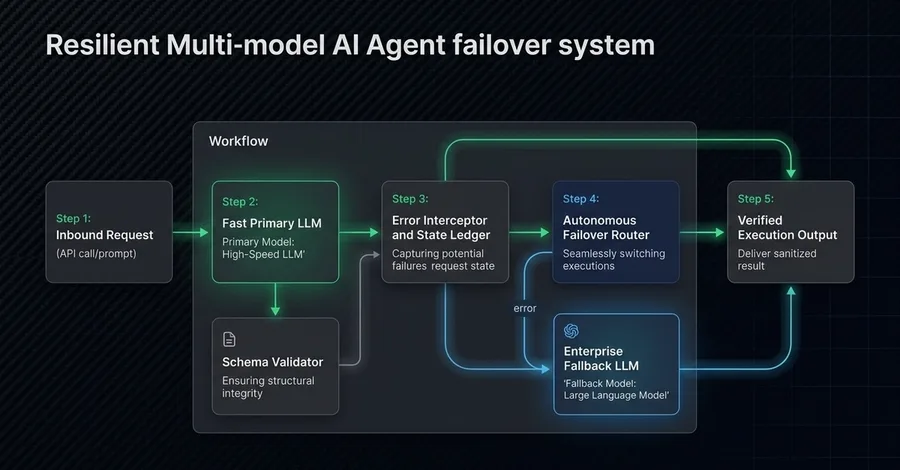
Single-model agent pipelines are fragile. When your LLM provider encounters latency spikes or schema drift, your entire business workflow stalls. Here is how to design an enterprise-grade agent with automated failover in Python. The Problem with Naive Agent Loops Most LangChain or basic Python agent implementations look like this: User input -> LLM -> Tool Call -> Response. If the LLM returns invalid JSON or hits an API quota, the script crashes. The Architecture: Primary + Fallback Engine Instead of a single LLM client, instantiate a dual-engine router: class ResilientAgent : def init ( self , primary_model , fallback_model ): self . primary = primary_model self . fallback = fallback_model def execute_step ( self , prompt , schema ): try : return self . primary . generate ( prompt , schema = schema ) except ( RateLimitError , ValidationError , APIConnectionError ) as e : logger . warning ( f " Primary model failover triggered: { e } " ) return self . fallback . generate ( prompt , schema = schema ) 3 Key Lessons Learned Always enforce Pydantic schemas on tool arguments. Track model confidence scores to trigger proactive failover before fatal errors. Maintain an immutable session state ledger so the fallback model picks up exactly where the primary left off. Check out the full open-source implementation on GitHub: https://github.com/osamatech786/AI-Sales-Agent
How to Build Bulletproof AI Agents with Autonomous Multi-Model Fallbacks
Osama