Statistics isn't a supporting subject in data science, it's the thing that makes the "science" part of data science actually mean something. Code Gives You Numbers. Statistics Tells You What They Mean. Anyone can write a few lines of code to calculate an average, plot a chart, or run a model. What statistics adds is the ability to know whether any of that actually means anything. Is a 3% increase…
This week we’re talking about Mark Zuckerberg’s latest essay, “The Future Is for Everyone,” which outlines his positive new vision about the potential of A.I. But do we think it’s credible? Then, Pangram’s chief executive, Max Spero, joins us to talk about the breakout success of his A.I. slop detector. And finally, it’s time for our new segment all about math — we’re Running the Numbers.
I have a measure that uses radiation dose (M.U. $Gray$) and $\log(Volume)$. The measure is $[\frac{Dose}{\log(Volume)}]$ that is $[\frac{D}{\log(l^3)}]$ with $D$ as radiation dose (M.U. unit is Gray ) and $l$ is length (M.U. in international measure units is meter ). What is the correct measure unit for this kind of measure after the following steps $[\frac{D}{\log(l^3)}]\Leftrightarrow [\frac{D}…
Many people in the U.S. believe that their statistical knowledge is limited, but they would rely on statistics for decision-making more if they understood statistics better, according to a new study led by a Penn State researcher.
The oldest person in the world, Kane Tanaka of Japan, died in April 2022 at 119 years. The record of Jeanne Calment of France, who died at 122, has stood for almost 25 years. Will it be beaten?
Analyzing 20 million recorded mosquito flight paths revealed the mathematical rules behind how these tiny predators move and zero in on their human targets.
The Quest Begins (The "Why") I still remember the first time I felt like I was stuck in a swamp of slow code. I was building a simple utility that checked whether an array contained any duplicate values. The function looked innocent enough — two nested loops, a couple of if‑statements, and a return true the moment a match was found. I ran it on a modest dataset of 10 000 items, and it finished in…
The superstition claims Friday the 13th is unlucky. It turns out it's also, very slightly, the most likely — the 13th lands on a Friday more often than on any other weekday. I counted every month in a full 400-year Gregorian cycle (plain Date UTC math) to see how big that edge really is. The edge, in one line: over 400 years the 13th falls on a Friday 688 times — more than any other weekday — but…
This paper explores the inductive logic associated with exponential smoothing, the most widely used predictive rule that manifests the idea that more recent observations have a stronger influence on predictive probabilities than more remote ones. The main result shows that exponential smoothing can be derived from a set of plausible qualitative invariance assumptions about conditional probabiliti…
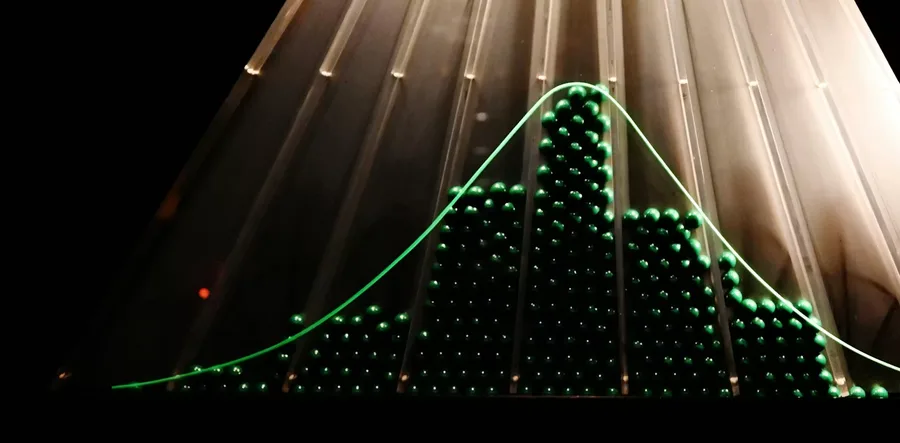
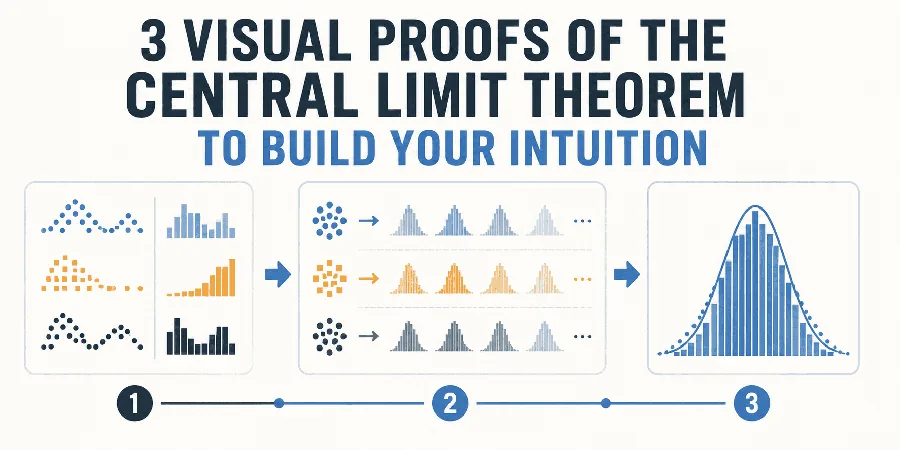
Bernoulli, Binomial Distribution & Central Limit Theorem Explained from First Principles When I first started learning probability, I came across terms like: Bernoulli Distribution Binomial Distribution Sampling Distribution Central Limit Theorem At first, they felt like completely different topics. But after understanding the reason behind each concept , I realized that they are actually connect…
I am trying to apply a volatility strategy. I am reading a paper where the authors defined the volatility as: "Exponential Weighted Volatility of returns with a 1-year window and 3-month half-life" I am having a hard time understanding the mathematical formula underlying it. The 1-year window part is easily understood as a summation of weighted square return deviation up to 12 months back. I thi…





 research.io