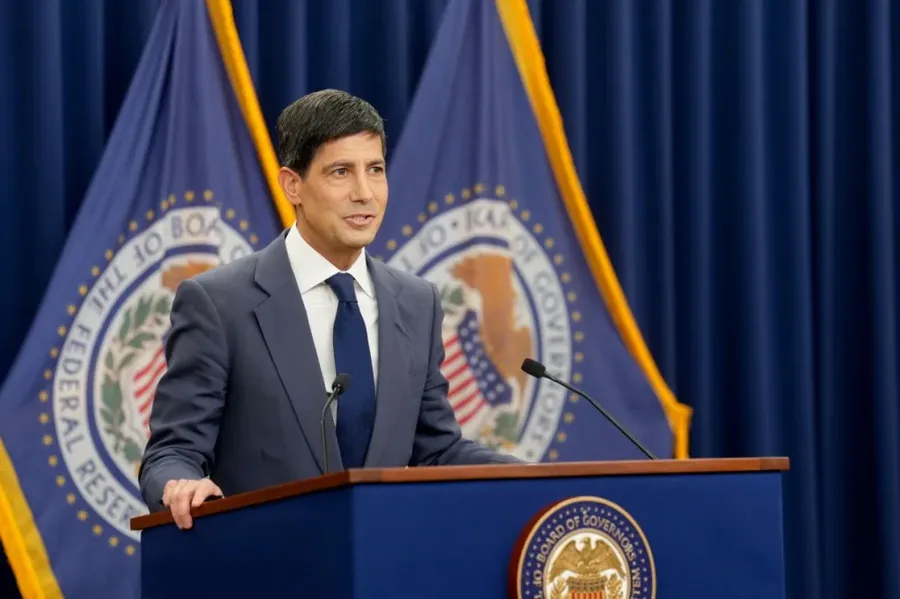
Photo of Kevin Warsh from bloomberg.com via the Wall Street Journal It was a foregone conclusion that at its meeting that ended today, the Federal Open Market Committee (FOMC) would leave unchanged its target range for the federal funds rate at 3.50 percent to 3.75 percent. There was great interest, however, about whether at his … Continue reading "FOMC Holds Target Rate Constant as Warsh Promise…
The Federal Reserve (Fed) implements monetary policy in a regime of ample reserves , where short-term interest rates are controlled mainly through the setting of administered rates, and active management of the reserve supply is not required. In yesterday’s post , we proposed a methodology to evaluate the ampleness of reserves in real time based on the slope of the reserve demand curve—the elasti…
As shown in a past Liberty Street Economics post , in the United States, the yields of money market fund (MMF) shares respond to changes in monetary policy rates much more than the rates of bank deposits; in other words, the MMF beta is much higher than the deposit beta. Consistent with this, the size of the U.S. MMF industry fluctuates over the interest rate cycle, expanding during times of mone…
How can we gauge the tightness of monetary policy? The SF Fed’s new monthly Proxy Funds Rate page focuses on financial market indicators to measure monetary policy tightness beyond what the federal funds rate level can show.
In July 2021, the Federal Open Market Committee announced a new tool for monetary policy implementation: a domestic standing repurchase agreement facility. In the last post of this series, we explain what this new tool is and how it will support the effective implementation of monetary policy in the floor system through which the Fed implements policy.
In response to the 2007-2009 financial crisis, in December 2008, the Federal Open Market Committee effectively cut its target for the federal funds to zero where it remained during the first six years of the recovery. In December 2015, Fed Chair Janet Yellen and the FOMC began the process of normalizing monetary policy by raising … Continue reading "Is the Natural Rate of Unemployment the Best Gu…
In a previous post, we compared the Federal Reserve’s discount window with the standing lending facilities (SLFs) at the Bank of England (BoE), the European Central Bank (ECB), and the Bank of Japan (BoJ). We showed that the Fed’s discount window was less integrated with monetary policy than the SLFs of the other central banks. In this post, we observe that the counterparty and collateral policie…