Designing membranes with specific binding sites for selective ion separations
Violet, Camille; Ball, Akash; Heiranian, Mohammad; Villalobos, Luis Francisco; Zhang, Junwei; Uralcan, Betul; Kulik, Heather; Haji-Akbari, Amir; Elimelech, Menachem
A new class of membranes that can separate ions of similar size and charge is highly desired for resource recovery, water reuse and energy storage technolog…
Nature Water, Published online: 14 April 2026; doi:10.1038/s44221-026-00633-w This study introduces a new membrane inspired by natural ion-transport proteins that can selectively pull lithium out of salty, lithium-poor waters with exceptional efficiency, and demonstrates that the technology can be scaled up to produce battery-grade lithium using very little energy.
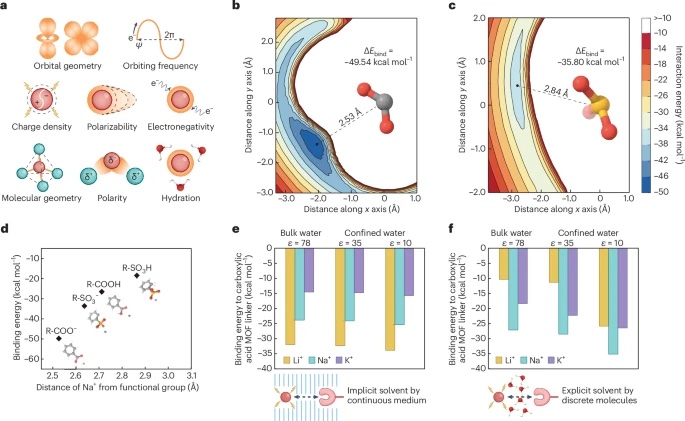
A new class of membranes that can separate ions of similar size and charge is highly desired for resource recovery, water reuse and energy storage technologies. These separations require membrane nanochannels with simultaneous ångström-scale confinement and ion-selective binding sites. Conventional membrane material design uses continuous, volume-averaged properties that cannot account for discre…
The collaborative research team is represented by DuPont, the National Renewable Energy Laboratory, Penn State University, and the University of Texas at Austin. This research team represents a successful collaboration between academia and industry over the past 6 years where the details of the structure and function of reverse osmosis membranes have been unraveled. Their research covered key… Re…
Anion-exchange membranes (AEMs) often dehydrate and lose ionic conductivity in ferric chloride solutions used in all-iron or iron−chromium redox flow batteries (RFB). This work studies the change in material and ionic transport properties of three AEMs with similar concentrations of ion exchange sites and hydration numbers upon exposure to ferric chloride/hydrochloric acid solutions. Read more [&…
Pictured is schematic representation of an ultrafiltration membrane self-assembled from polymer brush nanoparticles. This and other types of functional membranes are described in an article published by the Zharov group and featured on the cover of ChemComm. The article describes the recently developed approach to the preparation of membrane materials by self-assembly of inorganic, polymeric […]
There is usually a trade-off between selectivity and liquid permeability when making an ultrafiltration membrane but new research from scientists in the US suggests this doesn’t have to be the case. Membrane technology is the preferred approach to many industrial, environmental, analytical and biomedical separations. Drinking water purification, wastewater treatment, haemodialysis and fuel cells …