I am trying to understand what's going on with this problem: I summed the forces in the $x$ -axis, which is horizontal, and I thought the moment would create a force opposing the friction force. However, the given solution only included the friction force: $$F_\text{friction} = ma.$$ My equation was: $$F_\text{friction} - M/r = ma.$$ Why is the force caused by the moment excluded? Is it because t…
Table of Contents TL;DR Frictional force is the resistance that opposes relative motion (or attempted motion) between two surfaces in contact. It’s calculated as f = μN, where μ is... The post Frictional Force Explained: Formula, Types, Examples appeared first on 33Science .
I was playing with a toy model ( HTML + JS ) involving a mass, spring and damping that lets you vary those parameters using sliders. In the process, I got interested in the idea of varying the stiffness in real time in order to demonstrate parametric amplification. This does work pretty well... Read more
I understand the mathematics and geometry behind moments of inertia and an object's center of gravity, but I am struggling to reconcile the idea of an object hanging off the edge of a table when ...
I have just started to learn FBDs and forces.
I just cant wrap my head around the action-reaction (AR) pairs tension makes.
Situation
Say, a massless string has one of its end point connected to a ...
It is a simple problem, but I think it is quite nice. A disk of radius ##r## is connected to a shaft by means of a hinge ##S## located at the center of the disk. The hinge allows the disk to slide along the shaft and rotate around it, but maintains a constant angle ##\alpha\in(0,\pi/2)##... Read more
In 1959, rotating systems were still studied through "elastoid-inertial" oscillations. https://journals.ametsoc.org/view/journals/atsc/16/2/1520-0469_1959_016_0199_anooat_2_0_co_2.pdf This expression was clever and profoundly meaningful because it exactly describes what physics lies... Read more
Problem Statement A particle of mass m moving with velocity v 1 leaves a half-space in which its potential energy is a constant U 1 and enters another in which its potential energy is a different constant U 2. Determine the change in the direction of motion of the... Read more
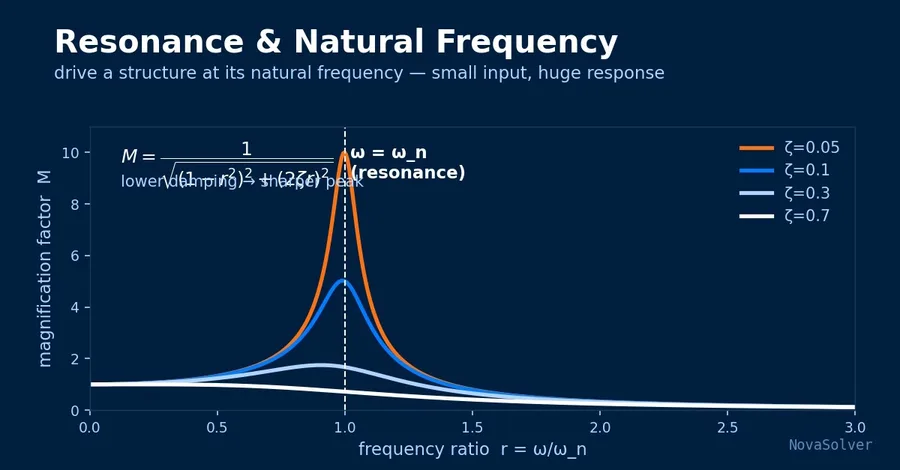
In 1831, a column of soldiers marched across the Broughton Suspension Bridge near Manchester and the bridge collapsed. The cadence of the march happened to match a frequency the structure responded to strongly, and each footfall added a little more energy than the bridge could shed. Armies have broken step on bridges ever since. The physics behind that order is the same physics that makes a wine …
Why is pulling a heavy object with a rope usually easier than carrying it by hand?
I have several 25-liter water containers stored in my yard a few meters from the entrance. When I tried moving them ...
I composed a problem and initially thought it could be solved by purely analytical means, but it turns out it cannot. The problem is as follows: a homogeneous ball of radius ##R## can rotate freely about its fixed center ##O##. Let ##J## denote its moment of inertia relative to an axis passing... Read more
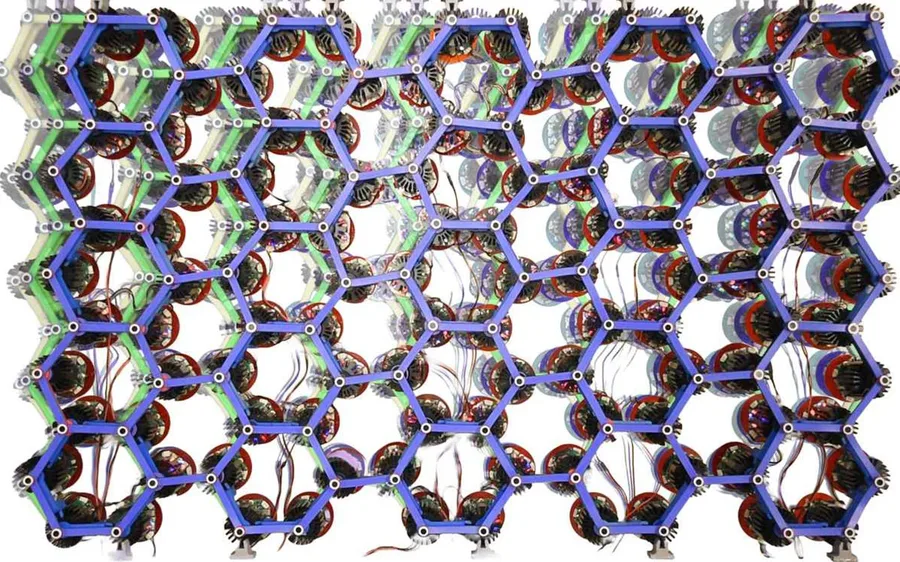
Physicists studying active matter — materials that can use their own internal energy to respond to forces — have uncovered surprising behaviors that challenge conventional ideas in mechanics. Materials that bend, snap, crawl, or even dig on their own may sound like science fiction, but physicists are now building systems that can do exactly that. [...]







 research.io