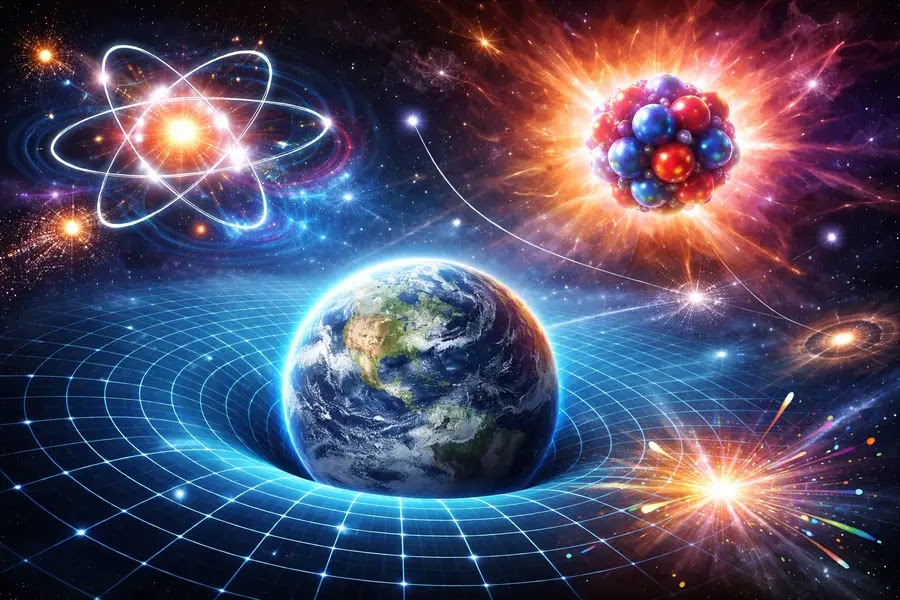
Gravity is something every person on Earth intuitively understands: It is what keeps you on the ground. But how come gravity pulls down, rather than pushes up? Einstein came up with the answer.
The David Potter Institute will combine theoretical and experimental physics, develop quantum sensors and train students working across quantum information, gravity and high energy physics Professors Jonathan Oppenheim, left, and Sougato Bose with the interferometer used to levitate nanospheres for experiments investigating whether spacetime is quantum. UCL is creating an interdisciplinary resear…
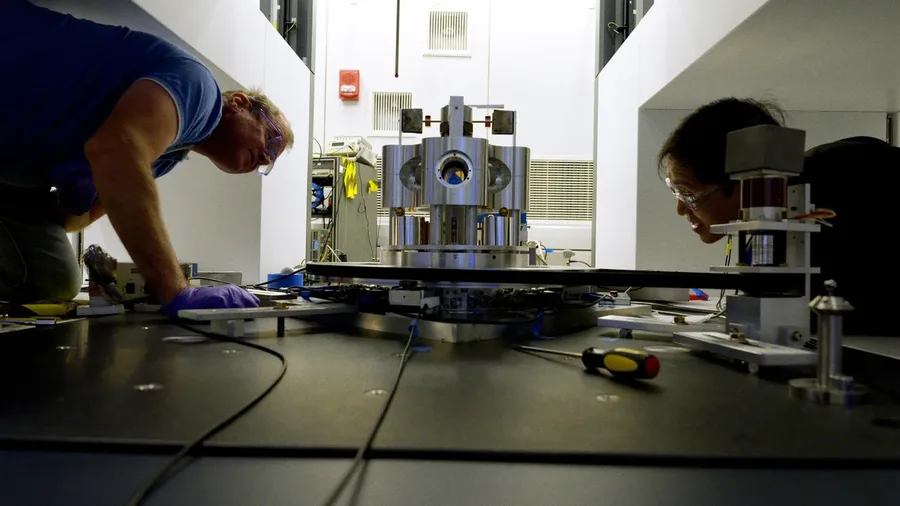
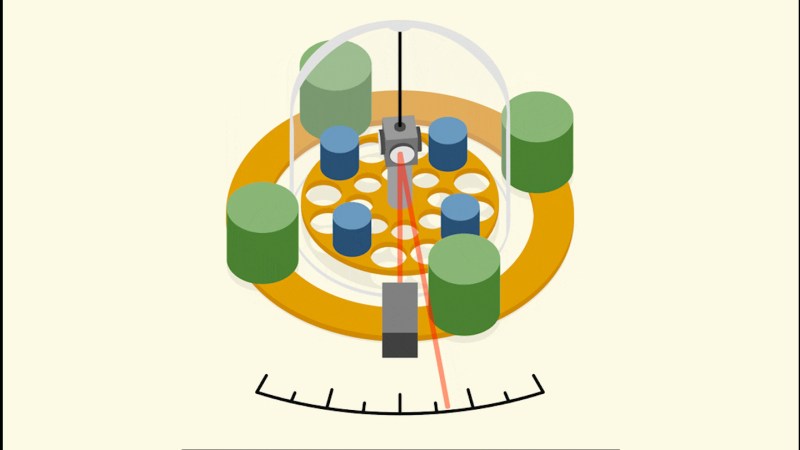
Physicists have been trying to measure the fundamental gravitation al constant for well over two centuries. The current accepted value of big G , as it’s known, is 6.67430 × 10 -11 cubic meters per kilogram per square second. It also has an uncertainty of ±0.00015 × 10 -11 m 3 /(kg s 2 ). As far as constants of the universe go, that’s very uncertain. Stephan Schlamminger Schlamminger is a physici…
On gravity in Randall-Sundrum models:
Andreas Karch, Lisa Randall, Locally Localized Gravity, JHEP 0105:008 (2001) [arXiv:hep-th/0011156, doi:10.1088/1126-6708/2001/05/008]
Andreas Karch, Randall-Sundrum Branes and Holography, talk at Strings 2022 [indico:4940841]
On AdS/CFT as open/closed string duality and early discussion of the concept of probe branes in AdS/CFT:
Introducing the concept of fl…
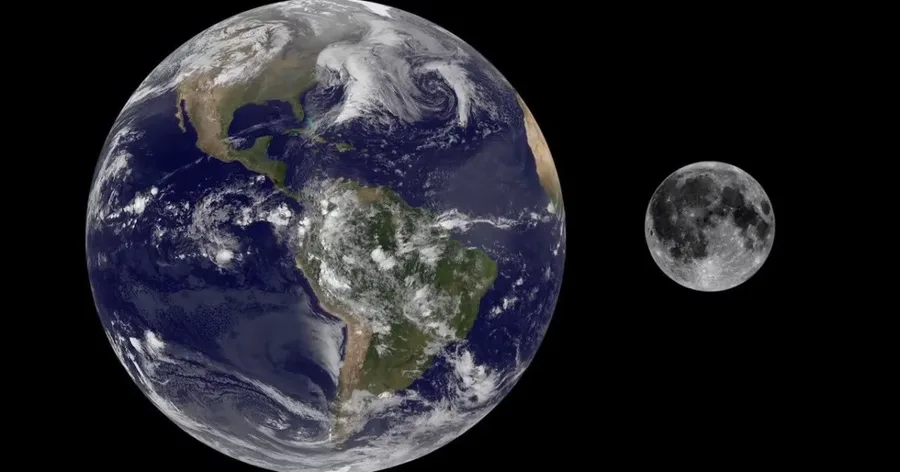
How can it be that the Moon’s mass is a little over 1 percent of Earth’s mass, while its gravity is about 17 percent of Earth’s gravity? Why aren’t the mass and gravity more closely correlated? John HaleyHuntsville, Alabama The answer to your question can be found in the universal law of gravitation, which states Continue reading "How is the Moon 1% of Earth’s mass, but its gravity is 17% of Eart…
I would like to explain to someone about why the Sun's gravity does not pull the Earth into the Sun. I know that the reason that the Sun's gravity does not pull the Earth into the Sun is that the momentum of the Earth orbiting the Sun is in equilibrium with the Sun's gravity. What I need to... Read more
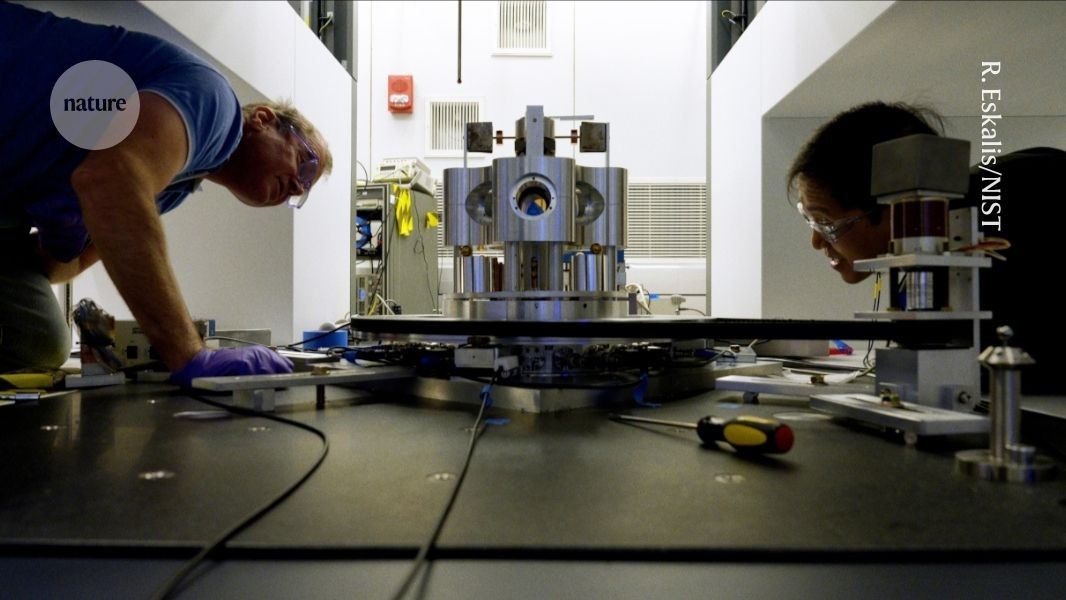
For more than 200 years, scientists have struggled to pin down the exact strength of gravity — and one physicist spent a decade chasing the answer while keeping his own results hidden from himself. Stephan Schlamminger and his team at NIST painstakingly recreated a landmark French experiment designed to measure “big G,” the universal gravitational constant that governs everything from falling app…
STEMgineer’s Guide to Problem Solving Workbooks What makes your feet stay on the ground? What keeps you from floating away into space? The answer is […] The post What is gravity? appeared first on STEM Education Works .
Hi What is the relationship between superconductors and gravity? Eugene podkletnov came up with some interesting findings. The first experiment centered on a spinning superconducting disk and the possibility of slight weight reduction above it .
Nature, Published online: 21 April 2026; doi:10.1038/d41586-026-01284-3 Physicists have spent the past decade trying to pin down the elusive fundamental constant, to no avail.
The present work develops a variational account of gravitational phenomena based on a closed quartic functional framework. Starting from a universal functional and its stationary condition, the admissible configuration space is constructed explicitly, together with the associated Hessian operator and its spectral structure. Within this framework, long-range interaction is not introduced as a fund…
Gravity is weaker than other fundamental forces because it spreads across extra dimensions and interacts universally with all mass-energy, diluting its strength. Unlike electromagnetism or nuclear forces, which act locally and strongly, gravity’s influence is cumulative but diffuse. Physicists suspect hidden dimensions or quantum effects may explain this imbalance, making gravity’s weakness one o…
Gravity is one of the great questions that classical science, based on the primacy of matter, has failed to resolve despite decades of countless efforts, just as it has failed to resolve the Three-Body Problem. This essay addresses how the impossibility of finding a general solution to these two key mysteries of Cosmology and Physics allows us, from the coherent framework of Informational Metaphy…
_Zenodo_. 2026This paper reclassifies the quantum gravity problem by exposing a directional error embedded in its very formulation. The phrase "quantum gravity" presupposes that gravity—like the other fundamental forces—should be quantized as an internal interaction. We demonstrate that this assumption conflates two operationally distinct roles: constraint (Type II) and generation (Type I). Gravi…



 research.io