The authors show that, contrary to this belief, at long horizons nothing is lost by ignoring cointegration when the forecasts are evaluated using standard multivariate forecast accuracy measures. In fact, simple univariate Box-Jenkins forecasts are just as accurate. The authors' results highlight a potentially important deficiency of standard forecast accuracy measures — they fail to value the ma…
I use QLIKE as loss function to evaluate the forecasting performance of a RV realized volatility model. QLIKE = log $h$ + $\frac{\hat{\sigma}^2}{h}$ where $h$ is volatility forecast and $\hat{\sigma}^2$ is the ex post value of volatility (realized volatility computed with intraday returns). If I proxy volatility with log(RV), what are $h$ and $\hat{\sigma}^2$ in the QLIKE? The forecast and ex pos…
Fractional Brownian motion is a stochastic process that can model mean reversion. Predicting future values turns out to be a simple linear model. This model has significant predictive power when applied to currencies.
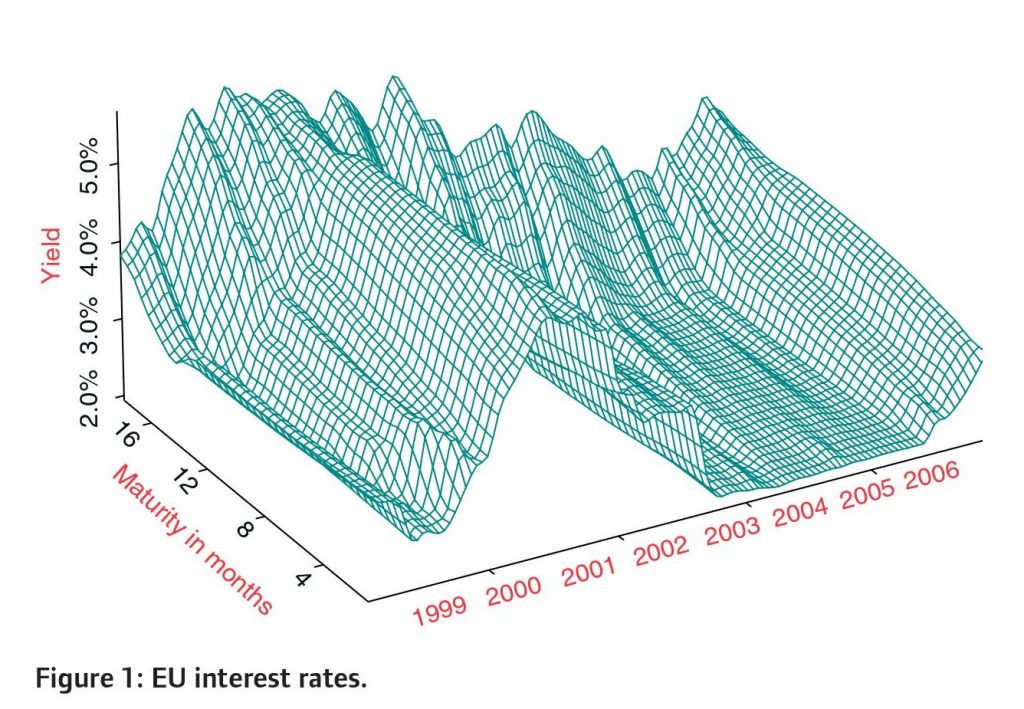
Methods capable of forecasting the entire yield curve based on a time series extension of the Nelson-Siegel model Nelson and Siegel (1987) were suggested in the literature and compared to the non-parametric alternatives Diebold and [...]
Today I was reading a recent discussion paper by Neil Ericcson , titled " Economic Forecasting in Theory and Practice: An Interview With David F. Hendry ". The interview is to be published in the International Journal of Forecasting . Here's the abstract: " David Hendry has made major contributions to many areas of economic forecasting. He has developed a taxonomy of forecast errors and a theory …
Here’s the start of the paper I’ve just written on forecasting the UK General Election (rather easy for a quant, much easier than valuing a CDO!), and lectured on for the CQF yesterday. The lecture [...]
Most economic data are released with a lag, sometimes quite a substantial one. Since the advent of regularly scheduled releases of economic data in the 1930s, a key challenge for economists has been to identify indicators that provide timely information about the release before it comes out—effectively, that “now-cast” its content.