A nasal spray containing vesicles naturally released by cells may work against Alzheimer's. This is the promise of a study conducted by researchers at the Universita Cattolica, Fondazione Policlinico Universitario A. Gemelli IRCCS, and the E. Menni Research Center of the Fondazione Poliambulanza.
Healthy middle-aged people deemed to be at higher risk of developing condition among those eligible to participate People without memory loss will be offered an experimental Alzheimer’s drug that could stop the development of the condition before dementia symptoms emerge. Healthy middle-aged people deemed to have a higher risk of developing the condition will be eligible to participate in the tri…
Two groundbreaking studies have fundamentally challenged established paradigms of Alzheimer’s disease progression by revealing previously unrecognized mechanisms of neurodegeneration. First, researchers from Columbia University overturned long-held assumptions about the tau protein, discovering that it is produced locally in neuronal dendrites rather than migrating from axons as previously believ…
A new study reveals that two different inflammatory proteins in the blood signal separate types of brain damage. Both distinct pathways ultimately converge to fuel Alzheimer's-related tau tangles, brain shrinkage, and memory decline in older adults.
IntroductionAnti-amyloid monoclonal antibodies are approved as disease-modifying therapies for early Alzheimer’s disease (AD), but real-world evidence remains limited, particularly among individuals treated during preclinical or minimally symptomatic stages. This study characterized clinical and biomarker trajectories among anti-amyloid therapy recipients across disease stages.MethodWe conducted …
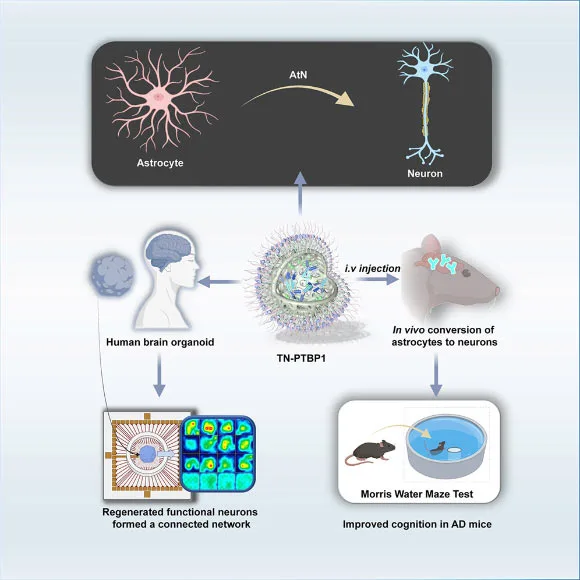
Scientists found a way to convert brain cells called astrocytes into neurons. In theory, this could replenish neurons lost in neurodegenerative conditions like Alzheimer's disease.
Researchers have developed a nanoparticle-based treatment that appears to improve performance on standard memory and learning tests as well as reduce brain inflammation and levels of amyloid-beta in mice with Alzheimer’s disease by converting star-shaped brain cells called astrocytes into functioning neurons. The post Nanoparticle Therapy Reverses Alzheimer’s Progression in Mice appeared first on…
Researchers used multi-ethnic proteomics and genetic data to identify blood proteins linked to Alzheimer’s risk. They found causal roles for immune-related proteins, highlighting potential diagnostic markers and drug targets.
(Washington Post) – The test is not meant for routine screening but can be pivotal for a diagnosis when cognitive problems are causing doctors to suspect the disease. The Food and Drug Administration has approved a new blood test for … Read More
A new research paper documents the outcomes of five volunteers who continued to receive 40Hz light and sound stimulation for around two years after participating in an MIT early-stage clinical study of the potential Alzheimer’s disease (AD) therapy. The results show that for the three participants with late-onset Alzheimer’s disease, several measures of cognition remained […]
Alzheimer’s disease may look similar from one person to another even when different biological processes are driving the damage, according to a new study led by researchers at the University of California, Irvine.
Researchers are finding ways to target the toxic proteins involved in neurodegenerative diseases such as Parkinson’s and Alzheimer’s that were once considered ‘undruggable.’
[Enigma Biomedical USA (Business Wire)] Enigma Biomedical USA announced the US FDA approval of TAUKLARIFY™, a radiodiagnostic agent indicated for positron emission tomography of the brain in adults with cognitive impairment who are being evaluated for Alzheimer’s disease to identify patients with tau neurofibrillary tangle pathology.
Acta Pharmacologica Sinica, Published online: 17 August 2026; doi:10.1038/s41401-026-01896-5 Oxyberberine-nanoparticle attenuates the cognitive deficits in a transgenic mouse model of Alzheimer’s disease via modulating gut microbiota through suppressing CXCL10/CXCR3 pathway
BackgroundEmerging evidence indicates that the neuroprotective effects of Astragalus polysaccharides (APS), an extract compound and bioactive constituent derived from traditional Chinese herbs, may be relevant to an effective prescription for delaying progression of Alzheimer’s disease (AD), yet the underlying mechanisms remain to be fully elucidated. This study aimed to investigate the therapeut…










 research.io