trigonometry

John D. Cook

The previous post gave a simple and accurate approximation for the smaller angle of a right triangle. Given a right triangle with sides a, b, and c, where a is the shortest side and c is the hypotenuse, the angle opposite side a is approximately in radians. The previous post worked in degrees, but here we’ll use radians. If the […] The post Approximation to solve an oblique triangle first appeare…

mathematicstrigonometry
Hot Questions - Stack Exchange

John D. Cook

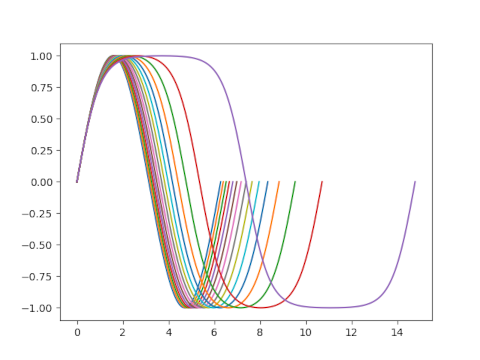
This post started out as a Twitter thread. The text below is the same as that of the thread after correcting an error in the first part of the thread. I also added a footnote on a theorem the thread alluded to. *** The following approximation for sin(x) is remarkably accurate for 0 < x […] The post Ancient accurate approximation for sine first appeared on John D. Cook .

mathematicstrigonometry
John D. Cook

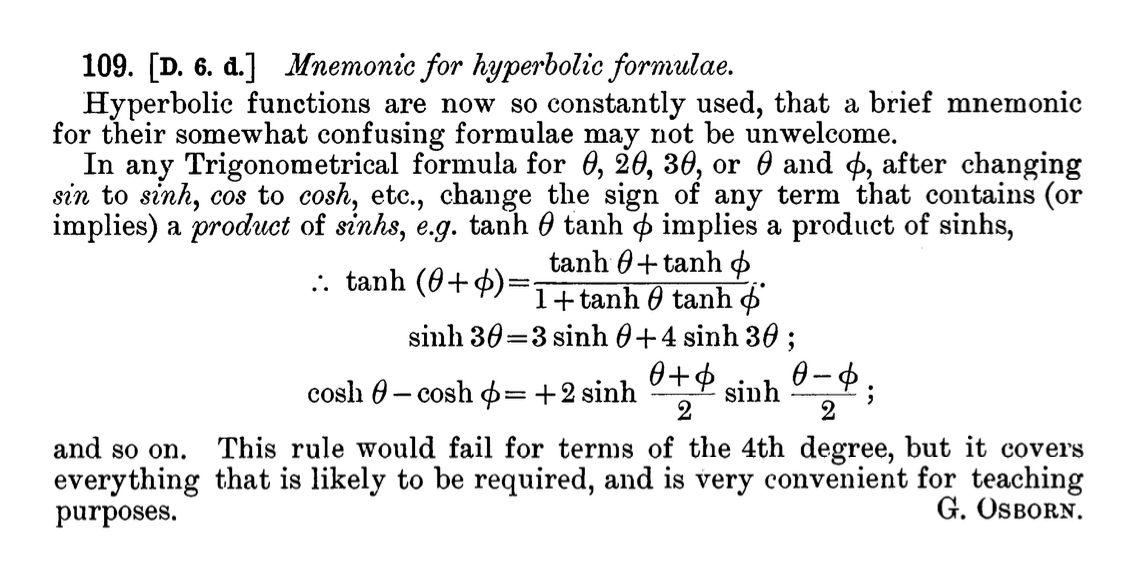
There is a simple rule of thumb for converting between (circular) trig identities and hyperbolic trig identities known as Osborn’s rule: stick an h on the end of trig functions and flip signs wherever two sinh functions are multiplied together. Examples For example, the circular identity sin(θ + φ) = sin(θ) cos(φ) + cos(θ) sin(φ) […] The post Rule for converting trig identities into hyperbolic id…

mathematicstrigonometry
John D. Cook

This post will explore how the trigonometric functions and the hyperbolic trigonometric functions relate to the Jacobi elliptic functions. There are six circular functions: sin, cos, tan, sec, csc, and cot. There are six hyperbolic functions: just stick an ‘h’ on the end of each of the circular functions. There are an infinite number of […] The post Circular, hyperbolic, and elliptic functions fi…

mathematicstrigonometry
John D. Cook
John
4/14/2023

This evening I ran across a trig identity I hadn’t seen before. I doubt it’s new to the world, but it’s new to me. Let A, B, and C be the angles of an arbitrary triangle. Then sin² A + sin² B + sin² C = 2 + 2 cos A cos B cos C. […] The post A new trig identity first appeared on John D. Cook .

mathematicstrigonometry
John D. Cook
John
1/6/2023

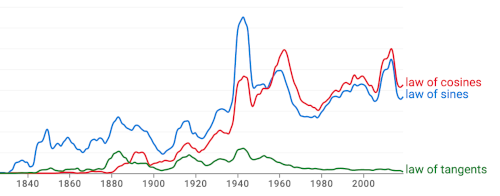
I would have thought that the laws of sines, cosines, and tangents were all about equally familiar, but apparently that is not the case. Here’s a graph from Google’s Ngram viewer comparing the frequencies of law of sines, law of cosines, and law of tangents. As of 2019, the number of references to the laws […] The post Law of tangents first appeared on John D. Cook .

mathematicstrigonometry
Physics Forums Insights

In calculus classes when you are asked to evaluate a trig function at a specific angle, it’s 99.9% of the time at one of the so-called special angles we use in our chart. Since you are likely to have learned degrees first I’ll include degree angles in the first chart, but after that, it’s gonna...

mathematicstrigonometry
Physics Forums Insights
Introduction Every secondary school student who has encountered trigonometry in his/her Math syllabus will most likely have come across the sine, cosine, and area rules which are typically used to solve triangles in which certain information is supplied and the remainder are to be calculated. Somewhat surprisingly (because it is relatively simple to derive), the...

mathematicstrigonometry
Chalkdust

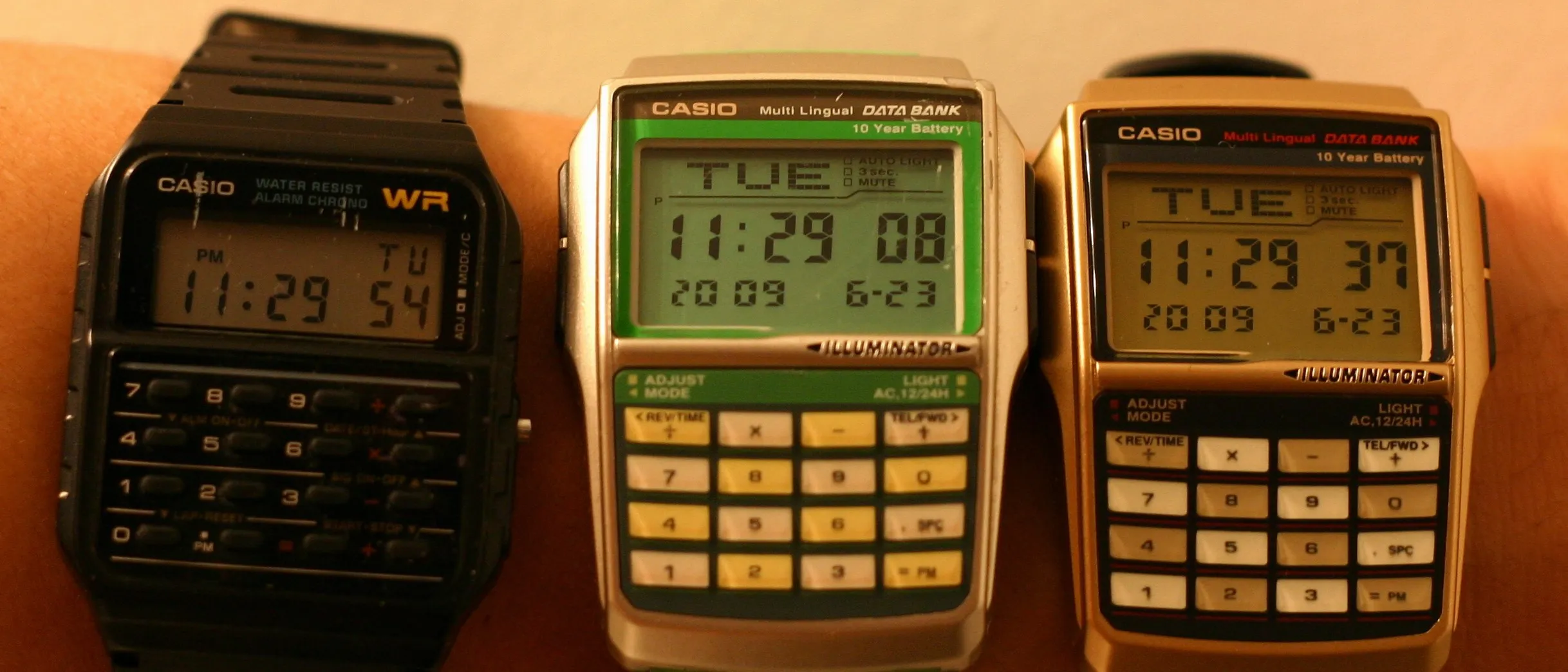
W.L. Feldhusen explains the obscure sine-finding trick hiding inside your calculator! The post How do calculators do trigonometry? appeared first on Chalkdust .

mathematicstrigonometry