Many of today’s electronic devices—from the semiconductors in your cell phone to the photovoltaic cells in your solar panels—are built on thin-film substrates. The thin film is an electrically conductive material, while the substrate is an inert material. Or is it? Physicists and materials scientists have long assumed substrates do not react to electrical stimuli, […]
Many of today's electronic devices are built on thin-film substrates where the thin film is electronically conductive and the substrate is inert. Or is it? New research from UC San Diego shows that substrates are not inert after all.
This study investigates the electrochemical properties of zinc hydroxide (Zn(OH)2) thin films synthesized through two distinct methods: chemical bath deposition (CBD) and successive ionic layer adsorption and reaction (SILAR). Notable variations in crystallite size, morphology, and bandgap energy were observed between the films synthesized using two methods. Specifically, a reduction in crystalli…
Scientific Reports, Published online: 11 May 2026; doi:10.1038/s41598-026-52482-y Structural, optical, and photodetection characteristics of thermally evaporated Azure A chloride/FTO thin films
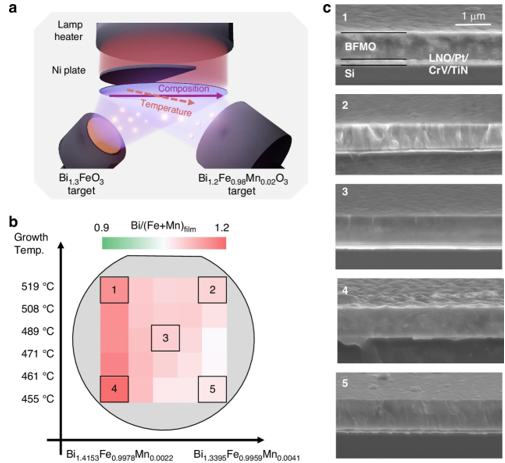
Overview of the biaxial combinatorial sputtering approach and the resulting films. a Schematic of the combinatorial radio frequency (RF) magnetron sputtering scheme; b mapping of composition ratio across a 2-inch wafer; c cross-sectional SEM images at various positions in the sample.
The kSA XRF (X-Ray fluorescence) tool measures film thicknesses below 100 nanometers for applications in coated glass, solar panels, and more. The post k-Space Launches Its Newest Thin Film Metrology Solution appeared first on Semiconductor Digest .
This process is a two-stage atomic layer deposition (ALD) process that uses hydrogen film formation to create a thin anti-oxidation film and oxygen for the deposition of a high-quality ruthenium film. The post TANAKA Establishes New Ruthenium Film Deposition Process appeared first on Semiconductor Digest .
Despite the many advantages of laser ablation, typical PLD suffers from ejection of micro scale particulates (or droplets) during the target ablation process. The deposition of such particulates is usually undesired in many applications as they can deteriorate the electrical, chemical, optical, and mechanical properties of the film. It is possible to reduce the density […]