Researchers at the Advanced Science Research Center at the City University of New York Graduate Center (CUNY-ASRC) have demonstrated something English mathematician and physicist Sir Roger Penrose predicted over 50 years ago. According to Penrose, it would be possible to extract energy from a rapidly spinning (Kerr) black hole by inserting an object into the […]
Explaining the passage of time has been a gnarly problem in physics basically forever, but physicist and computer scientist Stephen Wolfram has a radical proposal for where it comes from. He discussed his ideas on time – and what they mean for free will – with reporter Leah Crane
physics, mathematical physics, philosophy of physics
theory (physics), model (physics)
experiment, measurement, computable physics
Axiomatizations
Tools
Structural phenomena
Types of quantum field thories
examples
superalgebra and (synthetic ) supergeometry
supergravity in dimension 4.
The maximally supersymmetric -version arises from type II supergravity in 10 dimension by compactification on a …
This entry is about the concept in supergeometry. For the concept in gravity/cosmology see at Wheeler superspace.
superalgebra and (synthetic ) supergeometry
Physicists often refer to spaces in supergeometry, such as supermanifolds or super schemes, as superspaces. Hence a superspace can be an affine superspace (the affine counterpart of the super vector space over real or complex numbers), super…
Most philosophical debates about the emergence of molecular structure centre around the issue of irreducibility. Specifically, can the existence of structures be predicted from quantum theory without assuming their existence or invoking classical concepts? I will argue that the answer is yes, contrary to much of the philosophical literature, which relies heavily on the widespread use of the Born-…
Load Minimization Theory (LMT) has naturally given rise to four fundamental laws across different scales of human experience. This paper formally identifies them as the Four Laws of LMT and demonstrates their elegant fractal correspondence with the four fundamental forces of physics. We show that: ・The Primordial Exponential Meta-Law corresponds to the Strong Force (unification and compression). …
physics, mathematical physics, philosophy of physics
theory (physics), model (physics)
experiment, measurement, computable physics
Axiomatizations
Tools
Structural phenomena
Types of quantum field thories
examples
The theory of classical gravity (general relativity) a priori and straightforwardly admits the coupling to gravity of (matter-)fields with any covariant local Lagrangian. The resulting …
-From Intuitive Tension to a Unified Vibrational Ontology in Praline Load Minimization Theory- Abstract: The Praline Load Minimization Theory (PLMT) posits load minimization as the fundamental process underlying all physical phenomena. In this paper, we apply PLMT to M-theory’s eleven-dimensional framework and encounter a persistent intuitive tension: conventional hierarchical interpretations, pa…
This paper proposes a radical axiomatic framework for physics—the LC-R (Leech Lattice - Rate of Hysteresis) model—designed to resolve fundamental dilemmas such as UV divergence and the Mass Gap problem inherent in continuous manifold-based gauge theories. We depart from the traditional assumption of differentiable spacetime, adopting the 24-dimensional Leech Lattice ($\Lambda_{24}$) as the "hard-…
Joel Allen Smoller
Solutions in Einstein-Yang-Mills theory:
Joel Smoller, Arthur Wasserman, Shing-Tung Yau, J. Bryce McLeod, Smooth static solutions of the Einstein-Yang/Mills equation, Bull. Amer. Math. Soc. (N.S.) 27, pp. 239-242 (1992) [arXiv:math/9210226 doi:10.1007/BF02097002]
Joel Smoller, Arthur Wasserman, Existence of infinitely-many smooth, static global solutions of the Einstein-Yang-Mi…
The present work develops a variational account of gravitational phenomena based on a closed quartic functional framework. Starting from a universal functional and its stationary condition, the admissible configuration space is constructed explicitly, together with the associated Hessian operator and its spectral structure. Within this framework, long-range interaction is not introduced as a fund…
Roger Penrose is a very well-known mathematician, physicist, and author who won the Nobel Prize a few years back. He’s repeatedly questioned string theory’s prominent role in physics today, most notable in his 2016 book “Fashion, Faith and Fantasy” (the “fashion” part refers to string theory). We finally have a response.
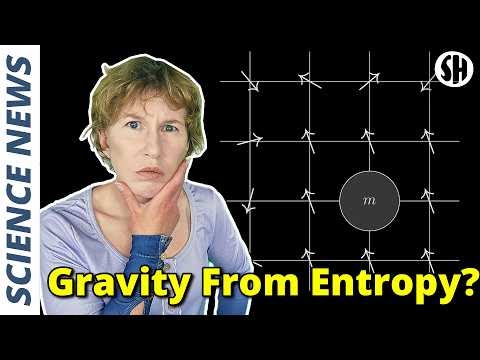
Over the past few decades, the idea that gravity is not a fundamental interaction but is instead caused by the increase of entropy has become increasingly popular in the world of physics. Today, we have a paper from a group of physicists who claim that entropic gravity might be the result of space being full of qubits. Let’s take a look.
University of Portsmouth physicist Melvin Vopson proposes a new way to think about gravity -- not just as a pull, but as something that happens when the Universe is trying to stay organized. The post Gravity is Result of Computational Process within Our Universe, Physicist Says appeared first on Sci.News: Breaking Science News .
This stunning simulation of Calabi-Yau spaces at each point in 3-d space was created by Jeff Bryant and based on concepts from A.J. Hanson, “A Construction for Computer Visualization of Certain Complex Curves,” in “Computers and Mathematics” column, ed. Keith Devlin, of Notices of the American Mathematical Society, 41, No. 9, pp. 1156–1163 (American Math. Soc., Providence, … Continue reading Wha…
It was June 4th, 2018, when Robbert Dijkgraaf, director of the world-renown Princeton Institute for Advanded Study, announced his breakthrough insight. After decades of investigating string theory, Dijkgraaf has concluded that there are no laws of physics.
Guess that’s it, then, folks. Don’t forget to turn off the light when you close the lab door for the last time.
Dijkgraaf knows what he is
For those who just want the survey itself, not the backstory, it’s here. (Note: Partly because of the feedback I’ve gotten on this blog, it’s now expanded to 121 pages!) Update (Jan. 23) By request, I’ve prepared a Kindle-friendly edition of this P vs. NP survey—a mere 260 pages! Two years ago, I learned that John […]
On the one hand it is good to get members of the general public excited about scientific research, and so having some new excitement about something Stephen Hawking said, driven by gushingly written articles in the press and online, can be good. On the other hand, it is annoying that the thrust of the articles are largely that he's stunned the world again with a brilliant and unlooked-for idea. P…
Too many term papers to grade? Tenure clock running? Don't have the time to crank out a new theorem today? Fear not! TheoryMine can come to your rescue. As they so delightfully explain: "You can name your very own mathematical theorem, newly generated by one of the world's most advanced computerised theorem provers (a kind of robot mathematician), and you can immortalise your loved ones, teachers…
Edward Witten gave two talks at MIT last week. The first was on gauge theory and wild ramification – very similar to earlier work he did with Kapustin and Gukov on geometric Langlands, but with some clever use of nineteenth century technology (namely, Stokes matrices) to deal with irregular singularities. I won’t say much about […]




 research.io