IntroductionGeomagnetically induced currents (GICs) pose a critical space weather hazard to ground-based conductive infrastructure. Previous studies have commonly identified large GIC events using daily maximum amplitudes exceeding 10 A, a criterion that may obscure the detailed temporal structure of GIC disturbances.MethodsIn this study, we apply an improved identification criterion to systemati…
Earth’s magnetic field is like a powerful trap. It lures electrically charged particles in space, near our planet, and snares them in an invisible, doughnut-shaped pen around Earth known as the ring current. This captive swarm of charged particles plays an important role in how Earth reacts to changing conditions in space, called space weather, which […]
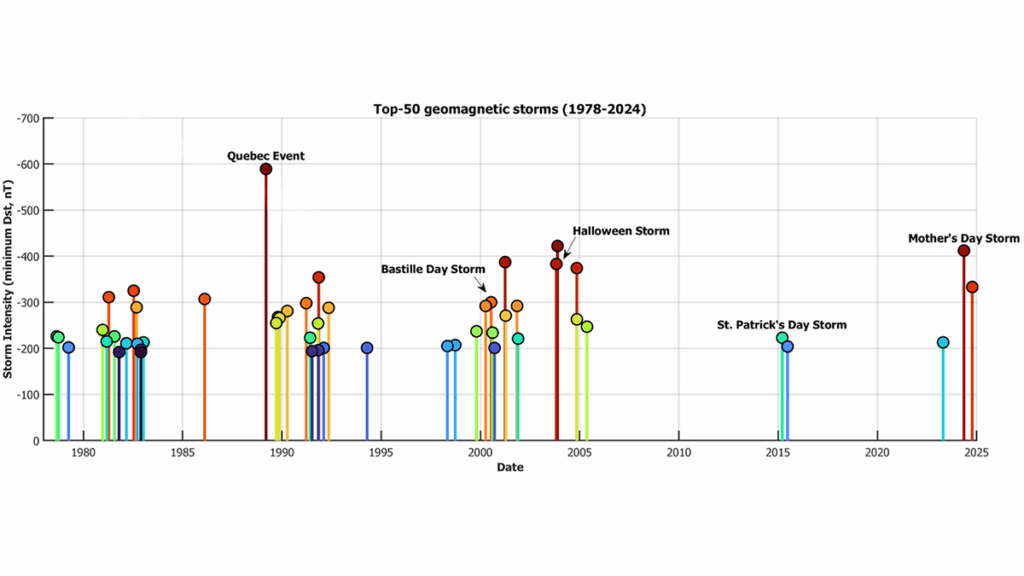
Very few geomagnetic storms (only five of the top 50 in 1978-2024) have been assigned a name in the scientific community, as indicated in this chart. The minimum Disturbance Stom Time (Dst) index of a storm is a key indicator of its peak intensity: Dst is a measure of the disturbance of Earth’s magnetic field, in units of nano-Tesla (nT), resulting from the electrical current (“ring current”) aro…