Consider the following predator-prey system:
$$
\begin{cases}
\dfrac{dN}{dT} &= rN\left(1-\dfrac{N}{K(T)}\right)
-aN^\alpha P
-\dfrac{qEN}{mE+nN},\\
\dfrac{dP}{dT} &=-d_1P+aeN^\alpha P.
...
Nature, Published online: 08 June 2026; doi:10.1038/d41586-026-01584-8 An exploration of chaos theory in population dynamics showed that unpredictable systems can often be modelled using surprisingly simple mathematics.
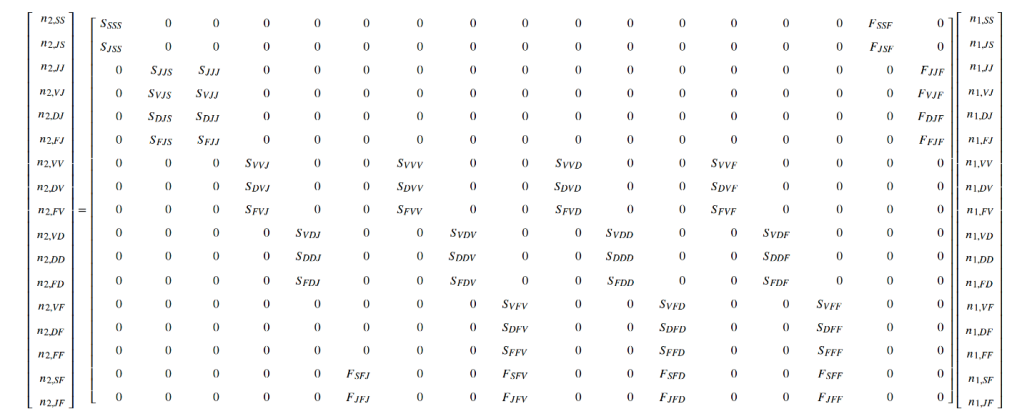
Post provided by Rich Shefferson Matrix projection modeling is a mainstay of population ecology. Ecologists working in natural area management and conservation, as well as in theoretical and academic realms such as the study of life history evolution, develop and use these models routinely. Matrix projection models (MPMs) have advanced dramatically in complexity over the years, originating from a…
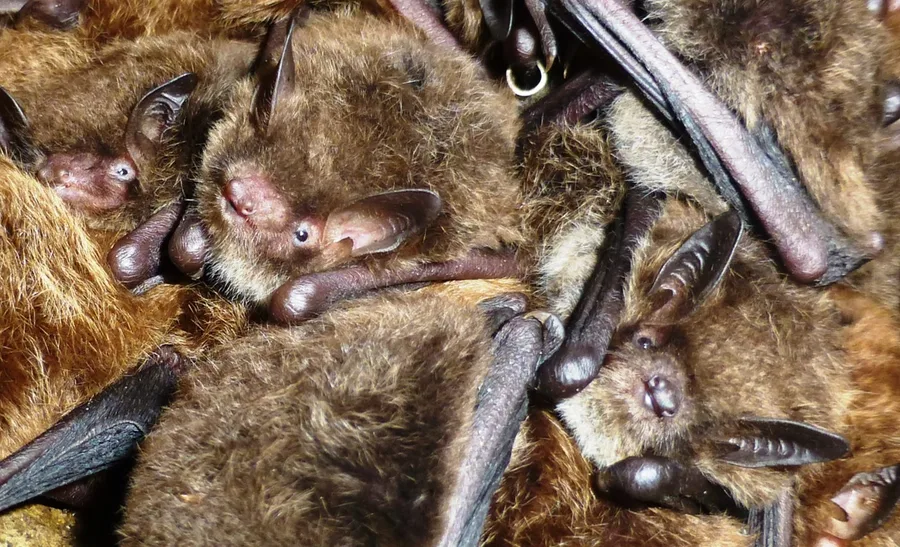
Understanding the trade-offs between survival and reproduction is essential for the study of population dynamics. A recent paper in the Journal of Animal Ecology used a novel statistical framework to reveal previously unknown life-cycle trends for two sympatric bat species. Lead author Dr Antica Culina from the University of Oxford and Netherlands Institute of Ecology, explains the research. Surv…
This guest post by Professor Charles J. Krebs (Department of Zoology, University of British Columbia) looks back at his experiences studying population cycles across several decades, his work with Charles Elton and the team of people who made such work possible. In 1959 I began my Ph.D. research on lemming cycles under Dr. Ian McTaggart Cowan at the University of British Columbia (UBC), Canada. T…
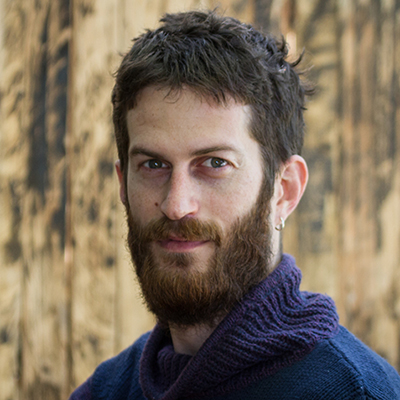
Dr Yoav Ram
Postdoctoral fellow
Contact
Email: Yoav Ram
Phone: +1 415 960 7839
Biosketch
Yoav Ram is a CEHG postdoctoral fellow in the Feldman Lab at Stanford University. He is a biologist with a special interest in evolutionary theory, population dynamics, and cultural evolution. He is also a mathematician who particularly likes applying probabilistic and statistical models to biological questio…