A plain-language essay explaining why photosynthesis operates at the precise boundary between quantum coherence and environmental noise. The seam condition R = Jτ/ℏ = 1 identifies the unique point where the coherent transport rate matches the decoherence rate. For the FMO complex, this yields a parameter-free decoherence-time prediction of 61 fs from the coupling alone — within 2% of experiment. …
Scientists from the Indian Institute of Science (IISc) and Caltech have finally solved a decades-old mystery about how photosynthesis really begins. They discovered why energy inside plants flows down only one of two possible routes — a design that lets nature move sunlight with astonishing precision. Using advanced computer simulations, the researchers showed that one branch has a much higher en…
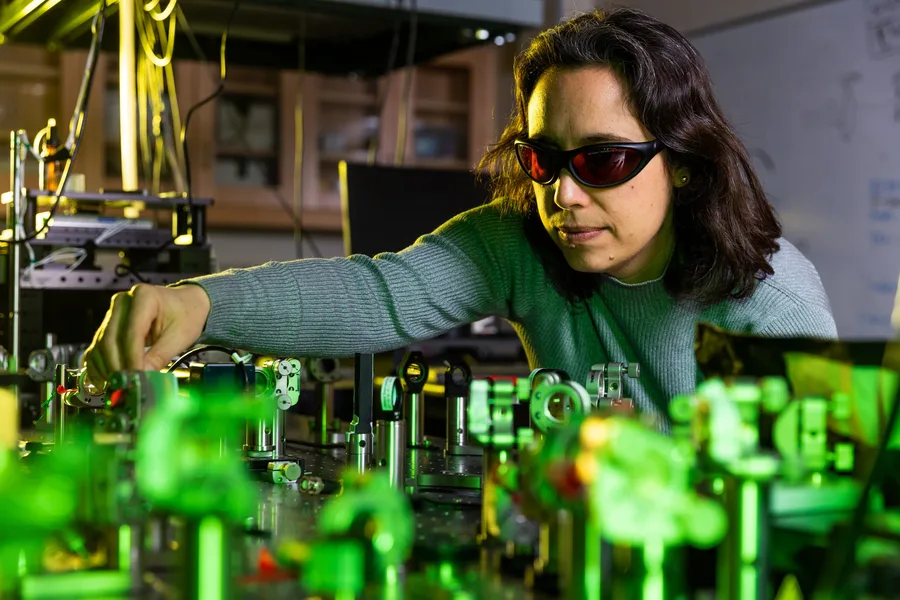
Daisy Ludlow is currently in her second year at MIT. She lived in Los Angeles until the age of nine, when she then moved to Utah. A member of the Schlau-Cohen Lab, Daisy is currently working on using two-dimensional electronic spectroscopy to study photosynthetic light-harvesting complexes. This has applications in solar energy technology and improving crop yields. […]
New research reveals how marine microbes use an extra membrane that once had digestive functions to boost their yield from photosynthesis. The post Microbes Gained Photosynthesis Superpowers From a ‘Proton Pump’ first appeared on Quanta Magazine
One of the fundamental concepts in biology is photosynthesis, the process by which plants use carbon dioxide, light, and water to make their own food.... The post Determining the Best Light Source for Photosynthesis appeared first on Vernier .
During photosynthesis, chlorophyll in plants absorbs packets of energy called photons from the sun’s rays. This energy is then transferred to a series of other chlorophyll molecules organized by protein scaffolds, funneling the energy into the next stage of photosynthesis. Those early light-harvesting stages of photosynthesis involve repeated excitation of pigments, as photons are passed […]
Photosynthesis is a key biological process that transforms light energy into chemical energy that is stored in organic molecules. It takes place in plants, algae, and some bacteria. The majority... The post Photosynthesis: Factors Affecting It and Its Different Types appeared first on THE SCIENCE NOTES .
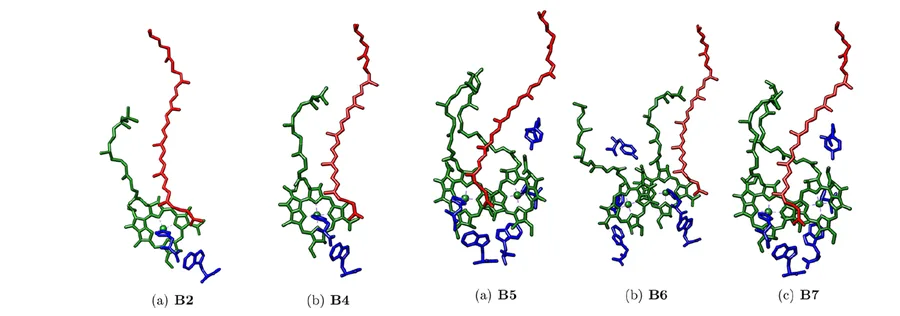
Photosynthetic organisms are so widespread around the globe they have adapted to various solar lighting conditions to thrive. The bacteria Blastochloris viridis absorbs light in the near infrared region of the electromagnetic spectrum, in fact, it holds the record for the longest wavelength (~1015 nm) absorbing organism whose Light Harvesting complex 1 (LHC1) has been […]
Dr. Gaylon S. Campbell discusses how to measure light and photosynthesis (PAR) in canopies and why it’s helpful to researchers. The ultimate source of all energy on earth is the sun. Availability of this energy to most organisms occurs through photosynthesis, the conversion of CO2 and H2O to carbohydrates (stored energy) and O2. Photosynthesis occurs […] The post Measuring Light and Photosynthesi…
In 1727, the English botanist Stephen Hales published a book, Vegetable Statick s, in which he observed that the plants use mainly air as the nutrient during their growth. In 1774 Joseph Priestly discovered oxygen and experimented with this new, invisible gas. He found that plants could restore air which has been injured by the burning of candles. A few years later, in 1977, Jan Ingenhousz, Dutch…