Galaxies grow through mergers and collisions, and astronomers want to know more about the mergers in the Milky Way's past. But mergers can stir up the stars in the resulting galaxy, making it difficult to determine exactly when an ancient merger occurred. A new study led by researchers at the Institute of Cosmos Sciences of the University of Barcelona (ICCUB) and the Institute of Space Studies of…
Scientists have uncovered the true boundary of the Milky Way’s star-forming region using stellar “age mapping.” They found a telltale U-shaped pattern showing that star formation drops sharply around 35,000–40,000 light-years from the center. Beyond that, stars are mostly migrants, slowly drifting outward rather than forming in place. The discovery gives a long-sought answer to where our galaxy’s…
The distribution of post-starburst regions within galaxies is linked to diverse quenching pathways that are likely driven by mergers. Guest author, Emmy Wisz, explains how different star formation histories could be the key to understanding quenching mechanisms.
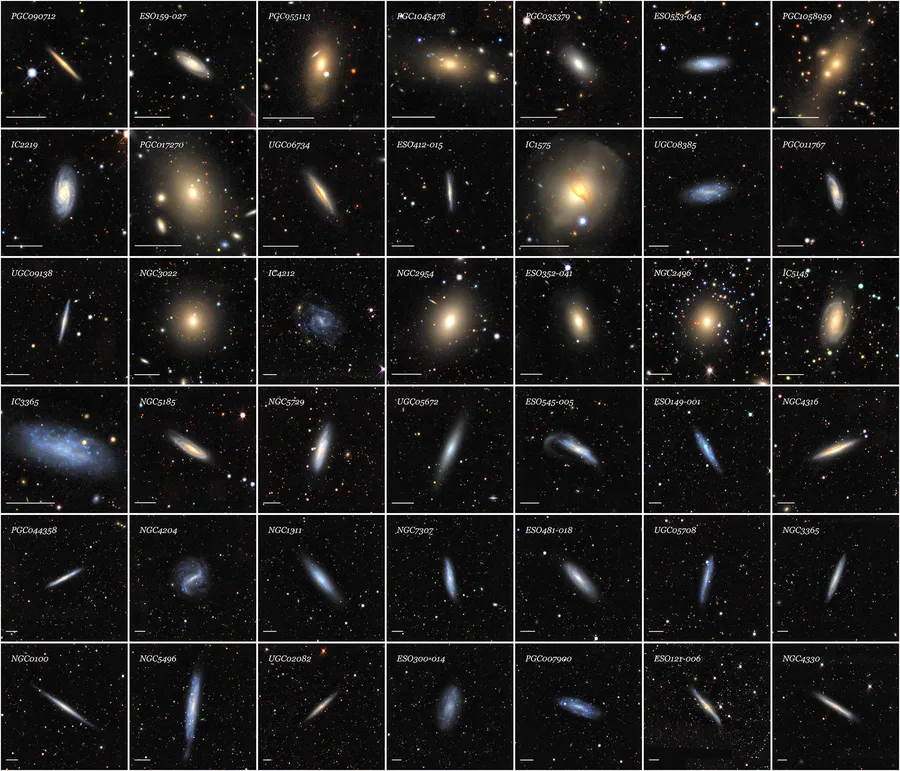
Astronomers have created a detailed atlas of almost 400,000 galaxies in our cosmic neighborhood. The Siena Galaxy Atlas was compiled using data from NSF's NOIRLab telescopes, and is designed to be the pre-eminent digital galaxy atlas for large galaxies. It’s a treasure trove of information for researchers investigating everything from galaxy formation and evolution to dark matter and gravitationa…