When solving a differential equation (like $\frac{dy}{dx} + 3x = 5x$, or simplified to $\frac{dy}{dx}=2x$), how does the logical framework and process of solving it work in formal/rigorous ...
Second order linear differential equations with polynomial coefficients form their own area of study. This seems like a narrow class of equations, but it’s very important in applications. This class of equations seems like a mathematically natural topic, but why is it so important in applications? I did a PhD in differential equations without ever […] The post Why polynomial coefficients? first a…
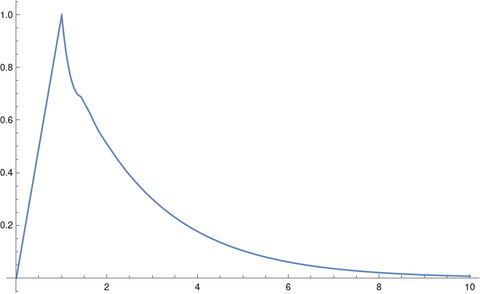
Here’s kind of a strange problem with an interesting solution: find a function f such that the derivative of f equals the inverse of f for all positive x. f ′(x) = f−1(x) This is a differential equation, but a very unusual one, one that cannot be solved using any of the techniques taught in a class on differential equations. […] The post Derivative equals inverse first appeared on John D. Cook .
I notice that a lot of books on basic differential equations focus more on initial value problems (IVP) than on boundary value problems (BVP). I also notice that a lot of functional analytic ...
I notice that a lot of books on basic differential equations focus more on initial value problems than on boundary value problems. I also notice that a lot of functional analytic approaches to ...
I am trying to find an example of the title. My first thought was to set something like
$$ x'(t) = \begin{cases} 1, x \geq 0 \\ 0, \text{else} \end{cases}$$
But this differential equation doesn't have ...
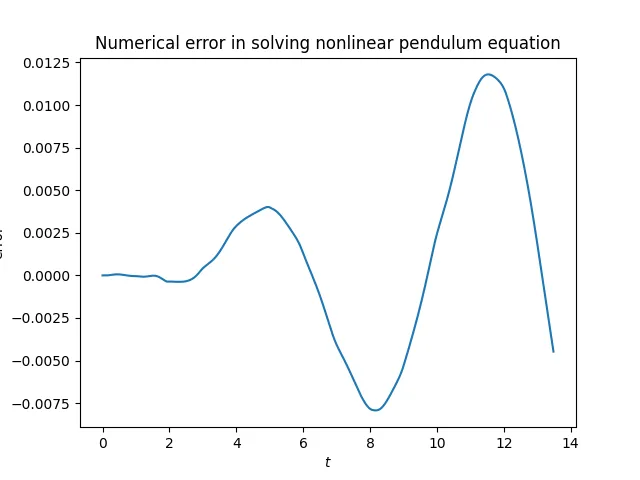
The previous post looks at the nonlinear pendulum equation and what difference it makes to the solutions if you linearize the equation. If the initial displacement is small enough, you can simply replace sin θ with θ. If the initial displacement is larger, you can improve the accuracy quite a bit by solving the linearized […] The post Closed-form solution to the nonlinear pendulum equation first …
In grad school I specialized in differential equations, but never worked with delay-differential equations, equations specifying that a solution depends not only on its derivatives but also on the state of the function at a previous time. The first time I worked with a delay-differential equation would come a couple decades later when I did […] The post Differential equation with a small delay fi…
When solving a fixed-constant linear ordinary differential equation where the part of the homogeneous solution is same form as part of a possible particular solution, why do we get the next independent solution in the form of x^n* possible form of part of particular solution? Show this through an example. See the pdf file ______________________ … Continue reading "Why multiply possible form of p…
Rate equations for level populations in rare earth ions are often of a kind which is called a stiff set of differential equations. The article discusses this in some detail and draws a number of conclusions, which are relevant e.g. for the modeling of fiber amplifiers and fiber lasers.
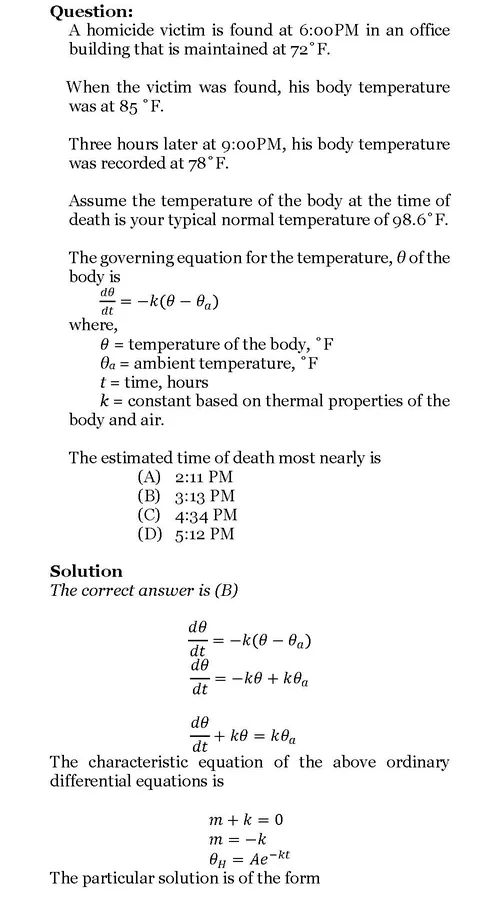
One of the classical applied problems in ordinary differential equations is that of finding the time of death of a homicide victim. The estimation of time of death is generally based on the temperature of the body at two times – 1) when the victim is found and 2) then a few hours later. Assuming … Continue reading "Time of death – a classic ODE problem"