developmental-neuroscience
Adolescence is widely thought to be a time when the brain trims away excess neural connections, refining circuits through synaptic pruning. New research now suggests this view may be incomplete. Adolescence is when the brain’s “control center” keeps coming online. As teens move toward adulthood, skills like planning ahead, weighing consequences, and solving unfamiliar problems [...]
Researchers from the City University of New York (CUNY) Graduate Center and Queens College suggest that building strong adaptive skills in early childhood may serve as a buffer against the detrimental effects of prenatal stress on a child's developing brain.
Scientists have made a major advance in developmental neuroscience, creating the very first detailed atlas of how the vascular network of a mouse's brain grows after birth. Their study is published in Cell.
Editorial Accepted on 03 Apr 2026 Editorial: Neurodevelopment: parental influences, in utero exposures, and genetics, volume II in Neurodevelopment Editorial Accepted on 03 Apr 2026 in Neurodevelopment Original Research Published on 01 Apr 2026 in Neurodevelopment Mini Review Accepted on 31 Mar 2026 in Neurodevelopment Original Research Accepted on 31 Mar 2026 in Neurodevelopment Original Researc…
A single query—Can your income meet your family’s basic needs?—appears to capture something profound about infant brain development. Researchers measuring electrical brain activity in babies during their first year of life found that caregivers who answered “never” or “rarely” to that question had infants whose brains showed slower maturation patterns, even when other risk factors were accounted …
We are now calling for the 10th Joseph Altman Award in Developmental Neuroscience. The Award recipient will be recognized at the annual meeting of the Japan Neuroscience Society. The application deadline is on January 31st, 2026 – click here for more information. We look forward to receiving many applications. The post Call for the Joseph Altman Award in Developmental Neuroscience, 2026 appeared …
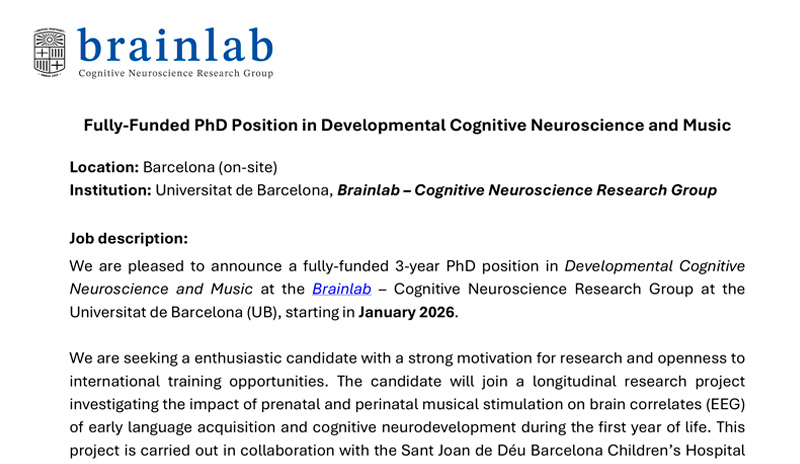
We are pleased to announce a fully-funded 3-year PhD position in Developmental Cognitive Neuroscience and Music at the Brainlab – Cognitive Neuroscience Research Group at the Universitat de Barcelona (UB), starting in January 2026. We are seeking a enthusiastic candidate with a strong motivation for research and openness to international training opportunities. The candidate [...] The post Fully…
The Japan Neuroscience Society (JNS), an IBRO society member, is calling for nominations for the 2024 Joseph Altman Award in Developmental Neuroscience. Named after Dr. Joseph Altman, the discoverer of neurogenesis in the adult mammalian brain, the award was established with a fund donated to the JNS by Dr. Shirley A. Bayer, a widow and […] The post Call for nominations for the 2024 Joseph Altman…
The Japan Neuroscience Society (JNS), an IBRO society member, is calling for nominations for the 2023 Joseph Altman Award in Developmental Neuroscience. Named after Dr. Joseph Altman, who discovered neurogenesis in the adult mammalian brain, the award was established with a fund donated to the JNS by Dr. Shirley A. Bayer, a widow and long-term […] The post Call for nominations for the 2023 Joseph…
Learning to navigate social relationships is a skill that is critical for surviving in human societies. For babies and young children, that means learning who they can count on to take care of them. MIT neuroscientists have now identified a specific signal that young children and even babies use to determine whether two people have […] The post Babies can tell who has close relationships based on…
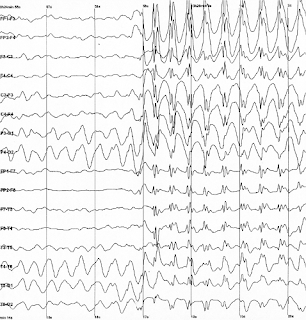
We can’t measure the brain activity of a human foetus – not whilst they’re inside their mother. But we’re really interested. What happens to a baby’s brain as it’s developing, and what does this tell us about our own and the developing process of sleep? EEG (electroencephalogram) reading via Wikipedia Commons . Researchers into brain activity have performed EEG (electroencephogram) exams on prema…
When children, especially very young children, are separated from their parents, it can lead to a lifetime of negative consequences. Young children rely on their parents to help them regulate their emotions and separating them from their parents negatively affects brain development. […] The post How Separating Children from Parents Does a Lifetime of Harm appeared first on The Neuroscience Schoo…
First Neuroscience Research Lab in Ghana Dr. Francis Djankpa, a developmental and molecular neuroscientist, has returned to Ghana to start his own lab with the support of an IBRO Return Home Fellowship. The laboratory will be the first neuroscience research laboratory in the country and will be based in the School of Medical Sciences at […] The post First Neuroscience Research Lab in Ghana appear…
The brilliant developmental neuropsychologist Annette Karmiloff-Smith has passed away and one of the brightest lights into the psychology of children’s development has been dimmed. She actually started her professional life as a simultaneous interpreter for the UN and then went on to study psychology and trained with Jean Piaget. Karmiloff-Smith went into neuropsychology and starting … Continue r…
The brain develops dramatically during childhood. These neural changes occur in the child’s interaction with its environment. The brain becomes a brain that functions in the culture in which it develops. If a child is mistreated, if it is deprived of important forms of interaction, like language and care, the brain is deprived of its […] The post The brain develops in interaction with culture app…
CNS 2014 Blog Our cognitive fates are not sealed – that was a powerful message that came out yesterday from a session on developmental cognitive neuroscience at the CNS meeting in Boston. In four talks, speakers laid out new ways neuroscience findings can help children learn, even if they are experiencing challenges because of a […] The post Changing Children’s Cognitive Abilities Through Targete…
For children with autism, being born several weeks early or several weeks late tends to increase the severity of their symptoms, according to new research out of Michigan State University. Additionally, autistic children who were born either preterm or post-term are more likely to self-injure themselves compared with autistic children born on time, revealed the study by Tammy Movsas of MSU’s Depa…