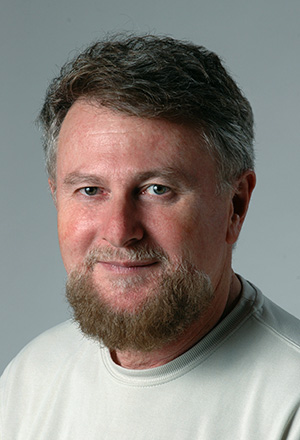
Xave Bower graduated from the University of Chicago in 2020 with a B.S. in Molecular Engineering, and a background in immunoengineering research. They spent 4 years in R&D at BillionToOne, […]
Please join us for the 2026 Rising Star Lecture in Bioengineering Dr. Neha Kamat Associate Professor of Biomedical Engineering Center of Synthetic Biology Northwestern University Wednesday, September 9 4:00 – 5:00 PM 105 Stanley Hall, UC Berkeley “Harnessing Membrane-Protein Interactions to Engineer Synthetic and Cellular Lipid Membranes” Abstract: Membranes play a vital role in a…
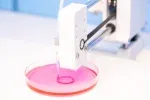
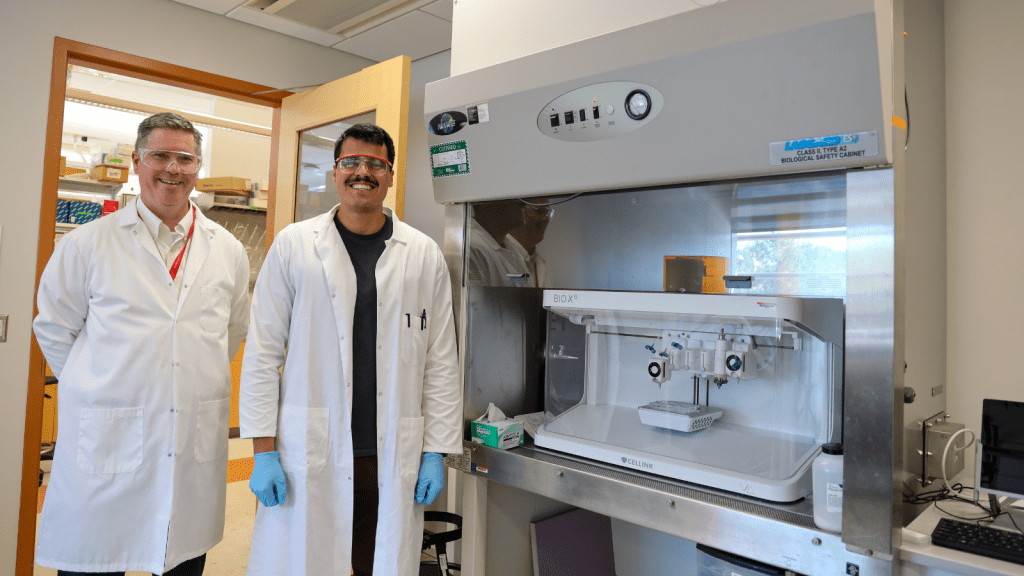
An EU-funded research team has developed a 3D bioprinting technique that grows living bone, fat and muscle tissue in the lab, with uses stretching from leukaemia research to cultivated meat.  The work comes out of PRISM-LT, a five-year project running until 2027 and coordinated scientifically by Massimo Vassalli, professor of bioengineering at the University of…
We are very proud to announce that fifteen Berkeley Bioengineers are receiving NSF Graduate Research Fellowships this year – one of the most competitive and prestigious awards for early-career PhD students. Congratulations to graduating seniors Esha Ananth, Emilie Petit and Christopher Zavala; recent BS alumni Sina Ghandian ’21, Pamela Herrera ’25, Cassandra Reyes ’24, Han…
Are you a student researcher looking for conferences to present your work at? iGEM at Berkeley is collaborating with UC Davis BioInnovation Group, Stanford iGEM, and other universities to bring you our third annual Bay Area Bioengineering Symposium (BABS), centered around exciting research like yours! This opportunity will be happening on Sunday, April 26th at Hearst Mining,…
Congratulations to Martin Carrasco, who was recently selected for the Mickey Dale Family Foundation Endowed Distinguished Graduate Fellowship in Bioengineering! See below for a snippet of the story: The A. James Clark School of Engineering at the University of Maryland, … Continue reading →
Notre Dame’s Bioengineering & Life Sciences Initiative has announced significant investments aimed at enhancing and growing biomedical research at the University. These include funding of four new cross-disciplinary faculty research teams and a milestone instrument acquisition that will enable cutting-edge experimentation and discovery. “These exciting commitments have launched large-scale invest…
A recent study calls into question the traditional distinction between individual and collective intelligence, suggesting that they share common elements. This finding could have potential applications in bioengineering and artificial intelligence. The research, conducted by Michael Levin and Richard Watson, was published by Sage Journals. Read more…
PhD alumna Julea Vlassakis, now Assistant Professor of Bioengineering at Rice University, has been named a 2023 NIH Director’s New Innovator! These prestigious awards support early-career investigators with ambitious, unconventional project proposals demonstrating broad impact potential.
Dr Giselle Yeo is an NHMRC Emerging Leadership Fellow and Group Leader at the Charles Perkins Centre, School of Life and Environmental Sciences at the University of Sydney. She completed her PhD in matrix protein biochemistry at the University of Sydney, then continued on with postdoctoral studies in the biofunctionalisation of materials for tissue engineering […]
ME Professor of the Graduate School Boris Rubinsky has been awarded the 2023 H.R. Lissner Medal from the Bioengineering Division of the American Society of Mechanical Engineers (ASME). The H.R. Lissner Medal recognizes outstanding achievements in the field of Bioengineering in the form of (1) significant research contributions in bioengineering; (2) development of new methods… The post ME Profess…
Congratulations Professor Aaron Streets, presented the 2023 Chancellor's Award for Advancing Institutional Excellence and Equity for outstanding contributions in advancing diversity, equity, inclusion, belonging, and justice. Streets is an award-winning bioengineer whose wide-ranging efforts to diversify engineering and the biosciences have been deeply transformative. He is the DIrector of the Bi…
Dr. Katharina Maisel obtained her BSE in Materials Science and Engineering from the University of Michigan and PhD in Biomedical Engineering from Johns Hopkins University. She completed her postdoctoral training at the University of Chicago in lymphatic and respiratory immunobiology prior to joining the Fischell Department of Bioengineering at the University of Maryland as faculty […]
Dr. Kevin McHugh is an Assistant Professor and CPRIT Scholar in Cancer Research in the Department of Bioengineering at Rice University whose work has been featured in journals such as Science, Science Translational Materials, Advanced Materials, and PNAS. Dr. McHugh received his B.S. in biomedical engineering from Case Western Reserve University in 2009 and Ph.D. […]
David Schaffer, PhD, a University of California, Berkeley professor of chemical and biomolecular engineering, bioengineering, and molecular and cell biology, who holds over 50 patents and whose research has spawned eight companies to commercialize stem cell and gene therapies, has been appointed the next executive director of QB3.
UC Berkeley researchers completed a study successfully reviving human heart tissue after preserving it in subfreezing conditions for one to three days. The study was conducted by Boris Rubinsky, Professor of the Graduate School in the department of mechanical engineering, and Kevin Healy, professor of bioengineering, materials science and engineering. Other contributors include Matthew Powell-Pal…
Arghya Paul is an Associate Professor and Canada Research Chair Tier II in Advanced Cell-Instructive Materials and Biotherapeutics at the University of Western Ontario. Professor Paul received his PhD in Biomedical Engineering from McGill University in 2012 and postdoctoral training at Harvard-MIT Division of Health Sciences and Technology, prior to starting his independent research career [̷…




 research.io