
bayesian

Department of Statistics | College of Liberal Arts and Sciences | University of Connecticut

PhD student Alokesh Manna received the 2026 M.N. Das Memorial Young Scientist Award by the Society of Statistics, Computer and Applications (SSCA) for his research paper entitled “Bayesian joint selection of features and autoregressive lags in time series models: theory and applications in environmental and financial forecasting”. Congratulations!

bayesianmathematicsstatistics
Department of Statistics | College of Liberal Arts and Sciences | University of Connecticut

Title: Item Response Theory (IRT), Introduction to Bayesian Statistics, Bayesian IRT, & Machine Learning in Stata presented by Chuck Huber, StatCorp Date: Friday, 10/24/25, 10am - 3pm, ET, HALL 104. Meeting Link: Link WebEx Meeting Number: 2633 977 5419. Password: RMMESTAT   Abstract: Item Response Theory: In this talk, I introduce the concepts and jargon […]

aibayesianmachine-learningmathematics
A Quest After Perspectives

In this paper we introduce ZhuSuan, a python probabilistic programming library for Bayesian deep learning, which conjoins the complimentary advantages of Bayesian methods and deep learning. ZhuSuan is built upon Tensorflow. Unlike existing deep learning libraries, which are mainly designed for deterministic neural networks and supervised tasks, ZhuSuan is featured for its deep root into Bayesian …

aibayesiandeep-learning
The 20% Statistician
Daniel Lakens (noreply@blogger.com)
1/14/2016

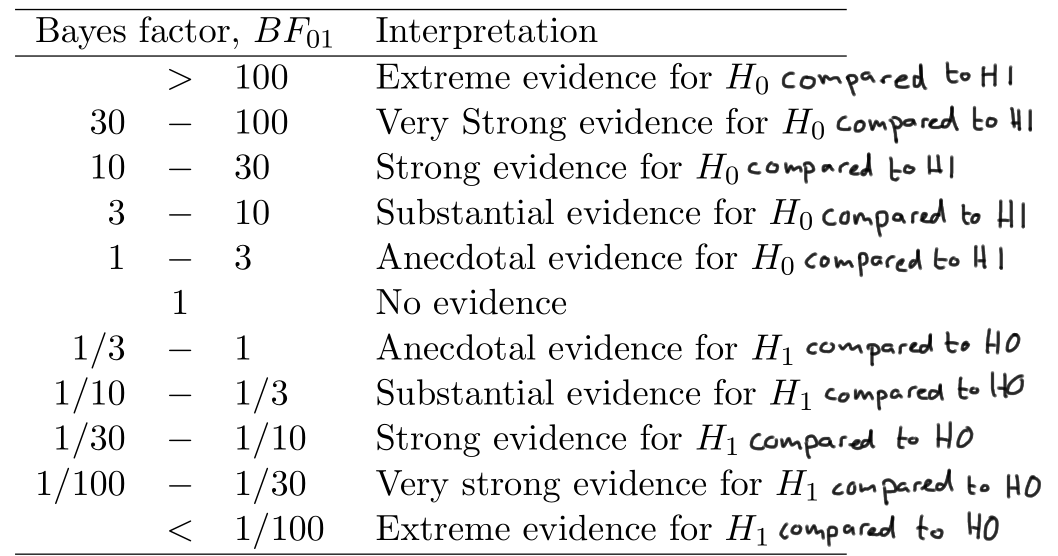
One important benefit of Bayesian statistics is that you can provide relative support for the null hypothesis. When the null hypothesis is true, p -values will forever randomly wander between 0 and 1, but a Bayes factor has consistency (Rouder, Speckman, Sun, Morey, & Iverson, 2009) , which means that as the sample size increases, the Bayes Factor will tell you which of two hypotheses has receive…

bayesianmathematicsstatistics
Healthy Algorithms
Abraham Flaxman
12/18/2014

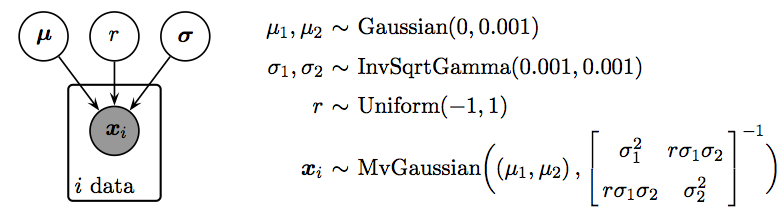
Here is a StackOverflow question with a nice figure: Is there a nice, simple reference for just what exactly these graphical model figures mean? I want more of them.

bayesianmathematics